Liu Wen-Yue, Lin Shi-Gang, Wang Li-Ren, Fang Chen-Chen, Lin Yi-Qian, Braddock Martin, Zhu Gui-Qi, Zhang Zhongheng, Zheng Ming-Hua, Shen Fei-Xia
From the Department of Endocrinology, the First Affiliated Hospital of Wenzhou Medical University (W-YL, C-CF, F-XS); School of the First Clinical Medical Sciences (S-GL, L-RW, G-QZ); Department of Infection and Liver Diseases, Liver Research Center, the First Affiliated Hospital of Wenzhou Medical University (L-RW, Y-QL, G-QZ, M-HZ); Renji School of Wenzhou Medical University, Wenzhou, China (Y-QL); Global Medicines Development, AstraZeneca R&D, Loughborough, United Kingdom (MB); Department of Critical Care Medicine, Jinhua Municipal Central Hospital, Jinhua Hospital of Zhejiang University, Jinhua (ZZ); and Institute of Hepatology, Wenzhou Medical University, Wenzhou, China (M-HZ).
Medicine (Baltimore). 2016 Jan;95(4):e2596. doi: 10.1097/MD.0000000000002596.
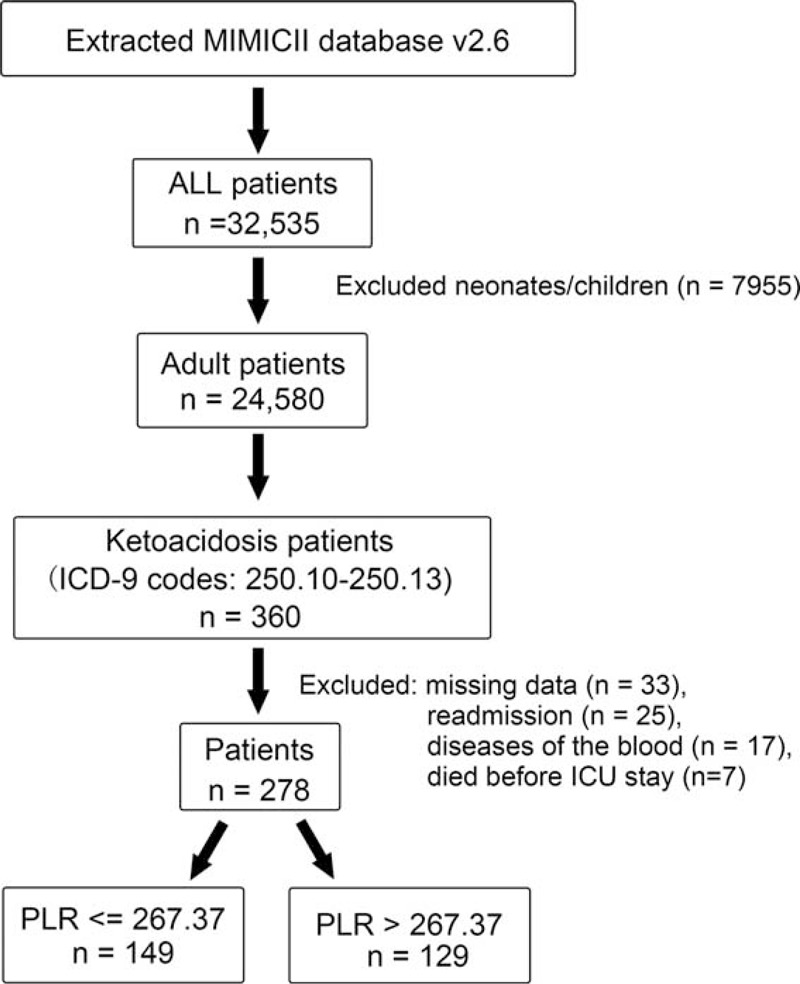
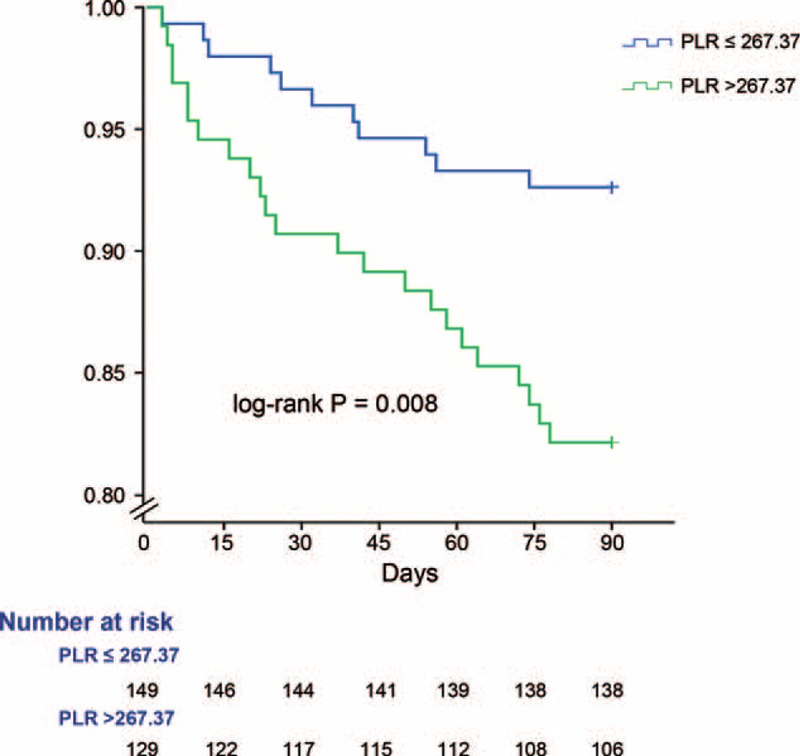
Diabetic ketoacidosis (DKA) is a life-threatening acute complication of diabetes mellitus and the novel systemic inflammation marker platelet-to-lymphocyte ratio (PLR) may be associated with clinical outcome in patients with DKA. This study aimed to investigate the utility of PLR in predicting 90-day clinical outcomes in patients with DKA. Patient data exacted from the Multiparameter Intelligent Monitoring in Intensive Care II (MIMIC II) database was analyzed. A cutoff value for PLR of 267.67 was determined using Youden index (P < 0.05) and used to categorize subjects into a high PLR group and a low PLR group. The hazard ratios (HRs) and 95% confidence intervals (CIs) for DKA were calculated across PLR. Clinical outcomes in our study were defined as intensive care unit (ICU) 90-day readmission and all-cause mortality. A total of 278 ICU admissions were enrolled and stratified by cutoff value of PLR. The incidence of readmission and mortality was 17.8% in the high PLR group, significantly higher than 7.4% in the low PLR group. In the multivariable model, after adjusting for known confounding variables including clinical parameters, comorbidities, laboratory parameters, the HRs for DKA were 2.573 (95% CI 1.239-5.345; P = 0.011), 2.648 (95% CI 1.269-5.527; P = 0.009), and 2.650 (95% CI 1.114-6.306; P = 0.028), respectively. The Kaplan-Meier survival curve showed that a high PLR level was associated with a higher risk for 90-day outcomes in patients with DKA. The authors report that higher PLR presents a higher risk for 90-day incidence of readmission and mortality in patients with DKA. It appears to be a novel independent predictor of 90-day outcomes in critically ill DKA patients in ICU units.
糖尿病酮症酸中毒(DKA)是糖尿病一种危及生命的急性并发症,新型全身炎症标志物血小板与淋巴细胞比值(PLR)可能与DKA患者的临床结局相关。本研究旨在探讨PLR在预测DKA患者90天临床结局中的作用。分析了从重症监护II多参数智能监测(MIMIC II)数据库中提取的患者数据。使用约登指数确定PLR的临界值为267.67(P<0.05),并用于将受试者分为高PLR组和低PLR组。计算不同PLR水平下DKA的风险比(HRs)和95%置信区间(CIs)。本研究中的临床结局定义为重症监护病房(ICU)90天再入院率和全因死亡率。共纳入278例ICU入院患者,并根据PLR临界值进行分层。高PLR组的再入院率和死亡率为17.8%,显著高于低PLR组的7.4%。在多变量模型中,在调整包括临床参数、合并症、实验室参数等已知混杂变量后,DKA的HRs分别为2.573(95%CI 1.239 - 5.345;P = 0.011)、2.648(95%CI 1.269 - 5.527;P = 0.009)和2.650(95%CI 1.114 - 6.306;P = 0.028)。Kaplan-Meier生存曲线显示,高PLR水平与DKA患者90天结局的较高风险相关。作者报告称,较高的PLR表明DKA患者90天再入院率和死亡率的风险更高。它似乎是ICU中重症DKA患者90天结局的一种新型独立预测指标。