Smith Bethany N, Bhowmick Neil A
Department of Medicine, Cedars-Sinai Medical Center, 8750 Beverly Blvd., Atrium 103, Los Angeles, CA 90048, USA.
J Clin Med. 2016 Jan 27;5(2):17. doi: 10.3390/jcm5020017.
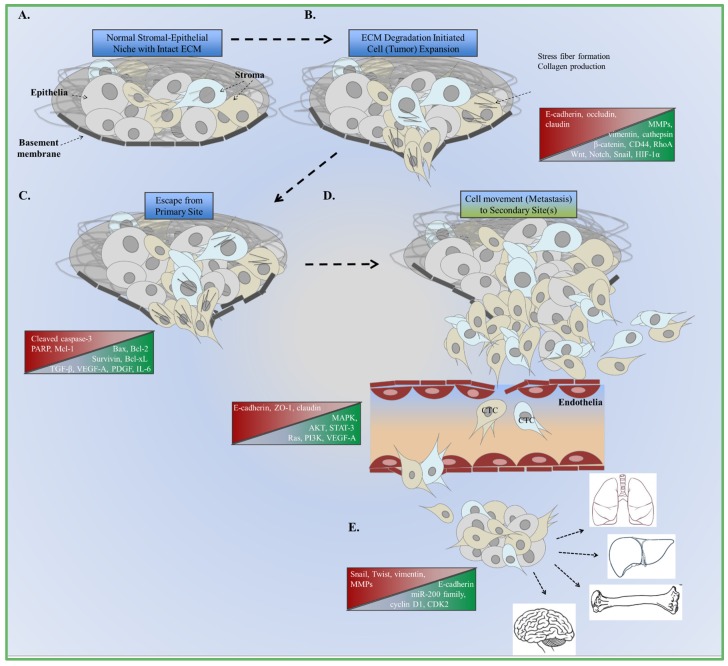
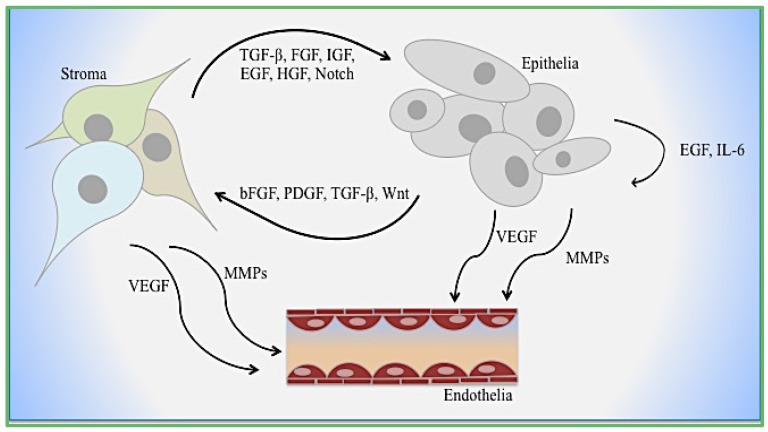
Epithelial-mesenchymal transition (EMT) is a complex molecular program that regulates changes in cell morphology and function during embryogenesis and tissue development. EMT also contributes to tumor progression and metastasis. Cells undergoing EMT expand out of and degrade the surrounding microenvironment to subsequently migrate from the primary site. The mesenchymal phenotype observed in fibroblasts is specifically important based on the expression of smooth muscle actin (α-SMA), fibroblast growth factor (FGF), fibroblast-specific protein-1 (FSP1), and collagen to enhance EMT. Although EMT is not completely dependent on EMT regulators such as Snail, Twist, and Zeb-1/-2, analysis of upstream signaling (i.e., TGF-β, EGF, Wnt) is necessary to understand tumor EMT more comprehensively. Tumor epithelial-fibroblast interactions that regulate tumor progression have been identified during prostate cancer. The cellular crosstalk is significant because these events influence therapy response and patient outcome. This review addresses how canonical EMT signals originating from prostate cancer fibroblasts contribute to tumor metastasis and recurrence after therapy.
上皮-间质转化(EMT)是一个复杂的分子程序,在胚胎发育和组织发育过程中调节细胞形态和功能的变化。EMT也促进肿瘤进展和转移。经历EMT的细胞从周围微环境中扩展并降解,随后从原发部位迁移。基于平滑肌肌动蛋白(α-SMA)、成纤维细胞生长因子(FGF)、成纤维细胞特异性蛋白-1(FSP1)和胶原蛋白的表达,成纤维细胞中观察到的间充质表型对于增强EMT尤为重要。尽管EMT并不完全依赖于Snail、Twist和Zeb-1/-2等EMT调节因子,但分析上游信号(即TGF-β、EGF、Wnt)对于更全面地理解肿瘤EMT是必要的。在前列腺癌中已经确定了调节肿瘤进展的肿瘤上皮-成纤维细胞相互作用。细胞间的相互作用很重要,因为这些事件会影响治疗反应和患者预后。本综述探讨了源自前列腺癌成纤维细胞的经典EMT信号如何促进治疗后肿瘤转移和复发。