Kiertiburanakul Sasisopin, Pinsai Subencha, Chantratita Wasun, Pasomsub Ekawat, Leechawengwongs Manoon, Thipmontree Wilawan, Siriyakorn Nirada, Sungkanuparph Somnuek
Department of Medicine, Faculty of Medicine Ramathibodi Hospital, Mahidol University, Bangkok, Thailand.
Department of Pathology, Faculty of Medicine Ramathibodi Hospital, Mahidol University, Bangkok, Thailand.
PLoS One. 2016 Feb 1;11(2):e0147945. doi: 10.1371/journal.pone.0147945. eCollection 2016.
HIV drug resistance (HIVDR) is the major cause of treatment failure after scaling up of antiretroviral therapy (ART). HIVDR testing prior to ART initiation is not routinely performed in resource-limited settings. We aimed to assess the prevalence of primary HIVDR by short reverse transcriptase (RT) genotypic resistance assay and evaluate of the impact of the mutations on the treatment outcomes.
A prospective cohort study was conducted in treatment-naïve HIV-infected patients. Fourteen major mutations of codon 99-191 on the RT gene were selected (K103N, V106A/M, V108I, Q151M, Y181C/I, M184V/I, Y188C/L/H, and G190S/A) at a cost of testing of 35 USD. The association between the presence of primary HIVDR and undetectable HIV RNA (<50 copies/mL) after 6 months of ART was determined.
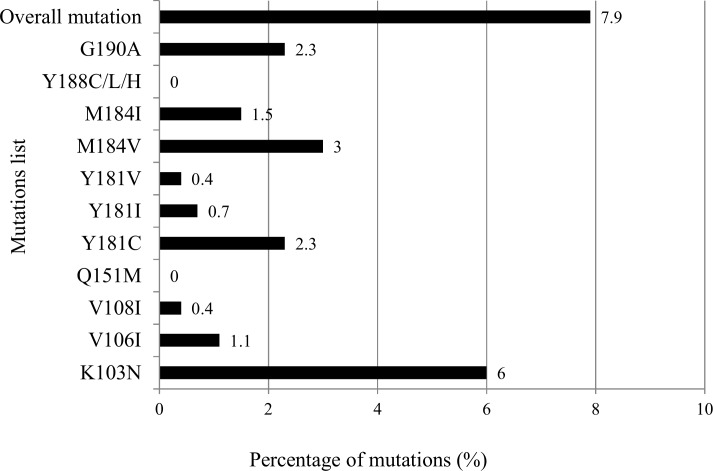
A total of 265 HIV-infected patients were included, with a median age of 35.2 (range, 16.8-75.2) years; 62.6% were males. The median (interquartile range) CD4 cell count at ART initiation was 216 (77-381) cells/mm3. The overall prevalence of primary HIVDR was 7.9%. The prevalence of each HIVDR mutation were K103N 6.0%, V106I 1.1%, V108I 0.4%, Y181C 2.3%, Y181I 0.7%, Y181V 0.4%, M184V 3.0%, M184I 1.5%, and G190A 2.3%. No associated factor of having primary HIVDR was determined. By multiple stepwise logistic regression, factors associated with undetectable HIV RNA after 6 months of ART were: having M184V/I (odds ratio [OR] 0.11; 95% confidence interval [CI] 0.02-0.62, p = 0.013), condom use (OR 2.38; 95% CI 1.12-5.06, p = 0.024), and adherence per 5% increase (OR 1.16; 95% CI 1.00-1.35, p = 0.044).
The prevalence of primary HIVDR is approximately 8%; it is associated with detectable HIV RNA at 6 months after ART initiation. Routine "short RT" genotypic resistance assay should be considered in resource-limited settings to maximize treatment outcome.
在扩大抗逆转录病毒治疗(ART)规模后,HIV耐药性(HIVDR)是治疗失败的主要原因。在资源有限的环境中,开始ART前的HIVDR检测并非常规进行。我们旨在通过短逆转录酶(RT)基因分型耐药性检测评估原发性HIVDR的患病率,并评估这些突变对治疗结果的影响。
对未接受过治疗的HIV感染患者进行了一项前瞻性队列研究。选择了RT基因上密码子99 - 191的14个主要突变(K103N、V106A/M、V108I、Q151M、Y181C/I、M184V/I、Y188C/L/H和G190S/A),检测费用为35美元。确定了原发性HIVDR的存在与ART 6个月后HIV RNA检测不到(<50拷贝/毫升)之间的关联。
共纳入265例HIV感染患者,中位年龄为35.2岁(范围16.8 - 75.2岁);62.6%为男性。ART开始时CD4细胞计数的中位数(四分位间距)为216(77 - 381)个/立方毫米。原发性HIVDR的总体患病率为7.9%。每种HIVDR突变的患病率分别为:K103N 6.0%、V106I 1.1%、V108I 0.4%、Y181C 2.3%、Y181I 0.7%、Y181V 0.4%、M184V 3.0%、M184I 1.5%和G190A 2.3%。未确定有原发性HIVDR的相关因素。通过多步逻辑回归分析,与ART 6个月后HIV RNA检测不到相关的因素为:存在M184V/I(比值比[OR] 0.11;95%置信区间[CI] 0.02 - 0.62,p = 0.013)、使用避孕套(OR 2.38;95% CI 1.12 - 5.06,p = 0.024)以及依从性每增加5%(OR 1.16;95% CI 1.00 - 1.35,p = 0.044)。
原发性HIVDR的患病率约为8%;它与ART开始后6个月时可检测到的HIV RNA相关。在资源有限的环境中应考虑进行常规的“短RT”基因分型耐药性检测,以最大化治疗效果。