Yoshida Masaharu, Yamada Muneharu, Sudo Yasuyo, Kojima Tadasu, Tomiyasu Tomohiro, Yoshikawa Noriko, Oda Takashi, Yamada Michiyuki
Department of Nephrology, Tokyo Medical University Hachioji Medical Center, Tokyo, Japan.
Yokohama City University, Yokohama, Japan.
Nephrology (Carlton). 2016 Jul;21(7):624-9. doi: 10.1111/nep.12736.
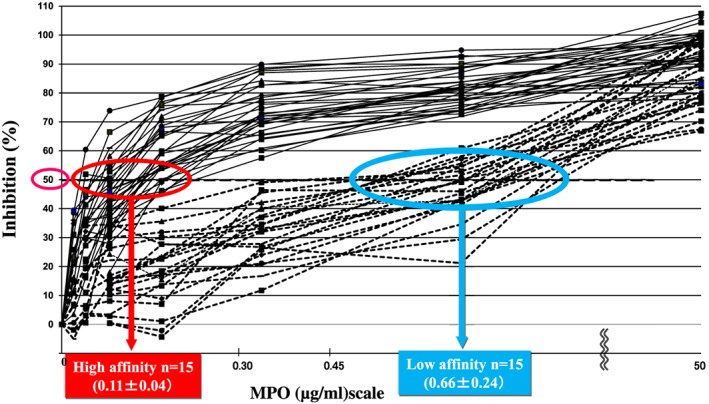
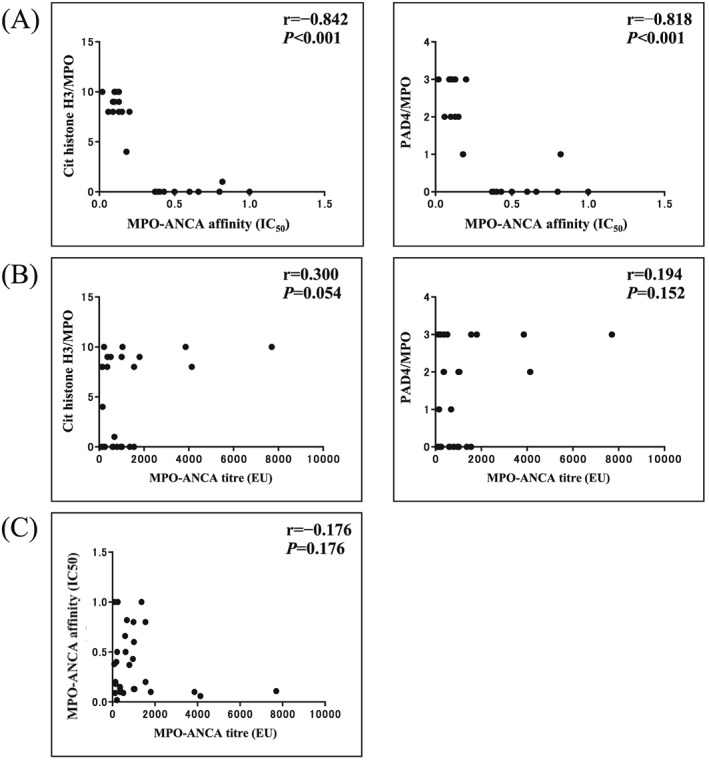
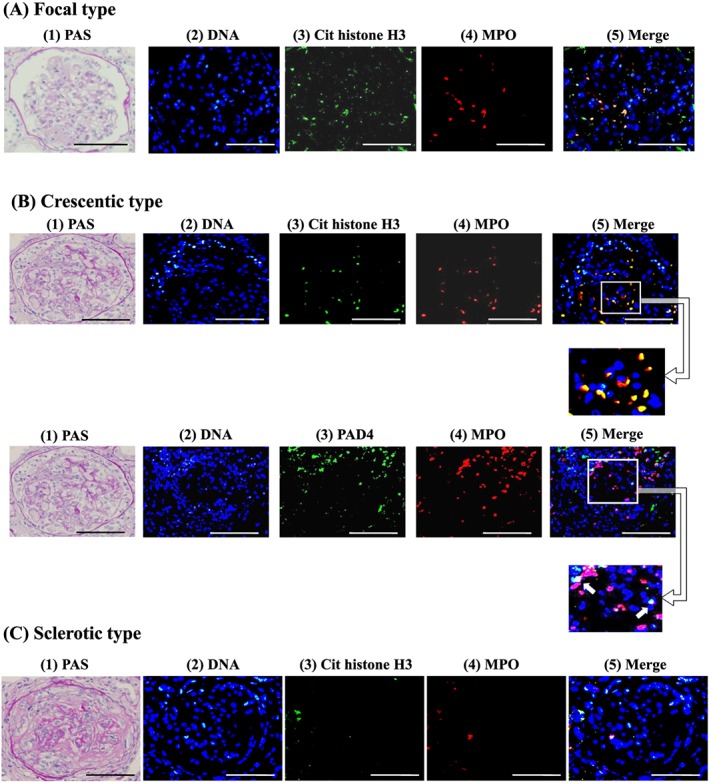
Anti-neutrophil cytoplasmic antibody (ANCA) is associated with small-vessel vasculitis particularly in the kidneys and can induce the formation of neutrophil extracellular traps (NETs) from primed neutrophils. Recently we have reported that the induction of NETs correlates with ANCA affinity for myeloperoxidase (MPO) and disease activity in patients with MPO-ANCA-associated microscopic polyangiitis. To investigate whether MPO-ANCA affinity is associated with the formation of NETs in vivo, we examined the occurrence of NETs in the renal tissues of patients with MPO-ANCA-associated microscopic polyangiitis and ANCA affinity by double immunofluorescence staining for NET components of citrullinated histone, MPO and PAD4 and by ELISA competition with MPO, respectively. We divided 30 MPO-ANCA-associated microscopic polyangiitis patients into 2 groups based on their ANCA affinity levels (IC50 for the high: 0.11 ± 0.04 µg/mL (Group1) and IC50 for the low: 0.66 ± 0.24 µg/mL (Group2)). Group1 showed a higher Birmingham vasculitis activity score (15.6 ± 5.7) and 73% of the patients presented clinically with rapidly progressive glomerulonephritis and histologically with focal/crescentic glomerulonephritis (GN). Group 2 showed a lower Birmingham vasculitis activity score (9.2 ± 4.9) and 73% of the patients presented clinically with chronic renal failure and histologically with mixed/sclerotic GN. Group 1 showed a much higher occurrence of NETs than Group 2. Our findings indicate that ANCA affinity was associated with the in vivo formation of NETs, which might be involved in the pathophysiology of patients with MPO-ANCA-associated microscopic polyangiitis.
抗中性粒细胞胞浆抗体(ANCA)与小血管炎相关,尤其是在肾脏中,并且可以诱导致敏中性粒细胞形成中性粒细胞胞外陷阱(NETs)。最近我们报道,在髓过氧化物酶(MPO)-ANCA相关性显微镜下多血管炎患者中,NETs的诱导与ANCA对MPO的亲和力及疾病活动度相关。为了研究MPO-ANCA亲和力是否与体内NETs的形成有关,我们分别通过对瓜氨酸化组蛋白、MPO和肽精氨酸脱亚胺酶4(PAD4)的NET成分进行双重免疫荧光染色以及与MPO进行ELISA竞争试验,检测了MPO-ANCA相关性显微镜下多血管炎患者肾组织中NETs的发生情况及ANCA亲和力。我们将30例MPO-ANCA相关性显微镜下多血管炎患者根据其ANCA亲和力水平分为两组(高亲和力组:IC50为0.11±0.04µg/mL(第1组),低亲和力组:IC50为0.66±0.24µg/mL(第2组))。第1组的伯明翰血管炎活动评分较高(15.6±5.7),73%的患者临床上表现为快速进展性肾小球肾炎,组织学表现为局灶性/新月体性肾小球肾炎(GN)。第2组的伯明翰血管炎活动评分较低(9.2±4.9),73%的患者临床上表现为慢性肾衰竭,组织学表现为混合性/硬化性GN。第1组的NETs发生率远高于第2组。我们的研究结果表明,ANCA亲和力与体内NETs的形成有关,这可能参与了MPO-ANCA相关性显微镜下多血管炎患者的病理生理过程。