Bang Oh Young
Department of Neurology, Samsung Medical Center, Sungkyunkwan University School of Medicine, Seoul, Korea.
J Clin Neurol. 2016 Apr;12(2):129-36. doi: 10.3988/jcn.2016.12.2.129. Epub 2016 Jan 28.
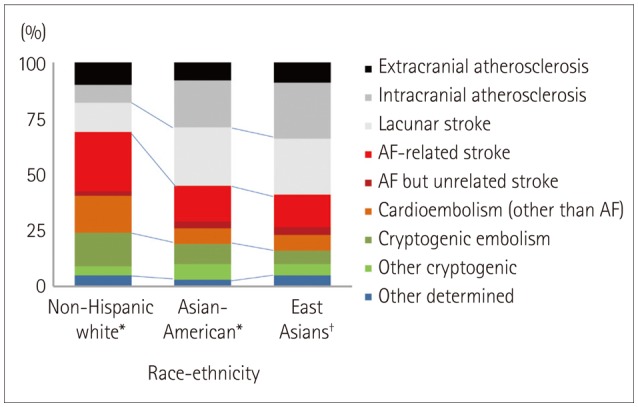
Both the incidence and prevalence of stroke in Asia are steadily increasing, and the burden of stroke is particularly high in Asian countries. Although strokes in Asians and Caucasians share many common features, there are some differences that are probably due to differences in lifestyle and genetic background. While there have been advances in the stroke classification system, the assignment of Asian stroke patients to etiological categories has received little attention. The current classification system may not be well suited to Asian patients with ischemic stroke because the proportions and relative importance of stroke subtypes may differ with race and ethnicity. This review addresses concerns about the use of the current stroke classification system in Asian patients with ischemic stroke, and proposes a classification system that is more specific to the Asian population, in conjunction with discussing advances in diagnostic techniques.
亚洲中风的发病率和患病率都在稳步上升,中风负担在亚洲国家尤为沉重。虽然亚洲人和白种人中的中风有许多共同特征,但也存在一些差异,这可能是由于生活方式和基因背景的不同所致。尽管中风分类系统已有进展,但亚洲中风患者病因类别的划分却很少受到关注。目前的分类系统可能不太适合亚洲缺血性中风患者,因为中风亚型的比例和相对重要性可能因种族和民族而异。本综述探讨了当前中风分类系统在亚洲缺血性中风患者中的应用问题,并结合讨论诊断技术的进展,提出了一个更适合亚洲人群的分类系统。