Stempfhuber Barbara, Richter-Heitmann Tim, Regan Kathleen M, Kölbl Angelika, Wüst Pia K, Marhan Sven, Sikorski Johannes, Overmann Jörg, Friedrich Michael W, Kandeler Ellen, Schloter Michael
Environmental Genomics, Helmholtz Zentrum München, German Research Centre for Environmental Health Neuherberg, Germany.
Faculty of Biology/Chemistry, University of Bremen Bremen, Germany.
Front Microbiol. 2016 Jan 22;6:1567. doi: 10.3389/fmicb.2015.01567. eCollection 2015.
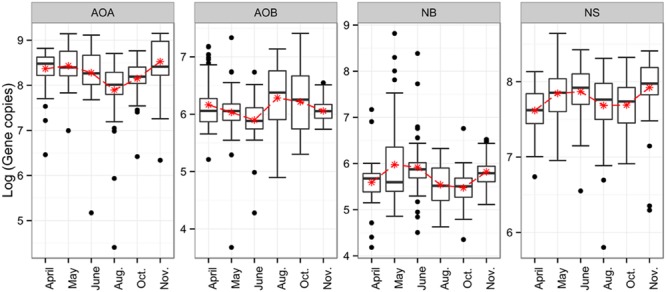
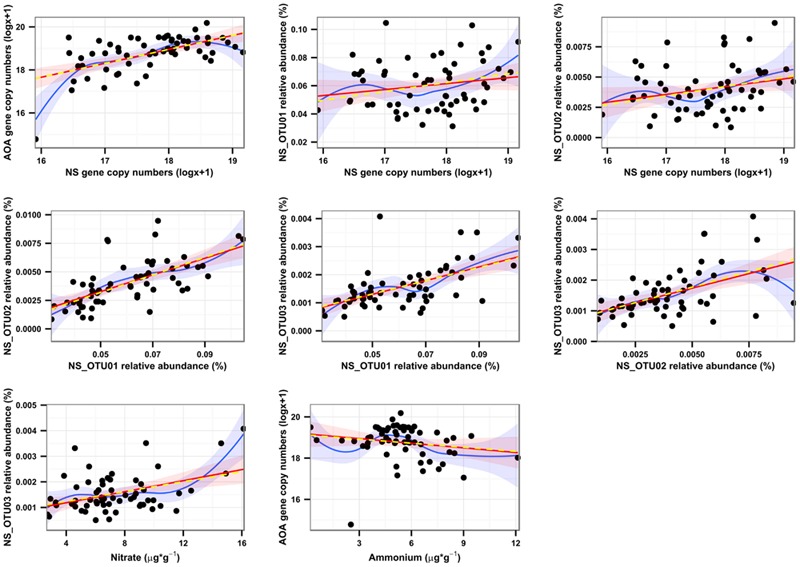
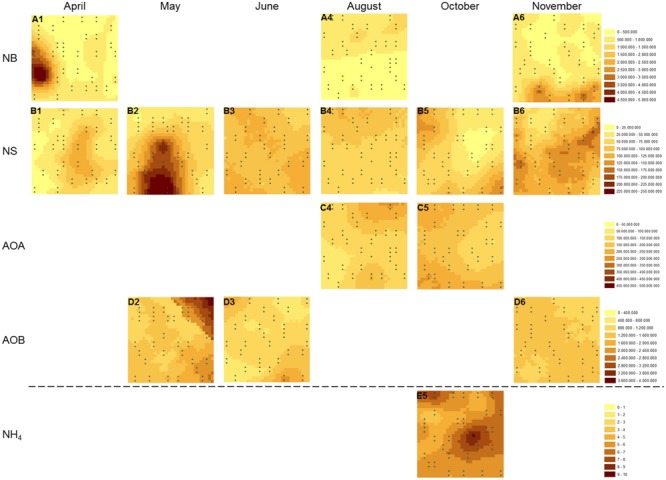
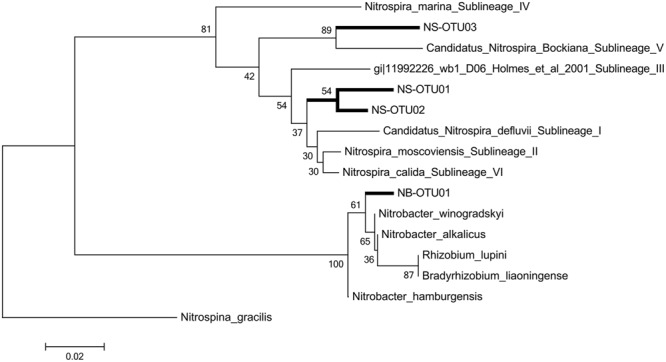
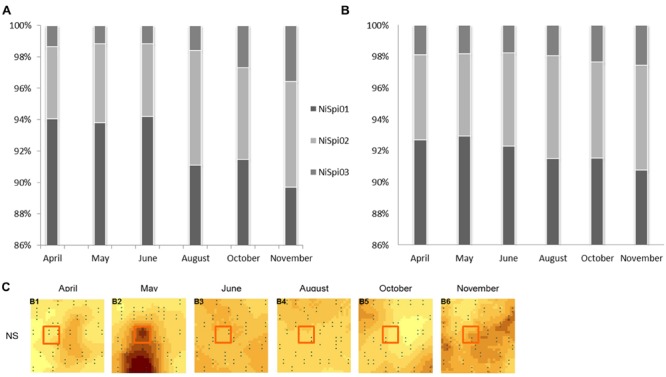
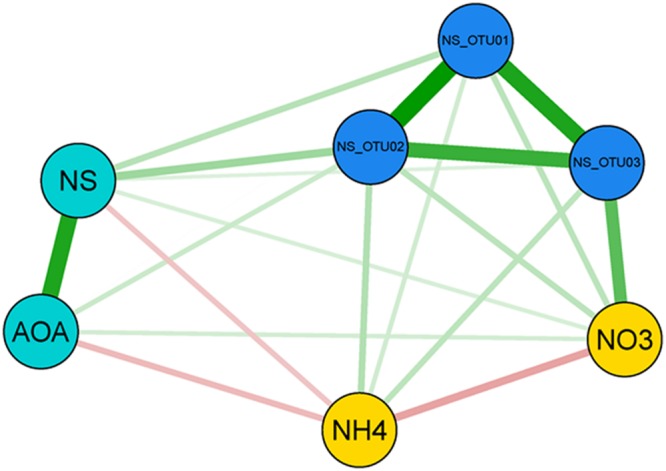
Interrelated successive transformation steps of nitrification are performed by distinct microbial groups - the ammonia-oxidizers, comprising ammonia-oxidizing archaea (AOA) and bacteria (AOB), and nitrite-oxidizers such as Nitrobacter and Nitrospira, which are the dominant genera in the investigated soils. Hence, not only their presence and activity in the investigated habitat is required for nitrification, but also their temporal and spatial interactions. To demonstrate the interdependence of both groups and to address factors promoting putative niche differentiation within each group, temporal and spatial changes in nitrifying organisms were monitored in an unfertilized grassland site over an entire vegetation period at the plot scale of 10 m(2). Nitrifying organisms were assessed by measuring the abundance of marker genes (amoA for AOA and AOB, nxrA for Nitrobacter, 16S rRNA gene for Nitrospira) selected for the respective sub-processes. A positive correlation between numerically dominant AOA and Nitrospira, and their co-occurrence at the same spatial scale in August and October, suggests that the nitrification process is predominantly performed by these groups and is restricted to a limited timeframe. Amongst nitrite-oxidizers, niche differentiation was evident in observed seasonally varying patterns of co-occurrence and spatial separation. While their distributions were most likely driven by substrate concentrations, oxygen availability may also have played a role under substrate-limited conditions. Phylogenetic analysis revealed temporal shifts in Nitrospira community composition with an increasing relative abundance of OTU03 assigned to sublineage V from August onward, indicating its important role in nitrite oxidation.
硝化作用的相互关联的连续转化步骤由不同的微生物类群执行——氨氧化菌,包括氨氧化古菌(AOA)和细菌(AOB),以及亚硝酸盐氧化菌,如硝化杆菌属和硝化螺菌属,它们是被调查土壤中的优势属。因此,硝化作用不仅需要它们在所研究生境中的存在和活性,还需要它们的时间和空间相互作用。为了证明这两类菌群的相互依赖性,并探讨促进每组内假定生态位分化的因素,在一个未施肥的草地站点,以10平方米的样地规模,在整个植被期监测了硝化生物的时间和空间变化。通过测量为各个子过程选择的标记基因(AOA和AOB的amoA、硝化杆菌属的nxrA、硝化螺菌属的16S rRNA基因)的丰度来评估硝化生物。数量上占优势的AOA和硝化螺菌属之间呈正相关,以及它们在8月和10月在相同空间尺度上的共存,表明硝化过程主要由这些类群执行,并且限于有限的时间范围。在亚硝酸盐氧化菌中,生态位分化在观察到的共存和空间分离的季节性变化模式中很明显。虽然它们的分布很可能由底物浓度驱动,但在底物受限的条件下,氧气可用性也可能起到了作用。系统发育分析揭示了硝化螺菌属群落组成的时间变化,从8月起,属于亚分支V的OTU03的相对丰度增加,表明其在亚硝酸盐氧化中起重要作用。