Department of Psychological and Brain Sciences, The Johns Hopkins University, Baltimore, Maryland 21218; Department of Psychology, University of Maryland, College Park, Maryland 20742.
Department of Psychological and Brain Sciences, The Johns Hopkins University , Baltimore, Maryland 21218.
eNeuro. 2016 Jan 23;3(1). doi: 10.1523/ENEURO.0145-15.2016. eCollection 2016 Jan-Feb.
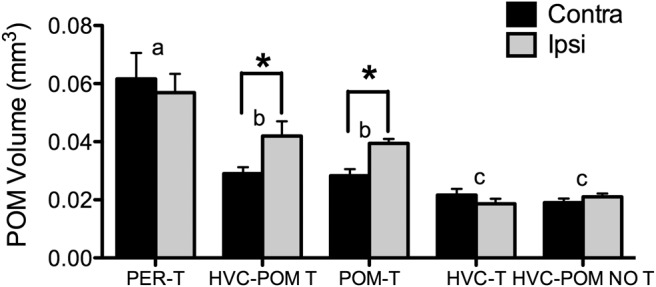
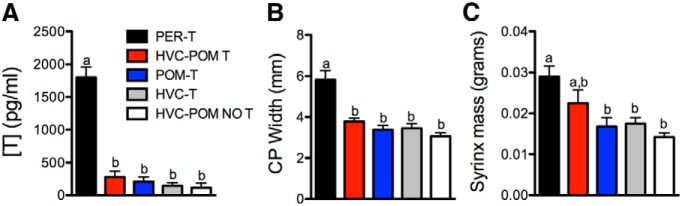
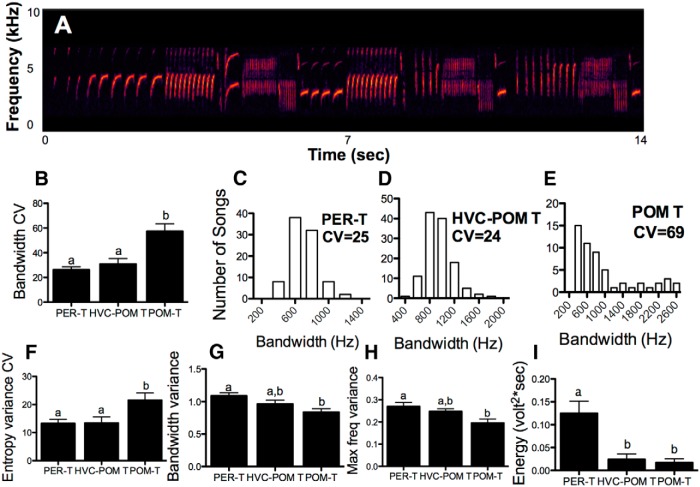
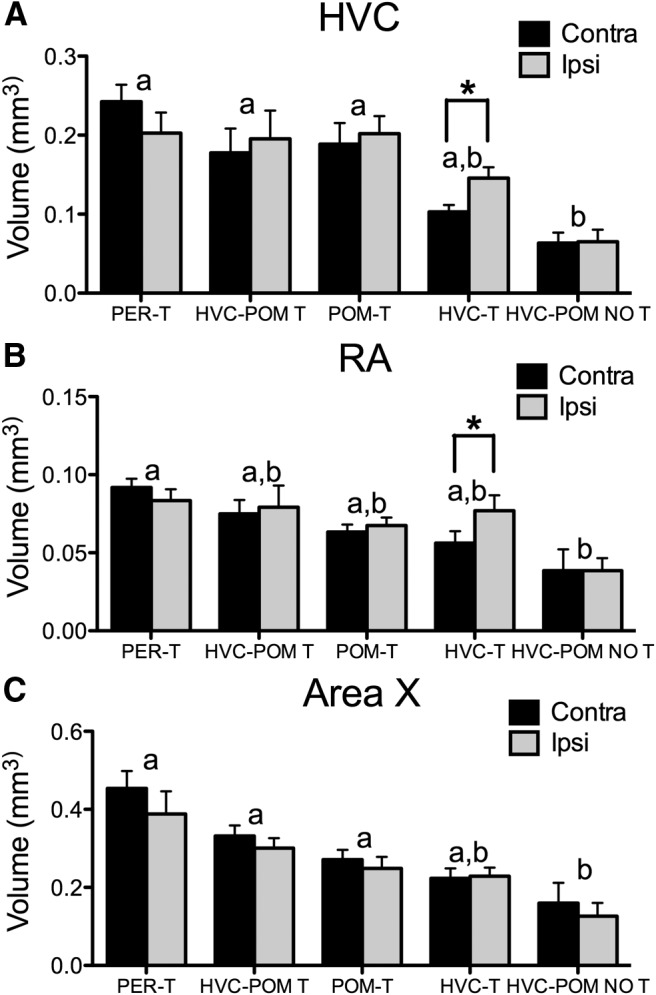
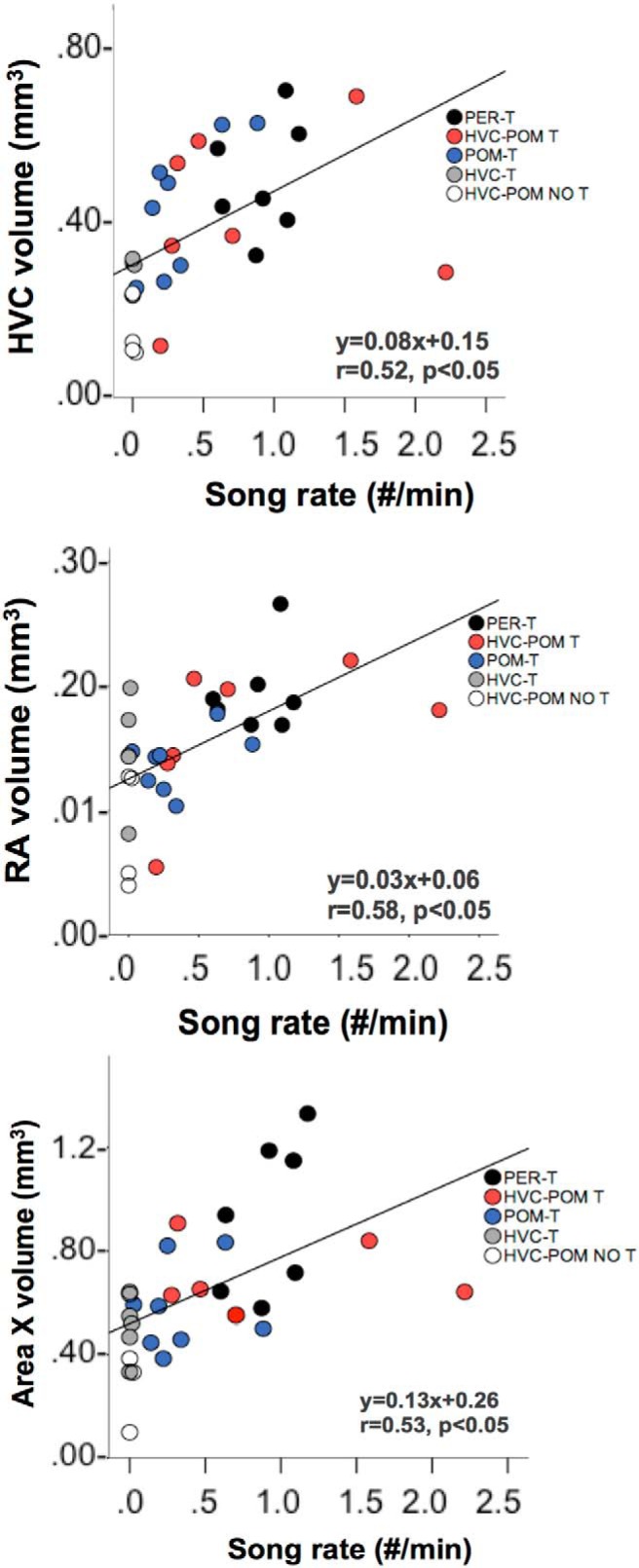
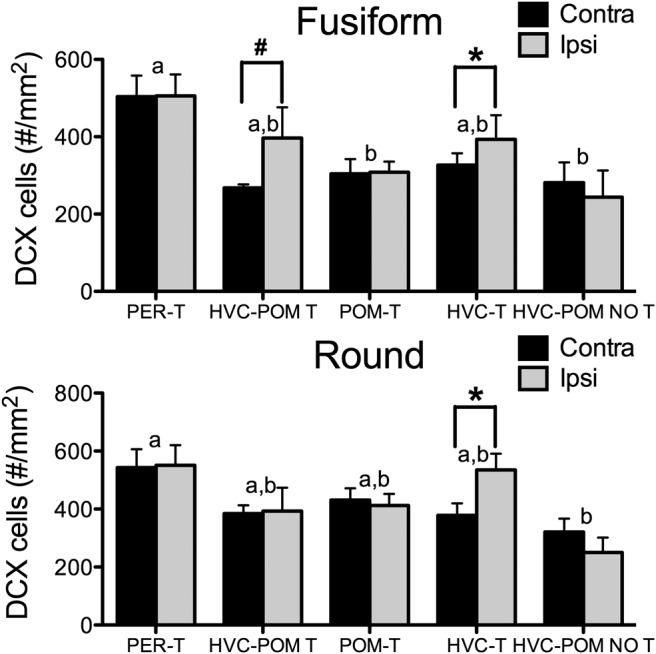
Steroid hormones coordinate multiple aspects of behavior and physiology. The same hormone often regulates different aspects of a single behavior and its underlying neuroplasticity. This pleiotropic regulation of behavior and physiology is not well understood. Here, we investigated the orchestration by testosterone (T) of birdsong and its neural substrate, the song control system. Male canaries were castrated and received stereotaxic implants filled with T in select brain areas. Implanting T solely in the medial preoptic nucleus (POM) increased the motivation to sing, but did not enhance aspects of song quality such as acoustic structure and stereotypy. In birds implanted with T solely in HVC (proper name), a key sensorimotor region of the song control system, little or no song was observed, similar to castrates that received no T implants of any sort. However, implanting T in HVC and POM simultaneously rescued all measures of song quality. Song amplitude, though, was still lower than what was observed in birds receiving peripheral T treatment. T in POM enhanced HVC volume bilaterally, likely due to activity-dependent changes resulting from an enhanced song rate. T directly in HVC, without increasing song rate, enhanced HVC volume on the ipsilateral side only. T in HVC enhanced the incorporation and recruitment of new neurons into this nucleus, while singing activity can independently influence the incorporation of new neurons into HVC. These results have broad implications for how steroid hormones integrate across different brain regions to coordinate complex social behaviors.
甾体激素协调行为和生理的多个方面。同一种激素通常调节单一行为及其潜在神经可塑性的不同方面。这种行为和生理的多效性调节还不太清楚。在这里,我们研究了睾酮(T)对鸟鸣及其神经基质,即歌唱控制系统的协调作用。雄性金丝雀被去势,并在选定的脑区接受装有 T 的立体定向植入物。仅将 T 植入中脑视前核(POM)会增加唱歌的动机,但不会增强歌曲质量的各个方面,如音响结构和刻板性。在仅将 T 植入 HVC(歌唱控制系统的关键感觉运动区域)的鸟类中,观察到很少或没有歌声,类似于未接受任何 T 植入的去势鸟类。然而,同时将 T 植入 HVC 和 POM 可同时挽救所有歌曲质量的测量。尽管如此,歌声幅度仍低于接受外周 T 治疗的鸟类。T 在 POM 双侧增强了 HVC 的体积,可能是由于增强的歌唱率导致的活动依赖性变化所致。T 直接在 HVC 中,而不增加歌唱率,仅增强同侧的 HVC 体积。T 在 HVC 中增强了新神经元的掺入和募集,而歌唱活动可以独立地影响 HVC 中新神经元的掺入。这些结果对甾体激素如何整合不同脑区以协调复杂的社会行为具有广泛的意义。