Keereetaweep Jantana, Chapman Kent D
Department of Biological Sciences, Center for Plant Lipid Research, University of North Texas, Denton, TX 76203, USA; Brookhaven National Laboratory, 50 Bell Avenue, Building 463, P.O. Box 5000, Upton, NY 11973-5000, USA.
Department of Biological Sciences, Center for Plant Lipid Research, University of North Texas, Denton, TX 76203, USA.
Neural Plast. 2016;2016:2426398. doi: 10.1155/2016/2426398. Epub 2015 Dec 29.
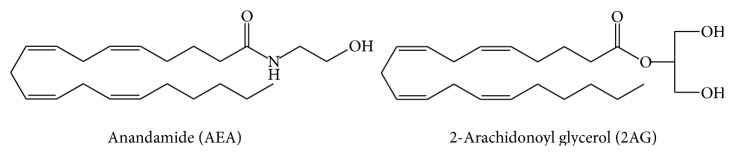
The endocannabinoids N-arachidonoylethanolamide (or anandamide, AEA) and 2-arachidonoylglycerol (2-AG) belong to the larger groups of N-acylethanolamines (NAEs) and monoacylglycerol (MAG) lipid classes, respectively. They are biologically active lipid molecules that activate G-protein-coupled cannabinoid receptors found in various organisms. After AEA and 2-AG were discovered in the 1990s, they have been extensively documented to have a broad range of physiological functions. Along with AEA, several NAEs, for example, N-palmitoylethanolamine (PEA), N-stearoylethanolamine (SEA), and N-oleoylethanolamine (OEA) are also present in tissues, usually at much larger concentrations than AEA. Any perturbation that involves the endocannabinoid pathway may subsequently alter basal level or metabolism of these lipid mediators. Further, the altered levels of these molecules often reflect pathological conditions associated with tissue damage. Robust and sensitive methodologies to analyze these lipid mediators are essential to understanding how they act as endocannabinoids. The recent advances in mass spectrometry allow researchers to develop lipidomics approaches and several methodologies have been proposed to quantify endocannabinoids in various biological systems.
内源性大麻素N-花生四烯酸乙醇胺(或花生四烯酸乙醇胺,AEA)和2-花生四烯酸甘油酯(2-AG)分别属于N-酰基乙醇胺(NAEs)和单酰基甘油(MAG)脂质类的较大类别。它们是具有生物活性的脂质分子,可激活在各种生物体中发现的G蛋白偶联大麻素受体。在20世纪90年代AEA和2-AG被发现后,它们已被广泛记录具有广泛的生理功能。与AEA一起,几种NAEs,例如N-棕榈酰乙醇胺(PEA)、N-硬脂酰乙醇胺(SEA)和N-油酰乙醇胺(OEA)也存在于组织中,其浓度通常比AEA高得多。任何涉及内源性大麻素途径的扰动随后都可能改变这些脂质介质的基础水平或代谢。此外,这些分子水平的改变通常反映了与组织损伤相关的病理状况。强大而灵敏的分析这些脂质介质的方法对于理解它们如何作为内源性大麻素发挥作用至关重要。质谱技术的最新进展使研究人员能够开发脂质组学方法,并且已经提出了几种方法来定量各种生物系统中的内源性大麻素。