Alkim Canan, Alkim Huseyin, Koksal Ali Riza, Boga Salih, Sen Ilker
Department of Gastroenterology, Şişli Hamidiye Etfal Training and Research Hospital, Şişli, 34360 Istanbul, Turkey.
Int J Inflam. 2015;2015:970890. doi: 10.1155/2015/970890. Epub 2015 Dec 29.
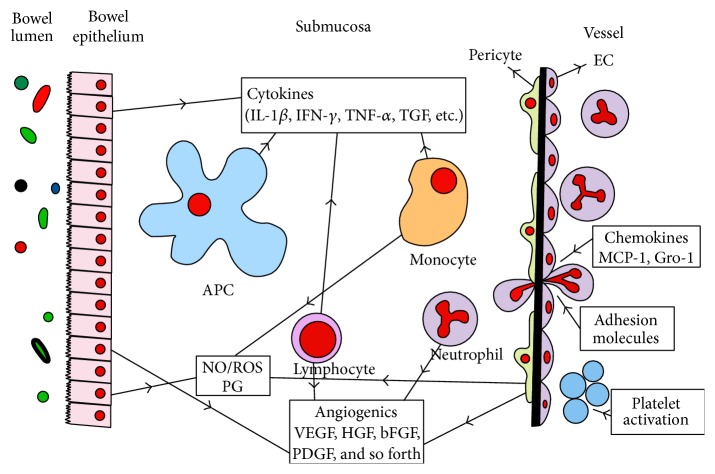
Angiogenesis is an important component of pathogenesis of inflammatory bowel disease (IBD). Chronic inflammation and angiogenesis are two closely related processes. Chronic intestinal inflammation is dependent on angiogenesis and this angiogenesis is modulated by immune system in IBD. Angiogenesis is a very complex process which includes multiple cell types, growth factors, cytokines, adhesion molecules, and signal transduction. Lymphangiogenesis is a new research area in the pathogenesis of IBD. While angiogenesis supports inflammation via leukocyte migration, carrying oxygen and nutrients, on the other hand, it has a major role in wound healing. Angiogenic molecules look like perfect targets for the treatment of IBD, but they have risk for serious side effects because of their nature.
血管生成是炎症性肠病(IBD)发病机制的重要组成部分。慢性炎症和血管生成是两个密切相关的过程。慢性肠道炎症依赖于血管生成,而这种血管生成在IBD中受到免疫系统的调节。血管生成是一个非常复杂的过程,包括多种细胞类型、生长因子、细胞因子、黏附分子和信号转导。淋巴管生成是IBD发病机制中的一个新研究领域。血管生成一方面通过白细胞迁移、输送氧气和营养物质来支持炎症,另一方面在伤口愈合中起主要作用。血管生成分子看似是治疗IBD的理想靶点,但因其性质存在严重副作用的风险。