Croquer Aldo, Cavada-Blanco Francoise, Zubillaga Ainhoa L, Agudo-Adriani Esteban A, Sweet Michael
Estudios Ambientales, Universidad Simón Bolívar , Caracas , Venezuela.
Biología de Organismos, Universidad Simón Bolivar , Caracas , Venezuela.
PeerJ. 2016 Jan 28;4:e1539. doi: 10.7717/peerj.1539. eCollection 2016.
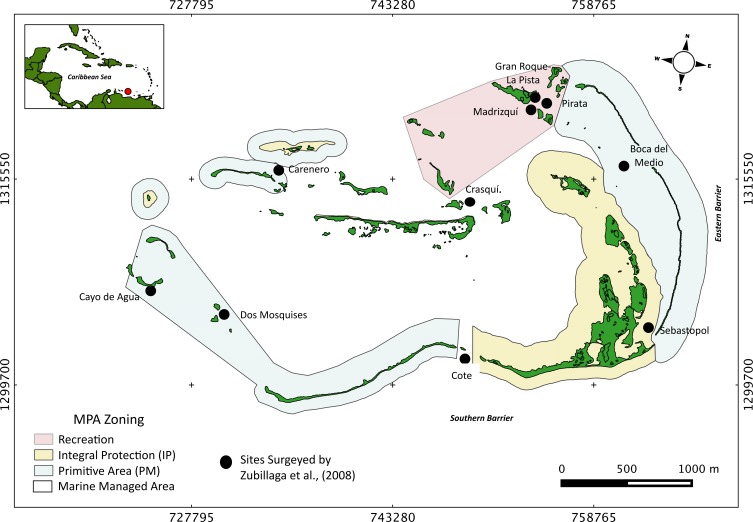
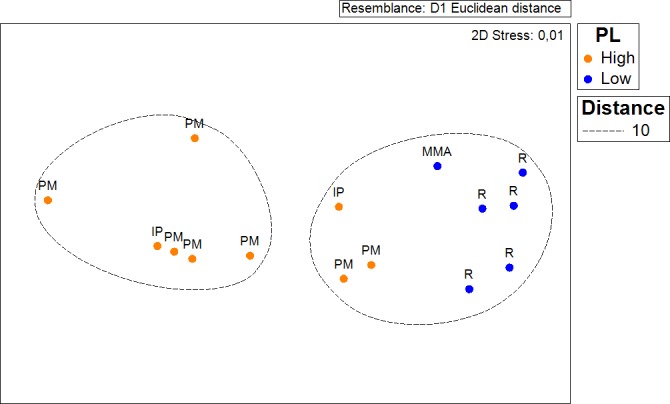
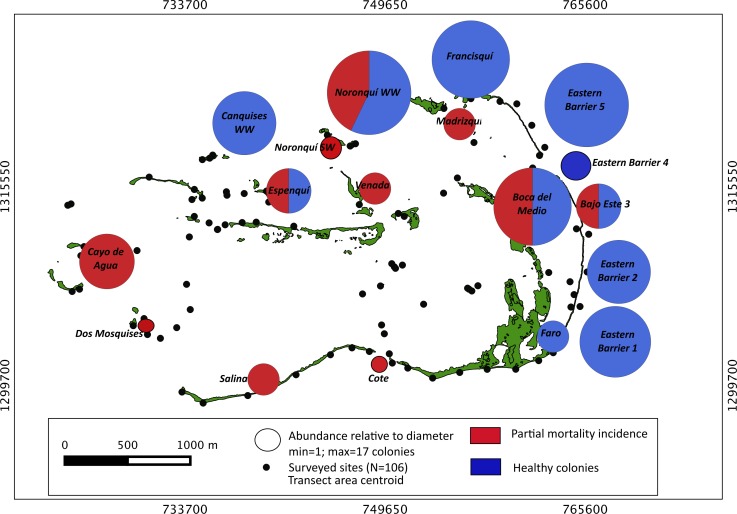
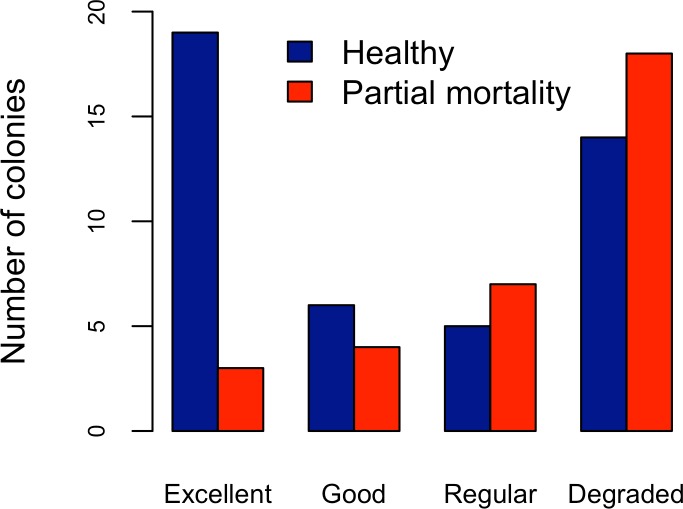
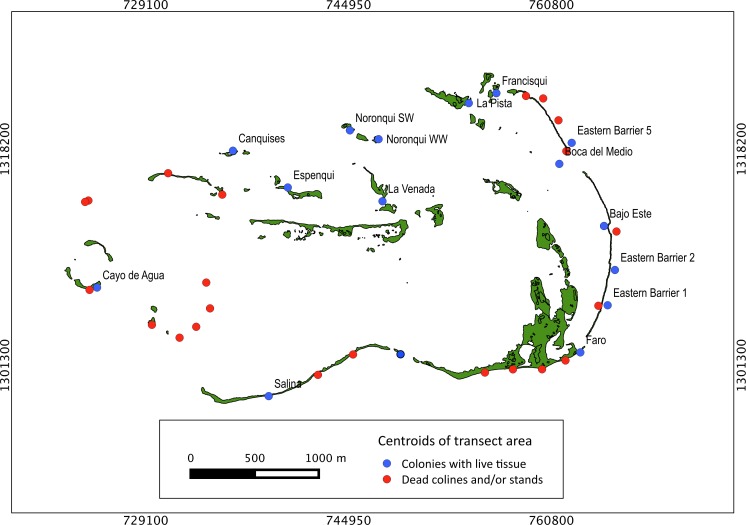
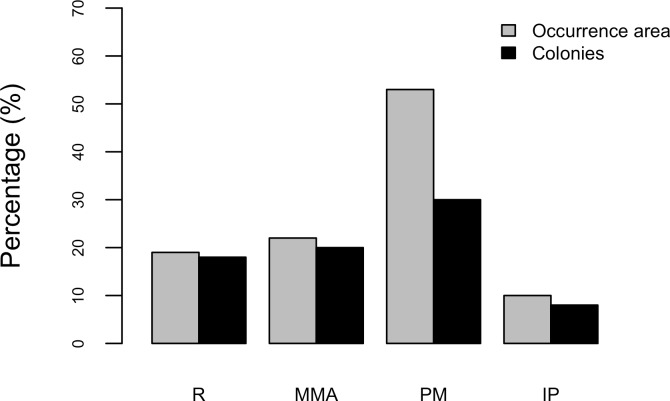
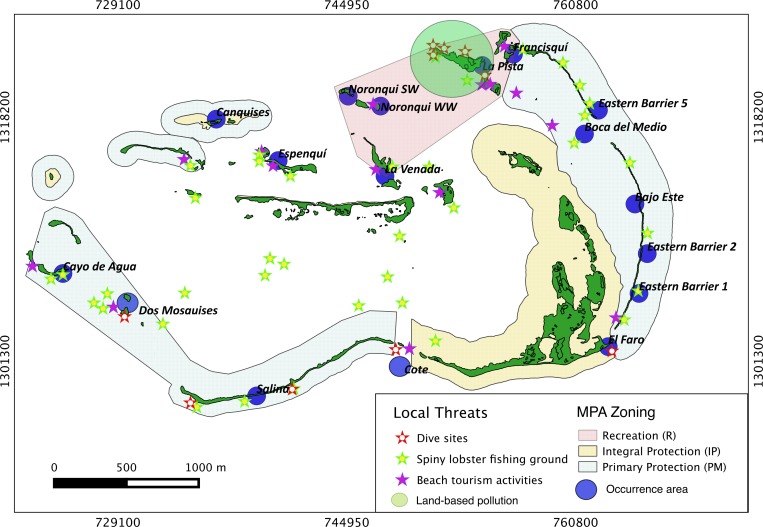
Eight years ago (2007), the distribution and status of Acropora palmata was quantified throughout Los Roques archipelago in Venezuela. The aim was to produce a baseline study for this species which combined population genetics with demographic data. The results highlighted that A. palmata had the potential to recover in at least 6 out of 10 sites surveyed. Recovery potential was assumed to be high at sites with a relatively high abundance of the coral, low disease prevalence, high genetic diversity, and high rates of sexual reproduction. However, as noted, Zubillaga et al. (2008) realized recovery was still strongly dependent on local and regional stressors. In 2014 (this study), the status of A. palmata was re-evaluated at Los Roques. We increased the number of sites from 10 in the original baseline study to 106. This allowed us to assess the population status throughout the entirety of the MPA. Furthermore, we also identified local threats that may have hindered population recovery. Here, we show that A. palmata now has a relatively restricted distribution throughout the park, only occurring in 15% of the sites surveyed. Large stands of old dead colonies were common throughout the archipelago; a result which demonstrates that this species has lost almost 50% of its original distribution over the past decades. The majority of corals recorded were large adults (∼2 m height), suggesting that these older colonies might be less susceptible or more resilient to local and global threats. However, 45% of these surviving colonies showed evidence of partial mortality and degradation of living tissues. Interestingly, the greatest increase in partial mortality occurred at sites with the lowest levels of protection ([Formula: see text]; df = 4, p < 0.05). This may suggest there is a positive role of small scale marine management in assisting reef recovery. We also recorded a significant reduction ([Formula: see text]; df = 8; p < 0.05) in the density of A. palmata in sites that had previously been categorized as having a high potential for recovery. One explanation for this continued decline may be due to the fact that over the past 10 years, two massive bleaching events have occurred throughout the Caribbean with records showing that Los Roques has experienced unprecedented declines in overall coral cover. We therefore conclude that although local protection could promote recovery, the impacts from global threats such as ocean warming may hamper the recovery of this threatened species.
八年前(2007年),对委内瑞拉洛斯罗克斯群岛上的鹿角珊瑚的分布和现状进行了量化研究。目的是为该物种开展一项将种群遗传学与人口统计学数据相结合的基线研究。结果突出表明,在所调查的10个地点中,至少有6个地点的鹿角珊瑚具有恢复潜力。在珊瑚丰度相对较高、疾病流行率低、遗传多样性高以及有性繁殖率高的地点,恢复潜力被认为较高。然而,如前所述,苏维利亚加等人(2008年)意识到恢复仍然强烈依赖于当地和区域的压力源。2014年(本研究),在洛斯罗克斯重新评估了鹿角珊瑚的现状。我们将地点数量从最初基线研究中的10个增加到了106个。这使我们能够评估整个海洋保护区内的种群状况。此外,我们还确定了可能阻碍种群恢复的当地威胁。在此,我们表明,鹿角珊瑚现在在整个公园内的分布相对受限,仅出现在所调查地点的15%。大片古老的死亡珊瑚群落在整个群岛都很常见;这一结果表明,在过去几十年里,该物种已失去了近50%的原始分布范围。记录到的大多数珊瑚是大型成年珊瑚(约2米高),这表明这些较老的珊瑚群落可能对当地和全球威胁的敏感度较低或更具恢复力。然而,这些存活的珊瑚群落中有45%显示出部分死亡和活体组织退化的迹象。有趣的是,部分死亡率增加最多的是在保护水平最低的地点([公式:见正文];自由度 = 4,p < 0.05)。这可能表明小规模海洋管理在协助珊瑚礁恢复方面具有积极作用。我们还记录到,在之前被归类为具有高恢复潜力的地点,鹿角珊瑚的密度显著下降([公式:见正文];自由度 = 8;p < 0.05)。这种持续下降的一个解释可能是,在过去10年里,整个加勒比地区发生了两次大规模白化事件,记录显示洛斯罗克斯的总体珊瑚覆盖率经历了前所未有的下降。因此,我们得出结论,尽管当地保护可以促进恢复,但诸如海洋变暖等全球威胁的影响可能会阻碍这种受威胁物种的恢复。