Keeling Jacob, Tsiokas Leonidas, Maskey Dipak
Department of Cell Biology, University of Oklahoma Health Sciences Center, 975 NE 10th Street, Oklahoma City, OK 73104, USA.
Cells. 2016 Jan 29;5(1):6. doi: 10.3390/cells5010006.
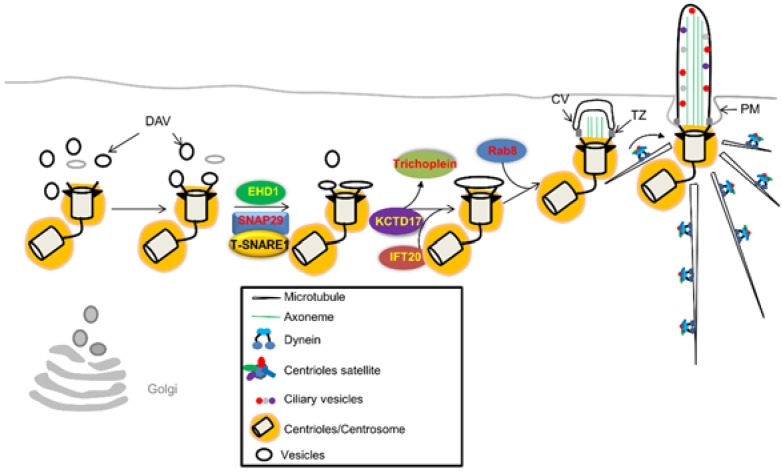
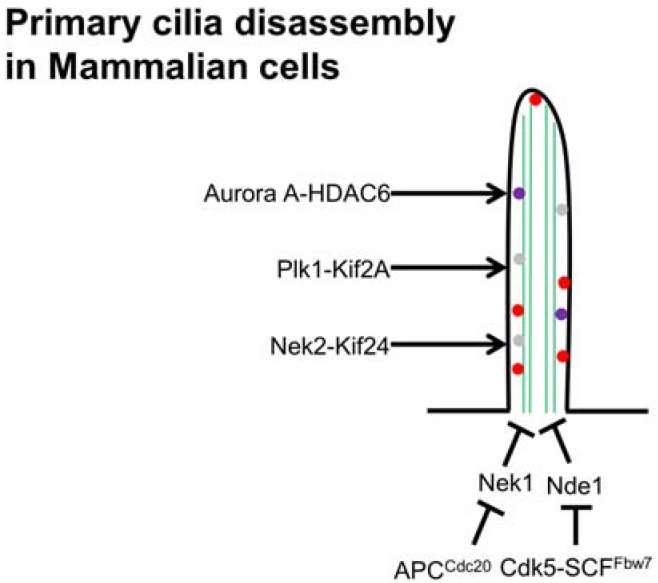
Cilia and flagella are evolutionarily conserved, membrane-bound, microtubule-based organelles on the surface of most eukaryotic cells. They play important roles in coordinating a variety of signaling pathways during growth, development, cell mobility, and tissue homeostasis. Defects in ciliary structure or function are associated with multiple human disorders called ciliopathies. These diseases affect diverse tissues, including, but not limited to the eyes, kidneys, brain, and lungs. Many processes must be coordinated simultaneously in order to initiate ciliogenesis. These include cell cycle, vesicular trafficking, and axonemal extension. Centrioles play a central role in both cell cycle progression and ciliogenesis, making the transition between basal bodies and mitotic spindle organizers integral to both processes. The maturation of centrioles involves a functional shift from cell division toward cilium nucleation which takes place concurrently with its migration and fusion to the plasma membrane. Several proteinaceous structures of the distal appendages in mother centrioles are required for this docking process. Ciliary assembly and maintenance requires a precise balance between two indispensable processes; so called assembly and disassembly. The interplay between them determines the length of the resulting cilia. These processes require a highly conserved transport system to provide the necessary substances at the tips of the cilia and to recycle ciliary turnover products to the base using a based microtubule intraflagellar transport (IFT) system. In this review; we discuss the stages of ciliogenesis as well as mechanisms controlling the lengths of assembled cilia.
纤毛和鞭毛是大多数真核细胞表面进化上保守的、膜结合的、基于微管的细胞器。它们在生长、发育、细胞迁移和组织稳态过程中协调多种信号通路发挥重要作用。纤毛结构或功能的缺陷与多种称为纤毛病的人类疾病相关。这些疾病影响多种组织,包括但不限于眼睛、肾脏、大脑和肺部。为了启动纤毛发生,许多过程必须同时协调进行。这些过程包括细胞周期、囊泡运输和轴丝延伸。中心粒在细胞周期进程和纤毛发生中都起着核心作用,使得基体和有丝分裂纺锤体组织者之间的转变对这两个过程都不可或缺。中心粒的成熟涉及从细胞分裂向纤毛成核的功能转变,这与它向质膜的迁移和融合同时发生。母中心粒远端附属物的几种蛋白质结构是这种对接过程所必需的。纤毛组装和维持需要两个不可或缺的过程之间精确平衡,即所谓的组装和拆卸。它们之间的相互作用决定了最终纤毛的长度。这些过程需要一个高度保守的运输系统,以在纤毛尖端提供必要的物质,并使用基于微管的鞭毛内运输(IFT)系统将纤毛周转产物循环回基部。在这篇综述中,我们讨论了纤毛发生的阶段以及控制组装后纤毛长度的机制。