Endres Heinz G, Kaufmann-Kolle Petra, Steeb Valerie, Bauer Erik, Böttner Caroline, Thürmann Petra
AQUA-Institute Goettingen, Goettingen, Germany.
Chair of Clinical Pharmacology, Faculty of Health, University Witten/Herdecke, Witten, Germany.
PLoS One. 2016 Feb 3;11(2):e0146811. doi: 10.1371/journal.pone.0146811. eCollection 2016.
The safety of potentially inappropriate medications (PIMs) in elderly patients is still debated. Using the PRISCUS list, we examined the incident all-cause hospitalization risk associated with PIMs compared to PIM alternatives during the 180 days post individual first pharmacy dispensing (index date).
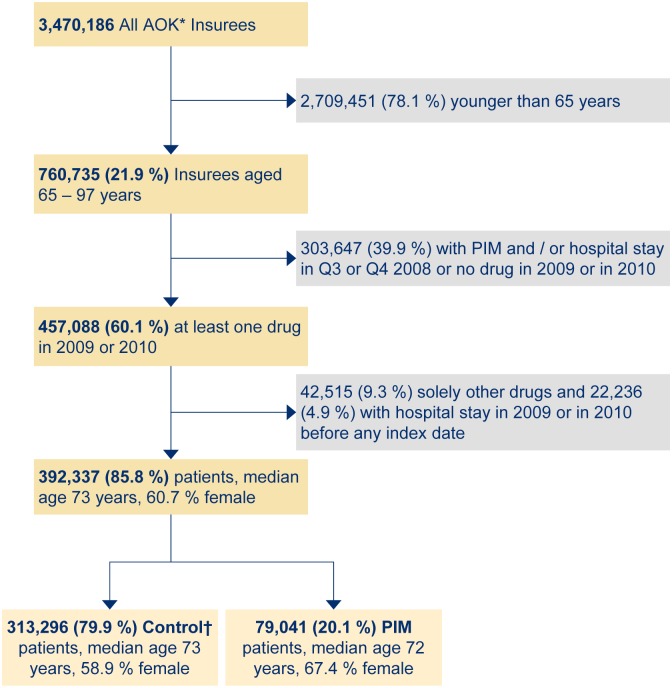
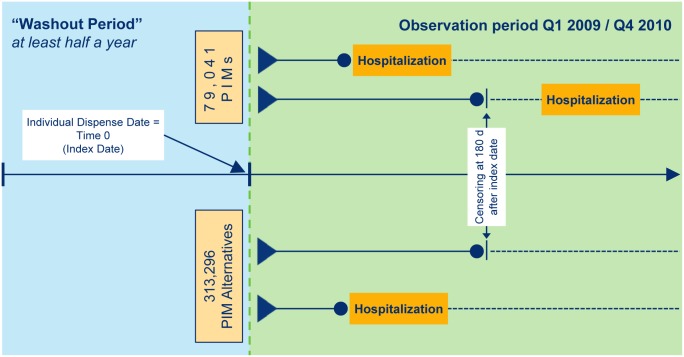
Routine claims data from a German health insurer on 392,337 ambulatory patients aged ≥65 years, were used to estimate adjusted hazard ratios (HRs) for hospitalization associated with incident PIM use. Observation period was January 2009 -December 2010. Users of PIM alternatives, as defined by the PRISCUS list, were the reference group. Patients with PIM dispensing or hospital stay in a six month "washout" period (second half of 2008) were excluded. All potential confounders were determined in the half year before the individual index date.
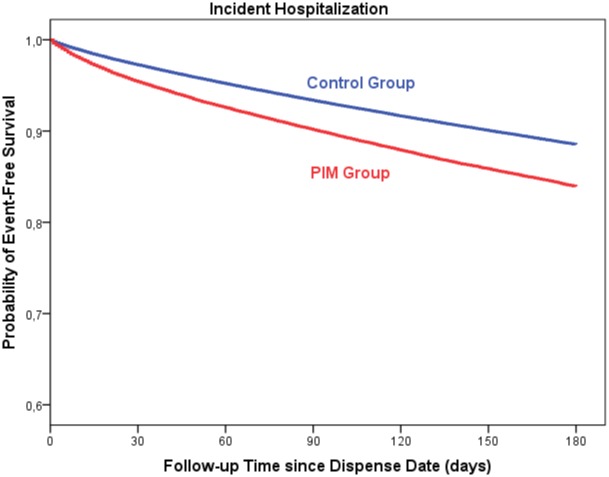
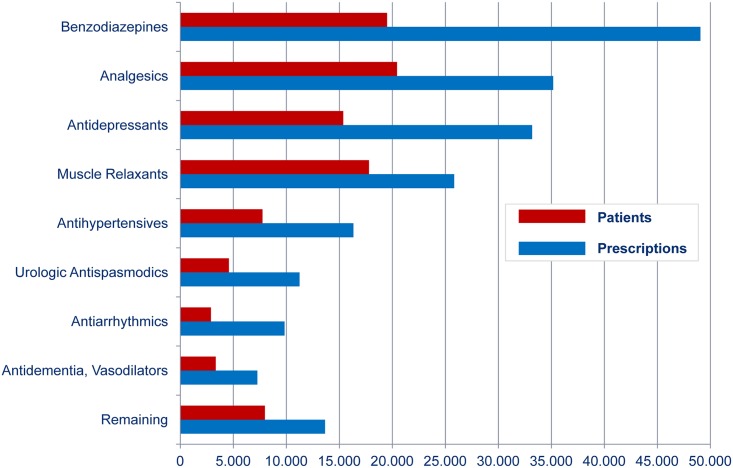
In the total cohort 60.7% were female. Median age was 73 years. Of 79,041 incident PIM users, 58.4% had PIMs dispensed in one quarter of 2009 or 2010, 19.3% in two quarters, and 22.3% in three or more quarters. There were 126,535 hospitalizations during the observation period, and 47,470 of them occurred within 180 days post first dispensing. Multivariable Cox regression analysis revealed PIM use as a significant risk factor for hospitalization (HR 1.378; 95% CI 1.349-1.407) compared to use of PIM alternatives.
PIM use compared to use of PIM alternatives is associated with an increased risk of all-cause hospitalization in the 180 days following individual index date. Future analyses comparing a single PIM with its corresponding alternative may help identify those PIMs responsible for this.
老年患者潜在不适当用药(PIMs)的安全性仍存在争议。我们使用PRISCUS清单,研究了在个体首次药房配药(索引日期)后的180天内,与PIMs替代药物相比,PIMs相关的全因住院风险。
利用德国一家健康保险公司提供的392337名年龄≥65岁门诊患者的常规理赔数据,估算与首次使用PIMs相关的住院调整风险比(HRs)。观察期为2009年1月至2010年12月。以PRISCUS清单定义的PIMs替代药物使用者作为参照组。排除在六个月“洗脱期”(2008年下半年)内有PIMs配药或住院的患者。所有潜在混杂因素在个体索引日期前半年确定。
在整个队列中,60.7%为女性。年龄中位数为73岁。在79041名首次使用PIMs的患者中,58.4%在2009年或2010年的一个季度内配用了PIMs,19.3%在两个季度内配用,22.3%在三个或更多季度内配用。观察期内有126535次住院,其中47470次发生在首次配药后的180天内。多变量Cox回归分析显示,与使用PIMs替代药物相比,使用PIMs是住院的一个显著风险因素(HR 1.378;95% CI 1.349 - 1.407)。
与使用PIMs替代药物相比,在个体索引日期后的180天内,使用PIMs会增加全因住院风险。未来比较单一PIM与其相应替代药物的分析可能有助于确定造成这种情况的PIMs。