Jia Sen, Lansdall-Welfare Thomas, Sudhahar Saatviga, Carter Cynthia, Cristianini Nello
Department of Computer Science, University of Bristol, Bristol, United Kingdom.
School of Journalism, Media and Cultural Studies, Cardiff University, Cardiff, United Kingdom.
PLoS One. 2016 Feb 3;11(2):e0148434. doi: 10.1371/journal.pone.0148434. eCollection 2016.
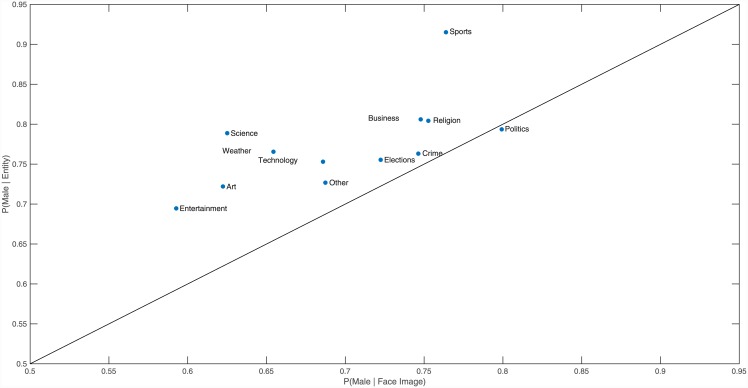
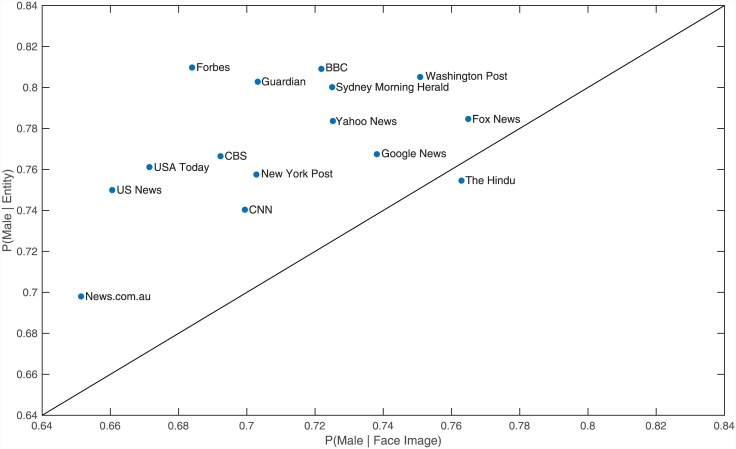
Feminist news media researchers have long contended that masculine news values shape journalists' quotidian decisions about what is newsworthy. As a result, it is argued, topics and issues traditionally regarded as primarily of interest and relevance to women are routinely marginalised in the news, while men's views and voices are given privileged space. When women do show up in the news, it is often as "eye candy," thus reinforcing women's value as sources of visual pleasure rather than residing in the content of their views. To date, evidence to support such claims has tended to be based on small-scale, manual analyses of news content. In this article, we report on findings from our large-scale, data-driven study of gender representation in online English language news media. We analysed both words and images so as to give a broader picture of how gender is represented in online news. The corpus of news content examined consists of 2,353,652 articles collected over a period of six months from more than 950 different news outlets. From this initial dataset, we extracted 2,171,239 references to named persons and 1,376,824 images resolving the gender of names and faces using automated computational methods. We found that males were represented more often than females in both images and text, but in proportions that changed across topics, news outlets and mode. Moreover, the proportion of females was consistently higher in images than in text, for virtually all topics and news outlets; women were more likely to be represented visually than they were mentioned as a news actor or source. Our large-scale, data-driven analysis offers important empirical evidence of macroscopic patterns in news content concerning the way men and women are represented.
长期以来,女权主义新闻媒体研究者一直认为,男性化的新闻价值观影响着记者日常对于新闻价值的判断。因此,有人认为,传统上主要被视为与女性相关且受女性关注的话题和问题,在新闻中经常被边缘化,而男性的观点和声音却被给予了特权空间。当女性出现在新闻中时,她们往往只是“花瓶”,从而强化了女性作为视觉愉悦来源的价值,而非基于她们观点的内容。迄今为止,支持此类说法的证据往往基于对新闻内容的小规模人工分析。在本文中,我们报告了对在线英语新闻媒体中性别呈现的大规模数据驱动研究的结果。我们对文字和图像进行了分析,以便更全面地了解在线新闻中性别是如何呈现的。所考察的新闻内容语料库包括从950多个不同新闻媒体在六个月内收集的2353652篇文章。从这个初始数据集,我们提取了2171239个对特定人物的提及,并使用自动化计算方法识别出1376824张图像中人物的性别。我们发现,在图像和文本中,男性出现的频率都高于女性,但比例会因话题、新闻媒体和呈现方式的不同而有所变化。此外,几乎在所有话题和新闻媒体中,女性在图像中的比例始终高于文本;女性在视觉上出现的可能性比作为新闻角色或消息来源被提及的可能性更大。我们的大规模数据驱动分析为新闻内容中有关男女呈现方式的宏观模式提供了重要的实证证据。