Peñas Julio, Barrios Sara, Bobo-Pinilla Javier, Lorite Juan, Martínez-Ortega M Montserrat
Plant Conservation Unit, Department of Botany, University of Granada , Granada , Spain.
Department of Botany, University of Salamanca , Salamanca , Spain.
PeerJ. 2016 Jan 18;4:e1474. doi: 10.7717/peerj.1474. eCollection 2016.
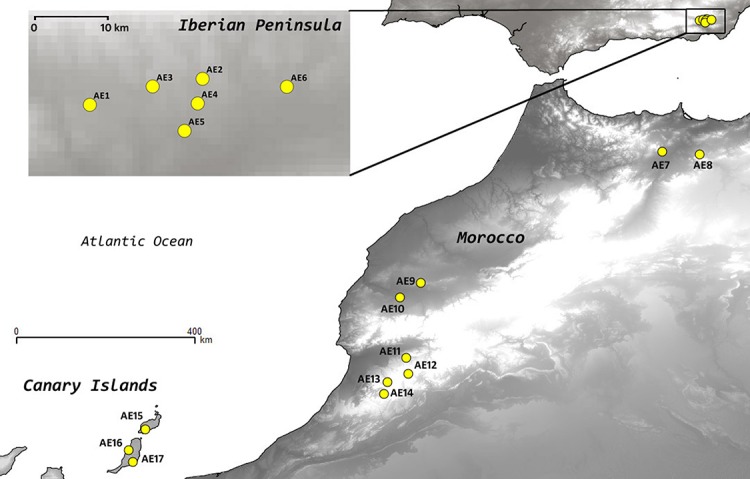
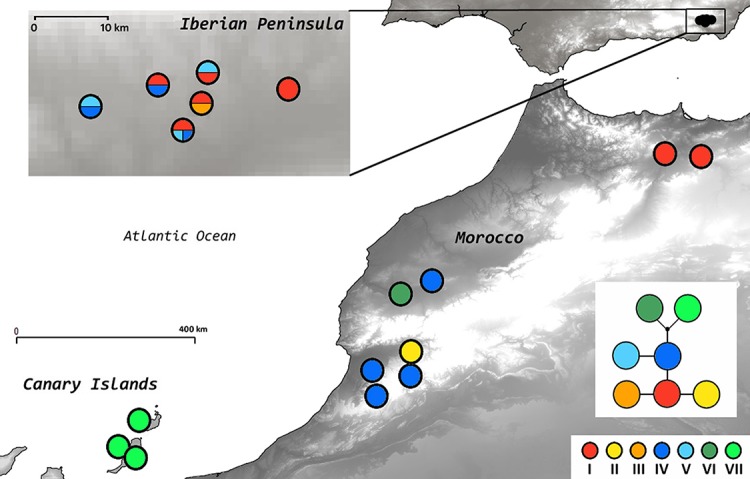
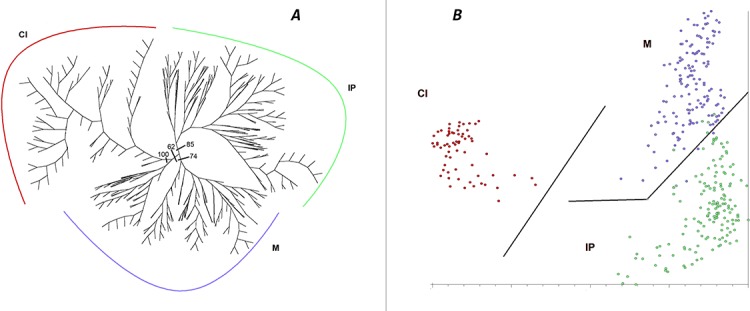
Astragalus edulis (Fabaceae) is an endangered annual species from the western Mediterranean region that colonized the SE Iberian Peninsula, NE and SW Morocco, and the easternmost Macaronesian islands (Lanzarote and Fuerteventura). Although in Spain some conservation measures have been adopted, it is still necessary to develop an appropriate management plan to preserve genetic diversity across the entire distribution area of the species. Our main objective was to use population genetics as well as ecological and phylogeographic data to select Relevant Genetic Units for Conservation (RGUCs) as the first step in designing conservation plans for A. edulis. We identified six RGUCs for in situ conservation, based on estimations of population genetic structure and probabilities of loss of rare alleles. Additionally, further population parameters, i.e. occupation area, population size, vulnerability, legal status of the population areas, and the historical haplotype distribution, were considered in order to establish which populations deserve conservation priority. Three populations from the Iberian Peninsula, two from Morocco, and one from the Canary Islands represent the total genetic diversity of the species and the rarest allelic variation. Ex situ conservation is recommended to complement the preservation of A. edulis, given that effective in situ population protection is not feasible in all cases. The consideration of complementary phylogeographic and ecological data is useful for management efforts to preserve the evolutionary potential of the species.
可食黄芪(豆科)是一种来自地中海西部地区的濒危一年生植物,分布于伊比利亚半岛东南部、摩洛哥东北部和西南部以及最东部的马卡罗尼西亚群岛(兰萨罗特岛和富埃特文图拉岛)。尽管西班牙已采取了一些保护措施,但仍有必要制定一项适当的管理计划,以保护该物种整个分布区域内的遗传多样性。我们的主要目标是利用种群遗传学以及生态和系统地理学数据,选择相关保护遗传单元(RGUCs),作为设计可食黄芪保护计划的第一步。基于种群遗传结构估计和稀有等位基因丧失概率,我们确定了六个用于原地保护的RGUCs。此外,还考虑了进一步的种群参数,即占用面积、种群大小、脆弱性、种群区域的法律地位以及历史单倍型分布,以确定哪些种群应给予保护优先地位。来自伊比利亚半岛的三个种群、来自摩洛哥的两个种群和来自加那利群岛的一个种群代表了该物种的全部遗传多样性和最稀有的等位基因变异。鉴于在所有情况下都无法有效地对种群进行原地保护,建议采用迁地保护来补充可食黄芪的保护工作。考虑互补的系统地理学和生态数据,有助于保护该物种进化潜力的管理工作。