Veerawatananan Bovorn, Surakul Pornprom, Chutabhakdikul Nuanchan
Research Center for Neuroscience, Institute of Molecular Biosciences, Mahidol University, Nakornpathom 73170, Thailand.
Faculty of Allied Health Sciences, Burapha University, Chonburi 20131, Thailand.
Neurobiol Stress. 2015 Dec 14;3:1-7. doi: 10.1016/j.ynstr.2015.12.001. eCollection 2016 Jun.
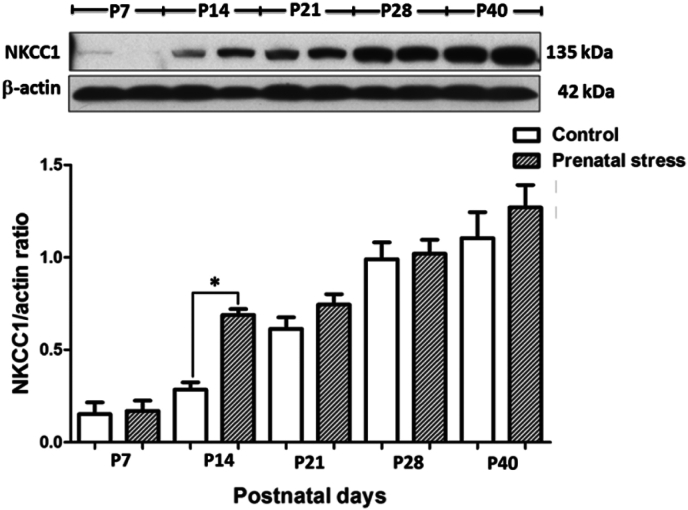
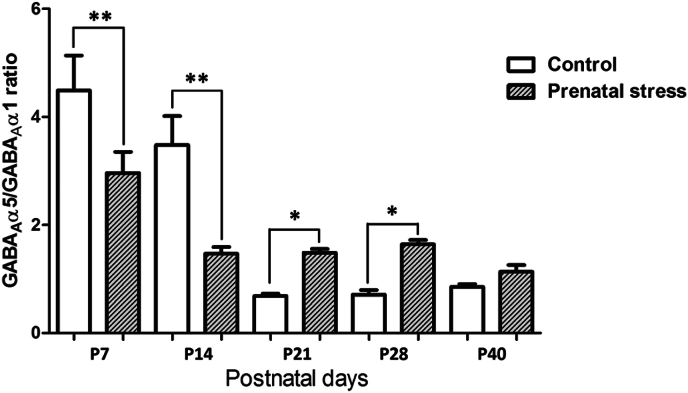
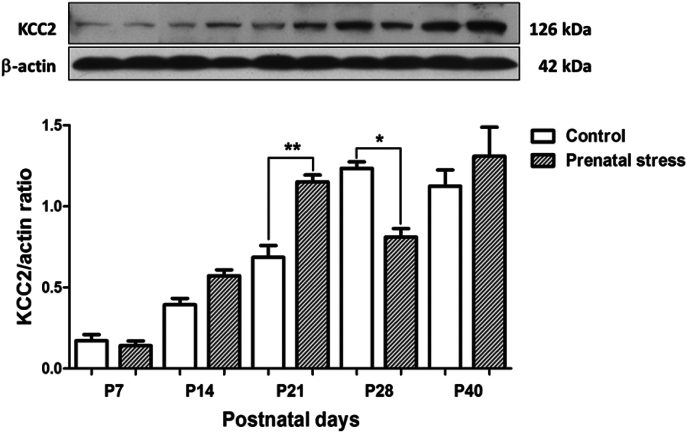
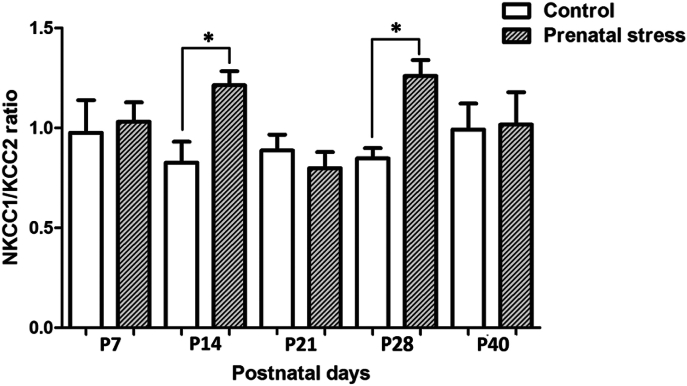
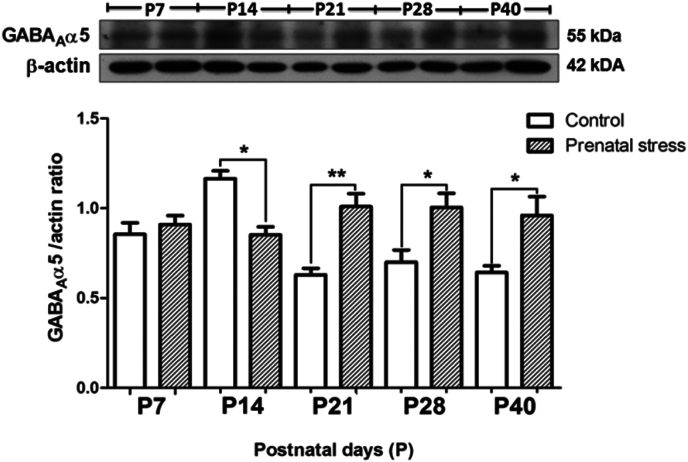
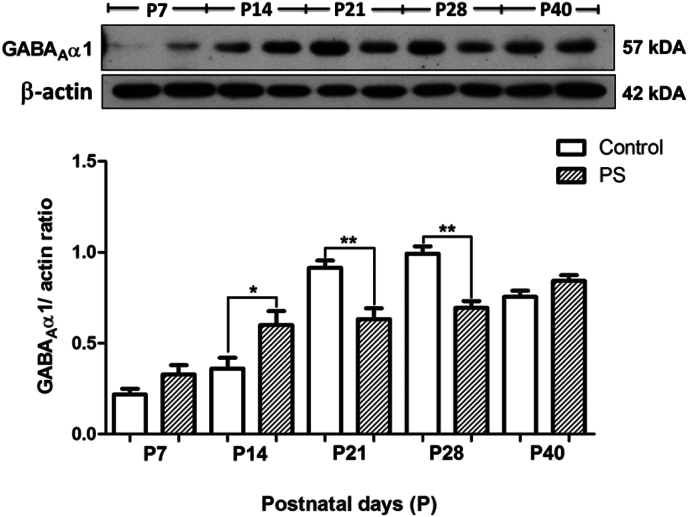
The GABAergic synapse undergoes structural and functional maturation during early brain development. Maternal stress alters GABAergic synapses in the pup's brain that are associated with the pathophysiology of neuropsychiatric disorders in adults; however, the mechanism for this is still unclear. In this study, we examined the effects of maternal restraint stress on the development of Cation-Chloride Cotransporters (CCCs) and the GABAA receptor α1 and α5 subunits in the hippocampus of rat pups at different postnatal ages. Our results demonstrate that maternal restraint stress induces a transient but significant increase in the level of NKCC1 (Sodium-Potassium Chloride Cotransporter 1) only at P14, followed by a brief, yet significant increase in the level of KCC2 (Potassium-Chloride Cotransporter 2) at P21, which then decreases from P28 until P40. Thus, maternal stress alters NKCC1 and KCC2 ratio in the hippocampus of rat pups, especially during P14 to P28. Maternal restraint stress also caused biphasic changes in the level of GABAA receptor subunits in the pup's hippocampus. GABAA receptor α1 subunit gradually increased at P14 then decreased thereafter. On the contrary, GABAA receptor α5 subunit showed a transient decrease followed by a long-term increase from P21 until P40. Altogether, our study suggested that the maternal restraint stress might delay maturation of the GABAergic system by altering the expression of NKCC1, KCC2 and GABAA receptor α1 and α5 subunits in the hippocampus of rat pups. These changes demonstrate the dysregulation of inhibitory neurotransmission during early life, which may underlie the pathogenesis of psychiatric diseases at adolescence.
γ-氨基丁酸能突触在大脑早期发育过程中经历结构和功能成熟。母体应激会改变幼崽大脑中的γ-氨基丁酸能突触,这与成年人神经精神疾病的病理生理学有关;然而,其机制仍不清楚。在本研究中,我们研究了母体束缚应激对不同出生后年龄的大鼠幼崽海马体中阳离子-氯离子协同转运体(CCC)以及GABAA受体α1和α5亚基发育的影响。我们的结果表明,母体束缚应激仅在出生后第14天(P14)诱导钠-钾-氯协同转运体1(NKCC1)水平短暂但显著升高,随后在出生后第21天(P21)钾-氯协同转运体2(KCC2)水平短暂但显著升高,然后从出生后第28天(P28)到第40天(P40)下降。因此,母体应激会改变大鼠幼崽海马体中NKCC1和KCC2的比例,尤其是在P14至P28期间。母体束缚应激还导致幼崽海马体中GABAA受体亚基水平发生双相变化。GABAA受体α1亚基在P14时逐渐增加,此后下降。相反,GABAA受体α5亚基显示短暂下降,随后从P21到P40长期增加。总之,我们的研究表明,母体束缚应激可能通过改变大鼠幼崽海马体中NKCC1、KCC2以及GABAA受体α1和α5亚基的表达来延迟γ-氨基丁酸能系统的成熟。这些变化表明生命早期抑制性神经传递失调,这可能是青春期精神疾病发病机制的基础。