Department of Clinical Biochemistry, Herlev and Gentofte Hospital, Copenhagen University Hospital, Herlev Ringvej 75, DK-2730 Herlev, Denmark.
Department of Clinical Biochemistry, Rigshospitalet, Copenhagen University Hospital, Blegdamsvej 9, 2100 Copenhagen, Denmark.
EBioMedicine. 2015 Nov 14;2(12):2010-5. doi: 10.1016/j.ebiom.2015.11.026. eCollection 2015 Dec.
Hyperglycemia-induced oxidative stress is one mechanism believed to underlie diabetic vascular disease. We tested the hypothesis that diabetic subjects heterozygous for extracellular superoxide dismutase (SOD3) R213G, which entails lower antioxidant capacity in tissues, have increased risk of cardiovascular disease and heart failure.
We used the prospective Copenhagen General Population Study and Copenhagen City Heart Study and genotyped 95,871 individuals for the rs1799895 R213G variation in the SOD3 gene, of which 4498 had diabetes. We used national hospitalization and death registers to assess cardiovascular disease and heart failure.
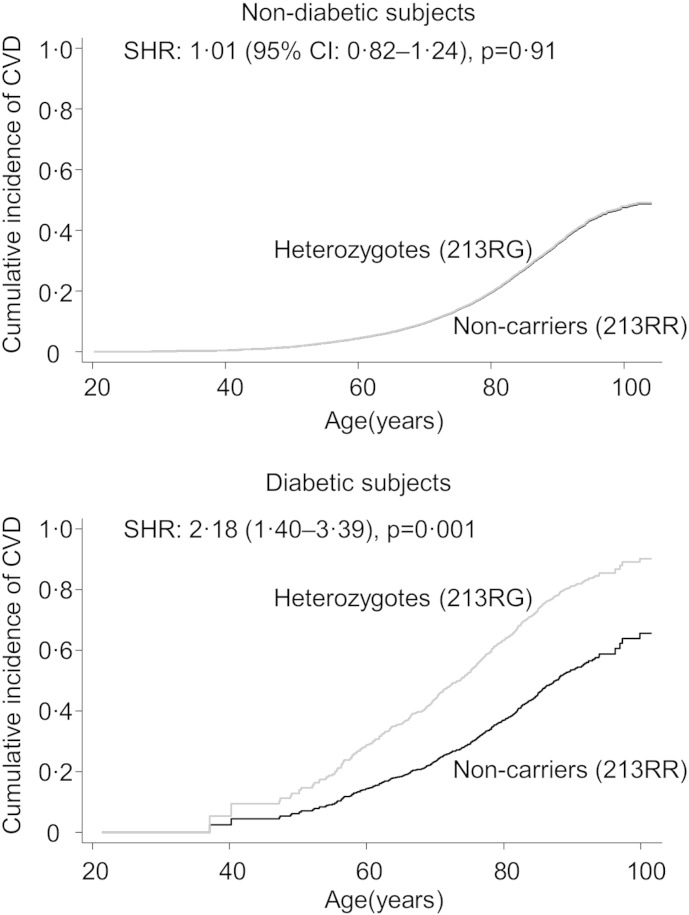
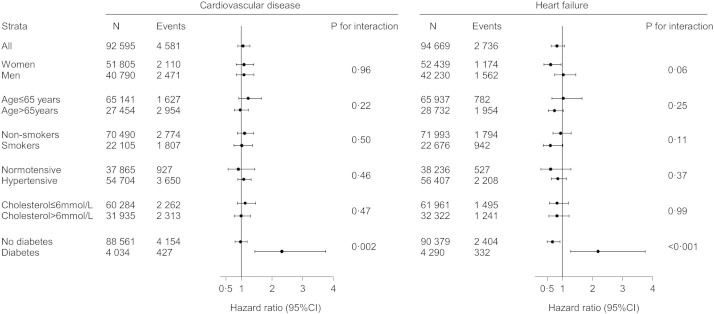
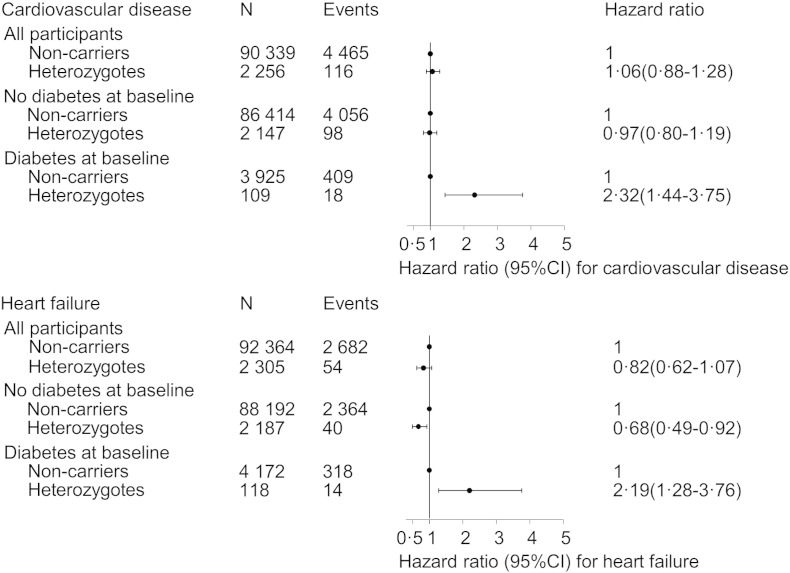
Out of 95,871 individuals, we identified 93,521 R213G non-carriers (213RR, 97.5%), 2336 heterozygotes (213RG, 2.4%) and 14 homozygotes (213GG, 0.01%). In diabetic subjects, the hazard ratio for cardiovascular disease in R213G heterozygotes compared to non-carriers was 2.32 (95% CI 1·44-3.75), with a corresponding hazard ratio in non-diabetic subjects of 0.97 (0·80-1.19) (p for interaction 0.002). For heart failure, the hazard ratios in R213G heterozygotes compared to non-carriers were 2.19 (1.28-3.76) in diabetic and 0.68 (0.49-0.92) in non-diabetic subjects (p for interaction < 0.001).
Risk of cardiovascular disease and heart failure was higher in R213G heterozygotes versus non-carriers in diabetic subjects, but not in non-diabetic subjects.
高血糖引起的氧化应激是导致糖尿病血管疾病的一种机制。我们验证了这样一种假说,即细胞外超氧化物歧化酶(SOD3)R213G 杂合子的糖尿病患者(该突变导致组织中抗氧化能力降低),其心血管疾病和心力衰竭的风险增加。
我们使用前瞻性哥本哈根普通人群研究和哥本哈根城市心脏研究,对 95871 个人的 SOD3 基因 rs1799895 R213G 变异进行基因分型,其中 4498 人患有糖尿病。我们使用国家住院和死亡登记处来评估心血管疾病和心力衰竭。
在 95871 名个体中,我们确定了 93521 名 R213G 非携带者(213RR,97.5%)、2336 名杂合子(213RG,2.4%)和 14 名纯合子(213GG,0.01%)。在糖尿病患者中,R213G 杂合子与非携带者相比,心血管疾病的风险比为 2.32(95%CI 1.44-3.75),而非糖尿病患者的相应风险比为 0.97(0.80-1.19)(p 交互作用=0.002)。对于心力衰竭,R213G 杂合子与非携带者相比,糖尿病患者的风险比为 2.19(1.28-3.76),而非糖尿病患者的风险比为 0.68(0.49-0.92)(p 交互作用<0.001)。
在糖尿病患者中,与非携带者相比,R213G 杂合子的心血管疾病和心力衰竭风险更高,但在非糖尿病患者中则不然。