Flanagan L, Meyer M, Fay J, Curry S, Bacon O, Duessmann H, John K, Boland K C, McNamara D A, Kay E W, Bantel H, Schulze-Bergkamen H, Prehn J H M
Department of Physiology and Medical Physics, Royal College of Surgeons in Ireland, Dublin, Ireland.
Centre for Systems Medicine, Royal College of Surgeons in Ireland, Dublin, Ireland.
Cell Death Dis. 2016 Feb 4;7(2):e2087. doi: 10.1038/cddis.2016.7.
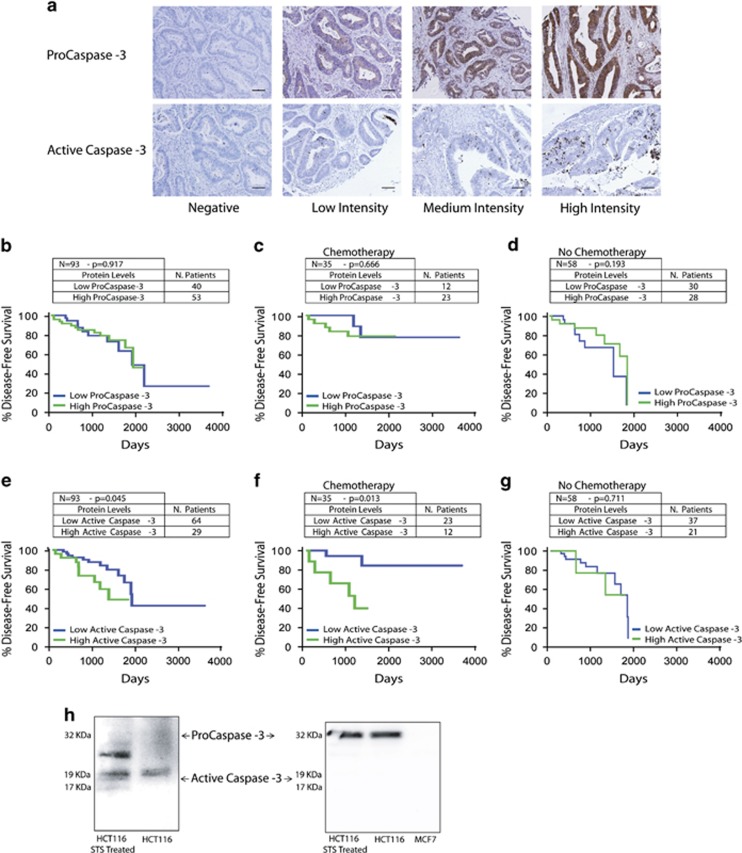
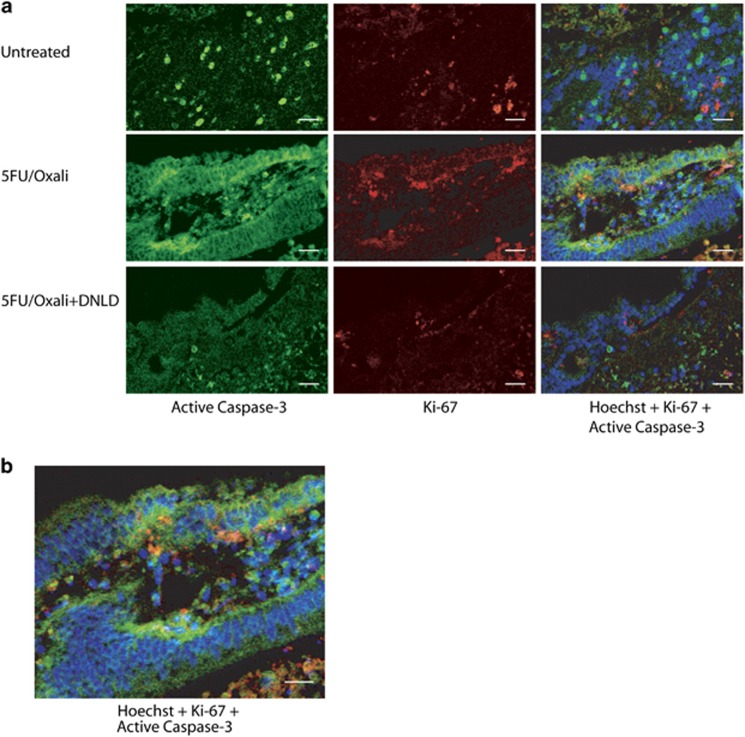
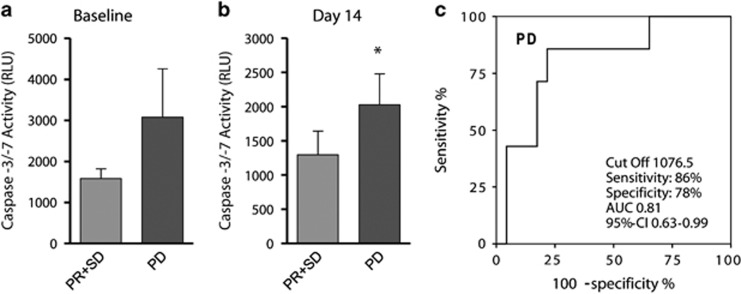
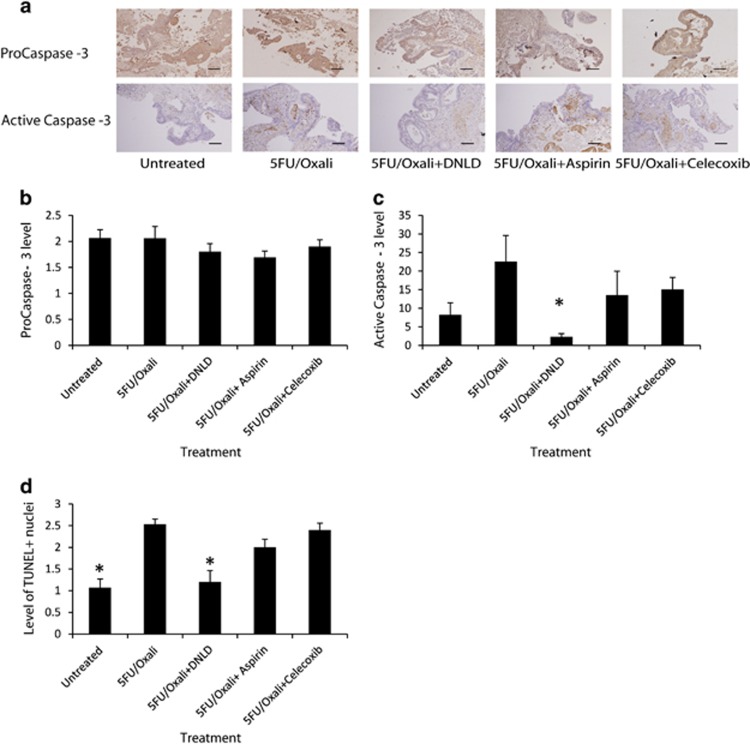
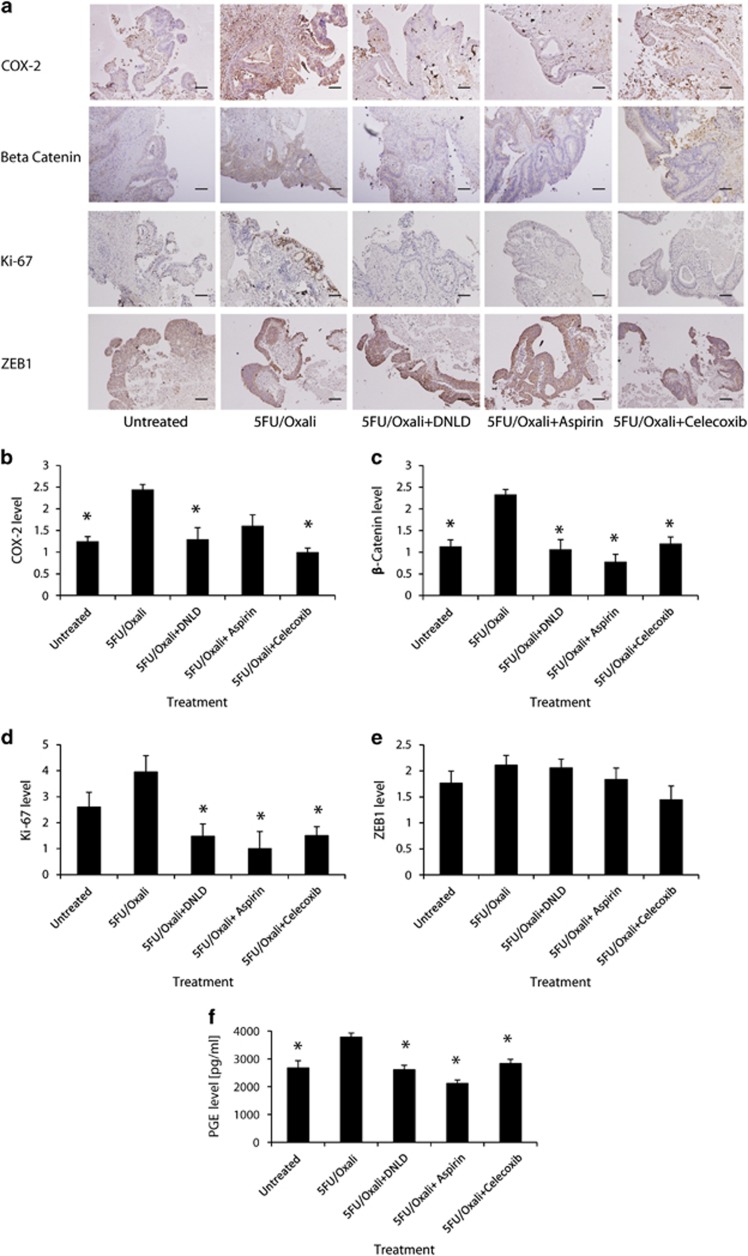
Colorectal cancer (CRC) is one of the most common cancers in the Western world. 5-Fluorouracil (5FU)-based chemotherapy (CT) remains the mainstay treatment of CRC in the advanced setting, and activates executioner caspases in target cells. Executioner caspases are key proteins involved in cell disassembly during apoptosis. Activation of executioner caspases also has a role in tissue regeneration and repopulation by stimulating signal transduction and cell proliferation in neighbouring, non-apoptotic cells as reported recently. Tissue microarrays (TMAs) consisting of tumour tissue from 93 stage II and III colon cancer patients were analysed by immunohistochemistry. Surprisingly, patients with low levels of active Caspase-3 had an increased disease-free survival time. This was particularly pronounced in patients who received 5FU-based adjuvant CT. In line with this observation, lower serum levels of active Caspase-3 were found in patients with metastasised CRC who revealed stable disease or tumour regression compared with those with disease progression. The role of Caspase-3 in treatment responses was explored further in primary human tumour explant cultures from fresh patient tumour tissue. Exposure of explant cultures to 5FU-based CT increased the percentage of cells positive for active Caspase-3 and Terminal Deoxynucleotidyl Transferase dUTP Nick end Labelling (TUNEL), but also the expression of regeneration and proliferation markers β-Catenin and Ki-67, as well as cyclooxygenase-2 (COX-2). Of note, selective inhibition of Caspase-3 with Ac-DNLD-CHO, a selective, reversible inhibitor of Caspase-3, significantly reduced the expression of proliferation markers as well as COX-2. Inhibition of COX-2 with aspirin or celecoxib did not affect Caspase-3 levels but also reduced Ki-67 and β-Catenin levels, suggesting that Caspase-3 acted via COX-2 to stimulate cell proliferation and tissue regeneration. This indicates that low levels of active Caspase-3 may represent a new predictor of CT responsiveness, and inhibition of Caspase-3, or antagonising downstream effectors of Caspase-3 paracrine signalling, such as COX-2 may improve patient outcomes following CT in advanced CRC.
结直肠癌(CRC)是西方世界最常见的癌症之一。以5-氟尿嘧啶(5FU)为基础的化疗(CT)仍然是晚期结直肠癌的主要治疗方法,并能激活靶细胞中的凋亡执行蛋白半胱天冬酶。凋亡执行蛋白半胱天冬酶是参与细胞凋亡过程中细胞解体的关键蛋白。最近报道,凋亡执行蛋白半胱天冬酶的激活还通过刺激邻近非凋亡细胞中的信号转导和细胞增殖,在组织再生和细胞重新填充中发挥作用。通过免疫组织化学分析了由93例II期和III期结肠癌患者的肿瘤组织组成的组织微阵列(TMA)。令人惊讶的是,活性半胱天冬酶-3水平低的患者无病生存时间延长。这在接受以5FU为基础的辅助化疗的患者中尤为明显。与此观察结果一致,与疾病进展的患者相比,在出现疾病稳定或肿瘤消退的转移性结直肠癌患者中发现活性半胱天冬酶-3的血清水平较低。在来自新鲜患者肿瘤组织的原发性人肿瘤外植体培养物中进一步探讨了半胱天冬酶-3在治疗反应中的作用。将外植体培养物暴露于以5FU为基础的化疗中,增加了活性半胱天冬酶-3和末端脱氧核苷酸转移酶dUTP缺口末端标记(TUNEL)阳性细胞的百分比,同时也增加了再生和增殖标志物β-连环蛋白、Ki-67以及环氧化酶-2(COX-2)的表达。值得注意的是,用半胱天冬酶-3的选择性可逆抑制剂Ac-DNLD-CHO选择性抑制半胱天冬酶-3,可显著降低增殖标志物以及COX-2的表达。用阿司匹林或塞来昔布抑制COX-2不影响半胱天冬酶-3水平,但也降低了Ki-67和β-连环蛋白水平,这表明半胱天冬酶-3通过COX-2刺激细胞增殖和组织再生。这表明低水平的活性半胱天冬酶-3可能代表CT反应性的一个新的预测指标,抑制半胱天冬酶-3或拮抗半胱天冬酶-3旁分泌信号的下游效应物,如COX-2,可能会改善晚期结直肠癌患者化疗后的预后。