Wang Ruohan, Zhang Zhixiang
National Engineering Laboratory for Tree Breeding; Key Laboratory for Genetics and Breeding of Forest Trees and Ornamental Plants; Ministry of Education; College of Biological Sciences and Biotechnology; Beijing Forestry University ; Beijing, PR China.
Lab of Systematic Evolution and Biogeography of Woody Plants; College of Nature Conservation; Beijing Forestry University ; Beijing, PR China.
Commun Integr Biol. 2015 Mar 9;8(1):e992746. doi: 10.4161/19420889.2014.992746. eCollection 2015 Jan-Feb.
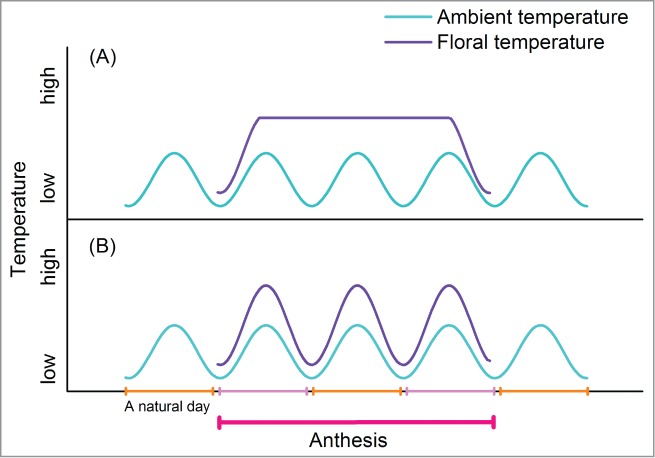
Floral thermogenesis plays a crucial role in pollination biology, especially in plant-pollinator interactions. We have recently explored how thermogenesis is related to pollinator activity and odour release in Magnolia sprengeri. By analyzing flower temperatures, emission of volatiles, and insect visitation, we found that floral blends released during pistillate and staminate stages were similar and coincided with sap beetle visitation. Thus, odour mimicry of staminate-stage flowers may occur during the pistillate stage and may be an adaptive strategy of Magnolia species to attract pollinators during both stages, ensuring successful pollination. In addition to the biological significance of floral thermogenesis in Magnolia species, we explored the underlying regulatory mechanisms via profiling miRNA expression in M. denudata flowers during thermogenic and non-thermogenic stages. We identified 17 miRNAs that may play regulatory roles in floral thermogenesis. Functional annotation of their target genes indicated that these miRNAs regulate floral thermogenesis by influencing cellular respiration and light reactions. These findings increase our understanding of plant-pollinator interactions and the regulatory mechanisms in thermogenic plants.
花部产热在传粉生物学中起着至关重要的作用,尤其是在植物与传粉者的相互作用中。我们最近研究了产热与望春玉兰传粉者活动及气味释放之间的关系。通过分析花朵温度、挥发性物质的释放以及昆虫访花情况,我们发现雌蕊期和雄蕊期释放的花香混合物相似,且与露尾甲的访花情况相符。因此,在雌蕊期可能会出现雄蕊期花朵的气味模拟现象,这可能是木兰属植物在两个阶段吸引传粉者的一种适应性策略,以确保成功授粉。除了望春玉兰属植物花部产热的生物学意义外,我们还通过分析望春花在产热和非产热阶段的miRNA表达谱,探究了其潜在的调控机制。我们鉴定出17个可能在花部产热中起调控作用的miRNA。对其靶基因的功能注释表明,这些miRNA通过影响细胞呼吸和光反应来调控花部产热。这些发现增进了我们对植物与传粉者相互作用以及产热植物调控机制的理解。