Rhee Chin Kook, Ha Jick Hwan, Yoon Jae Ho, Cho Byung Sik, Min Woo Sung, Yoon Hyoung Kyu, Lee Jong Wook
Division of Pulmonary and Critical Care Medicine, Department of Internal Medicine, Seoul St. Mary's Hospital, College of Medicine, The Catholic University of Korea, Seoul, Korea.
Division of Hematology, Department of Internal Medicine, Catholic Blood and Marrow Transplantation Center, Seoul St. Mary's Hospital, College of Medicine, The Catholic University of Korea, Seoul, Korea.
Yonsei Med J. 2016 Mar;57(2):365-72. doi: 10.3349/ymj.2016.57.2.365.
The development of bronchiolitis obliterans syndrome (BOS) after allogeneic hematopoietic stem cell transplantation (HSCT) deteriorates patients' quality of life. This study aimed to analyze the prevalence, clinical features, risk factors and prognostic factors of BOS.
This retrospective study included patients who underwent allogeneic HSCT from January 2002 to December 2008 and survived for ≥100 days after transplantation.
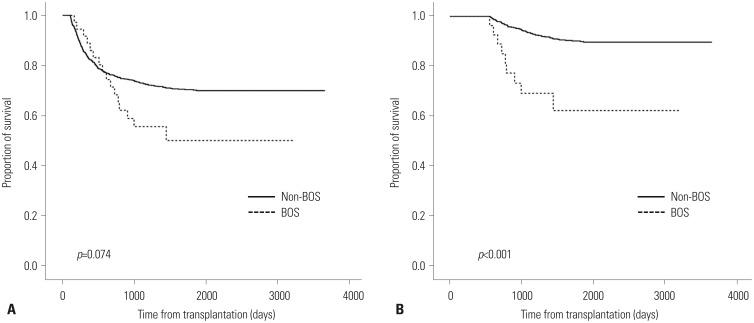
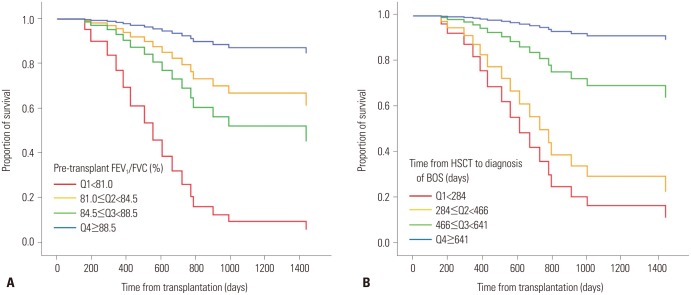
Of 860 patients who survived for ≥100 days, 36 (4.2%) met the diagnostic criteria. The duration of BOS development after transplantation was 466.00 (284.00-642.75) [median (interquartile range)] days. The risk factor for the development of BOS was peripheral blood as the stem cell source with a hazard ratio (HR) of 2.550 [95% confidence interval (CI): 1.274-5.104, p=0.008]. In multivariate analysis, pretransplant FEV₁/FVC (HR: 0.956, 95% CI: 0.921-0.993, p=0.020) and time from HSCT to diagnosis of BOS (HR: 0.997, 95% CI: 0.994-0.999, p=0.009) were independent prognostic factors associated with mortality.
Peripheral blood as a stem cell source is a risk factor for the development of BOS. A decreased pretransplant FEV₁/FVC and shorter duration of time from transplantation to diagnosis of BOS are poor prognostic factors for BOS.
异基因造血干细胞移植(HSCT)后闭塞性细支气管炎综合征(BOS)的发生会使患者生活质量下降。本研究旨在分析BOS的患病率、临床特征、危险因素及预后因素。
这项回顾性研究纳入了2002年1月至2008年12月接受异基因HSCT且移植后存活≥100天的患者。
在860例存活≥100天的患者中,36例(4.2%)符合诊断标准。移植后发生BOS的时间为466.00(284.00 - 642.75)[中位数(四分位间距)]天。BOS发生的危险因素是外周血作为干细胞来源,风险比(HR)为2.550 [95%置信区间(CI):1.274 - 5.104,p = 0.008]。多因素分析显示,移植前FEV₁/FVC(HR:0.956,95% CI:0.921 - 0.993,p = 0.020)以及从HSCT到诊断为BOS的时间(HR:0.997,95% CI:0.994 - 0.999,p = 0.009)是与死亡率相关的独立预后因素。
外周血作为干细胞来源是BOS发生的危险因素。移植前FEV₁/FVC降低以及从移植到诊断为BOS的时间较短是BOS的不良预后因素。