van Dalen Bas M, Strachinaru Mihai, van der Swaluw Julio, Geleijnse Marcel L
Department of Cardiology, The Thoraxcenter, Erasmus University Medical Center, 's-Gravendijkwal 230, Room Bd412, 3015 CE, Rotterdam, The Netherlands.
Department of Cardiology, Sint Franciscus Gasthuis, Rotterdam, The Netherlands.
Int J Cardiovasc Imaging. 2016 May;32(5):743-52. doi: 10.1007/s10554-015-0832-6. Epub 2016 Feb 3.
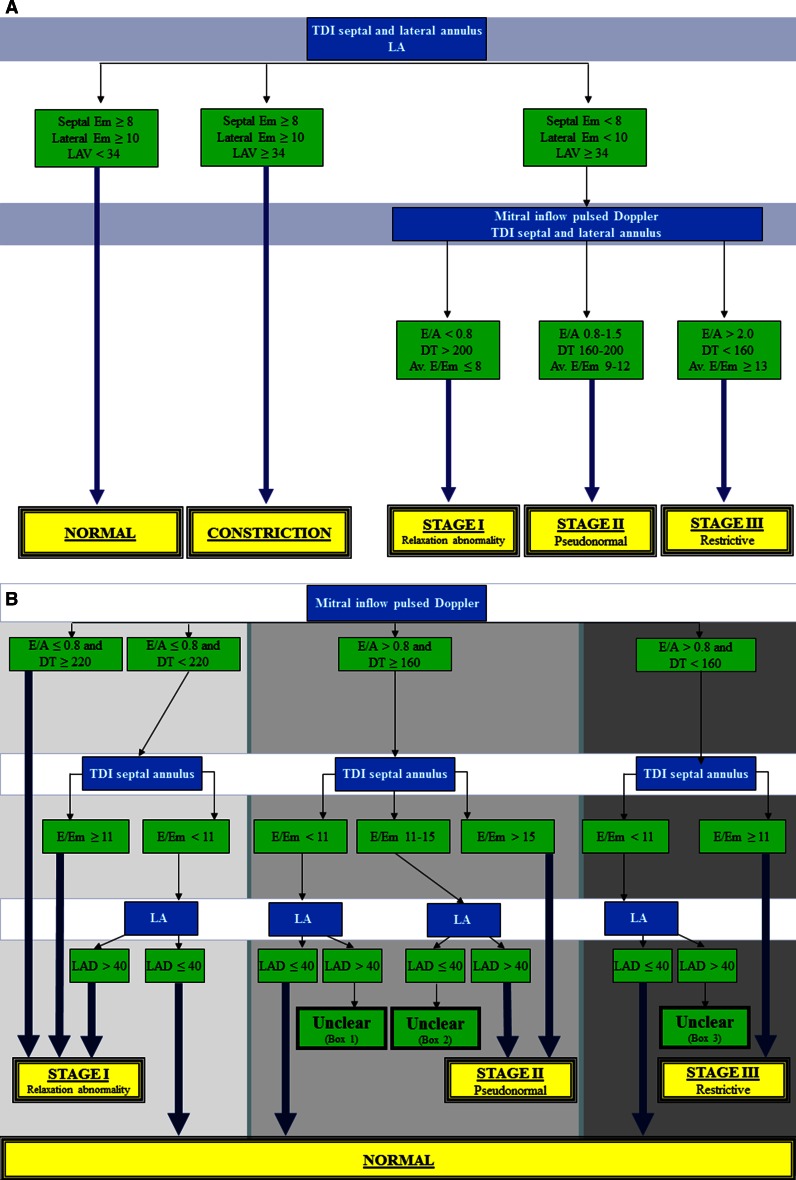
The American Society of Echocardiography and European Association of Echocardiography (ASE/EAE) have published an algorithm for the grading of diastolic function. However, the ability to use this algorithm effectively in daily clinical practice has not been investigated. We hypothesized that in some patients it may be difficult to grade diastolic dysfunction with this scheme, since there may be discrepancies in the assessed parameters. The aim of the current study was to test the feasibility of the ASE/EAE algorithm and to compare this with a new Thoraxcenter (TXC) algorithm. The ASE/EAE and TXC algorithms were applied to 200 patients. The ASE/EAE algorithm starts with assessment of diastolic myocardial wall velocities and left atrial (LA) volumes with subsequent assessment of E/A ratio, E-wave deceleration time and pulmonary venous flow. The TXC algorithm reverses these steps, uses LA dimension instead of volume and does not include a Valsalva manoeuvre and pulmonary venous flow. Due to inconsistencies between diastolic myocardial wall velocities and LA volumes and a not covered E/A ratio in the range of 1.5-2 it was not possible to classify 48 % of patients with the ASE/EAE algorithm, as opposed to only 10 % by the TXC algorithm. LA volume was always needed in the ASE/EAE algorithm. In only 64 % of patients LA size was necessary by the TXC algorithm. When LA volume would have been used instead of LA dimension, grading of LV diastolic function would have been different in only 2 % of patients without apparent improvement. Assessment of LA dimension was considerably faster than LA volume. The TXC algorithm to grade LV diastolic dysfunction was compared to the ASE/EAE algorithm simpler, faster, better reproducible and yields a higher diagnostic outcome.
美国超声心动图学会和欧洲超声心动图协会(ASE/EAE)已发布了一种舒张功能分级算法。然而,在日常临床实践中有效使用该算法的能力尚未得到研究。我们推测,在某些患者中,使用该方案对舒张功能障碍进行分级可能存在困难,因为评估参数可能存在差异。本研究的目的是测试ASE/EAE算法的可行性,并将其与一种新的Thoraxcenter(TXC)算法进行比较。将ASE/EAE和TXC算法应用于200例患者。ASE/EAE算法首先评估舒张期心肌壁速度和左心房(LA)容积,随后评估E/A比值、E波减速时间和肺静脉血流。TXC算法颠倒了这些步骤,使用LA内径而非容积,且不包括瓦尔萨尔瓦动作和肺静脉血流。由于舒张期心肌壁速度与LA容积之间存在不一致,且E/A比值在1.5 - 2范围内未涵盖,使用ASE/EAE算法无法对48%的患者进行分类,而TXC算法仅为10%。ASE/EAE算法始终需要LA容积。TXC算法仅在64%的患者中需要LA大小。如果使用LA容积而非LA内径,在仅2%的患者中左心室舒张功能分级会有所不同,且无明显改善。LA内径的评估比LA容积快得多。与ASE/EAE算法相比,TXC算法对左心室舒张功能障碍进行分级更简单、更快、重复性更好且诊断结果更高。