Tee Andrew E, Liu Bing, Song Renhua, Li Jinyan, Pasquier Eddy, Cheung Belamy B, Jiang Cizhong, Marshall Glenn M, Haber Michelle, Norris Murray D, Fletcher Jamie I, Dinger Marcel E, Liu Tao
Children's Cancer Institute Australia for Medical Research, Randwick, NSW, Australia.
Advanced Analytics Institute, University of Technology, Sydney, Broadway, NSW, Australia.
Oncotarget. 2016 Feb 23;7(8):8663-75. doi: 10.18632/oncotarget.6675.
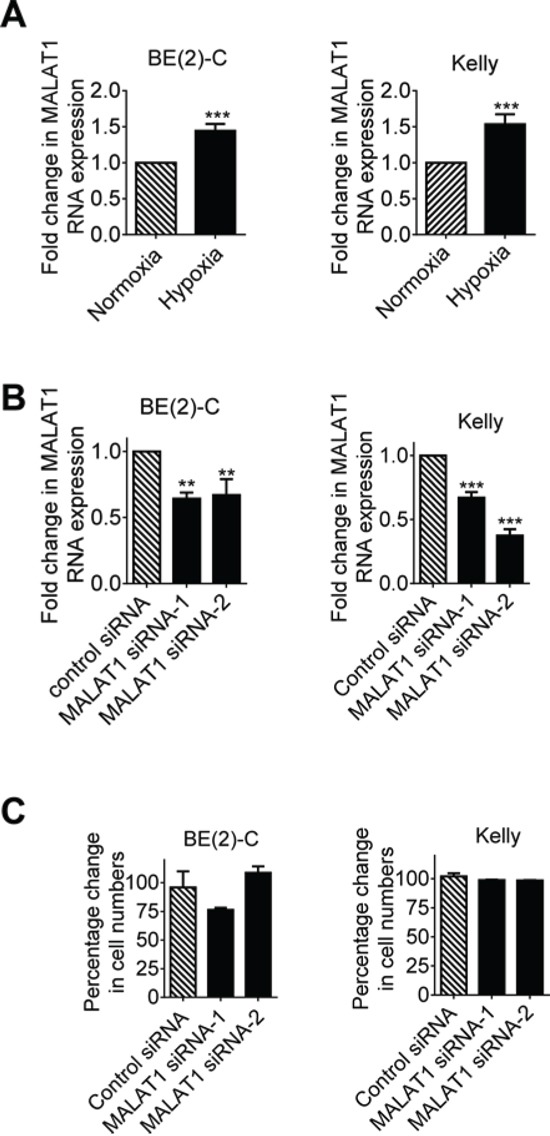
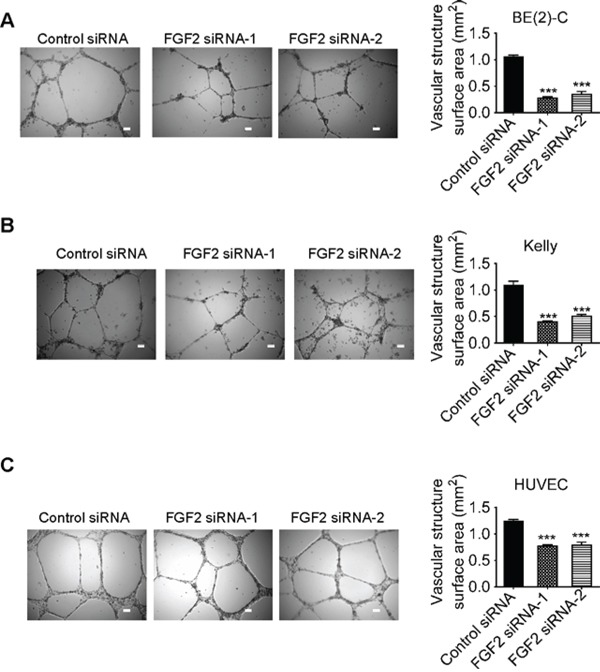
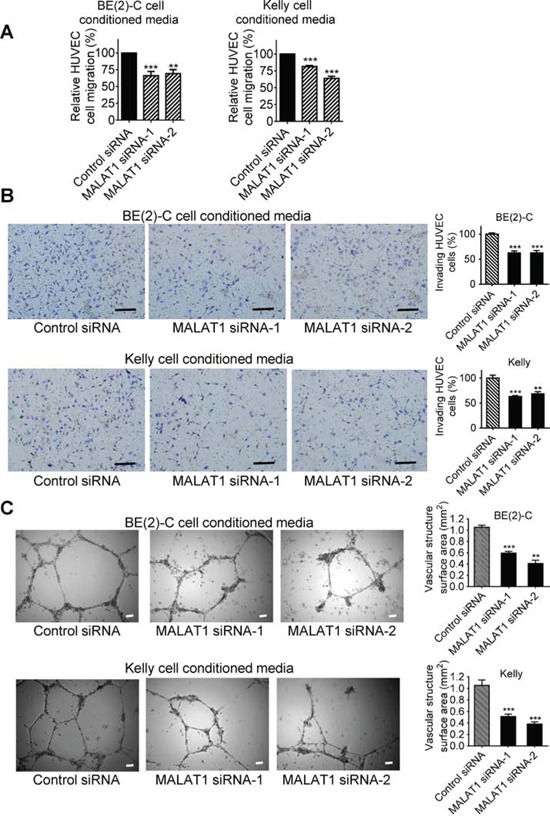
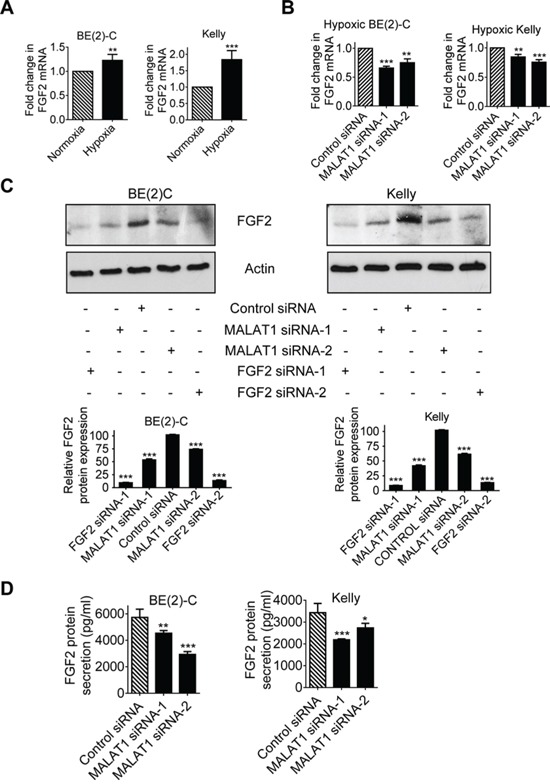
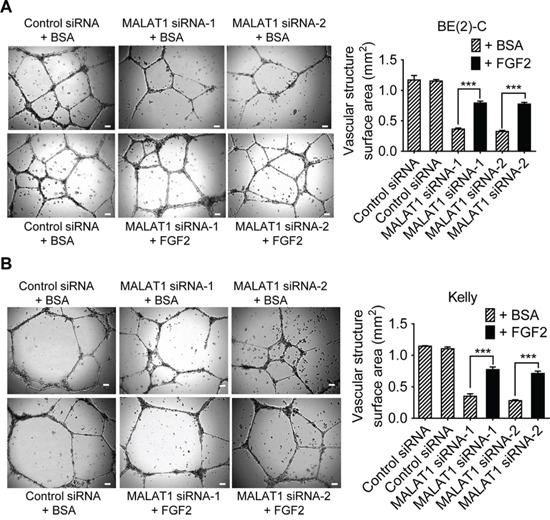
Neuroblastoma is the most common solid tumor during early childhood. One of the key features of neuroblastoma is extensive tumor-driven angiogenesis due to hypoxia. However, the mechanism through which neuroblastoma cells drive angiogenesis is poorly understood. Here we show that the long noncoding RNA MALAT1 was upregulated in human neuroblastoma cell lines under hypoxic conditions. Conditioned media from neuroblastoma cells transfected with small interfering RNAs (siRNA) targeting MALAT1, compared with conditioned media from neuroblastoma cells transfected with control siRNAs, induced significantly less endothelial cell migration, invasion and vasculature formation. Microarray-based differential gene expression analysis showed that one of the genes most significantly down-regulated following MALAT1 suppression in human neuroblastoma cells under hypoxic conditions was fibroblast growth factor 2 (FGF2). RT-PCR and immunoblot analyses confirmed that MALAT1 suppression reduced FGF2 expression, and Enzyme-Linked Immunosorbent Assays revealed that transfection with MALAT1 siRNAs reduced FGF2 protein secretion from neuroblastoma cells. Importantly, addition of recombinant FGF2 protein to the cell culture media reversed the effects of MALAT1 siRNA on vasculature formation. Taken together, our data suggest that up-regulation of MALAT1 expression in human neuroblastoma cells under hypoxic conditions increases FGF2 expression and promotes vasculature formation, and therefore plays an important role in tumor-driven angiogenesis.
神经母细胞瘤是儿童早期最常见的实体瘤。神经母细胞瘤的关键特征之一是由于缺氧导致广泛的肿瘤驱动血管生成。然而,神经母细胞瘤细胞驱动血管生成的机制尚不清楚。在此,我们表明长链非编码RNA MALAT1在缺氧条件下的人神经母细胞瘤细胞系中上调。与用对照小干扰RNA(siRNA)转染的神经母细胞瘤细胞的条件培养基相比,用靶向MALAT1的小干扰RNA(siRNA)转染的神经母细胞瘤细胞的条件培养基诱导的内皮细胞迁移、侵袭和血管形成明显减少。基于微阵列的差异基因表达分析表明,在缺氧条件下,人神经母细胞瘤细胞中MALAT1抑制后下调最显著的基因之一是成纤维细胞生长因子2(FGF2)。逆转录-聚合酶链反应(RT-PCR)和免疫印迹分析证实,MALAT1抑制降低了FGF2表达,酶联免疫吸附测定显示,用MALAT1 siRNA转染减少了神经母细胞瘤细胞中FGF2蛋白的分泌。重要的是,向细胞培养基中添加重组FGF2蛋白可逆转MALAT1 siRNA对血管形成的影响。综上所述,我们的数据表明,缺氧条件下人神经母细胞瘤细胞中MALAT1表达上调会增加FGF2表达并促进血管形成,因此在肿瘤驱动的血管生成中起重要作用。