Department of Oral Biology, Faculty of Dentistry, University of Oslo, Oslo, Norway;
Department of Oral Health Sciences, Medical University of South Carolina, Charleston, SC, USA.
J Oral Microbiol. 2016 Feb 4;8:30385. doi: 10.3402/jom.v8.30385. eCollection 2016.
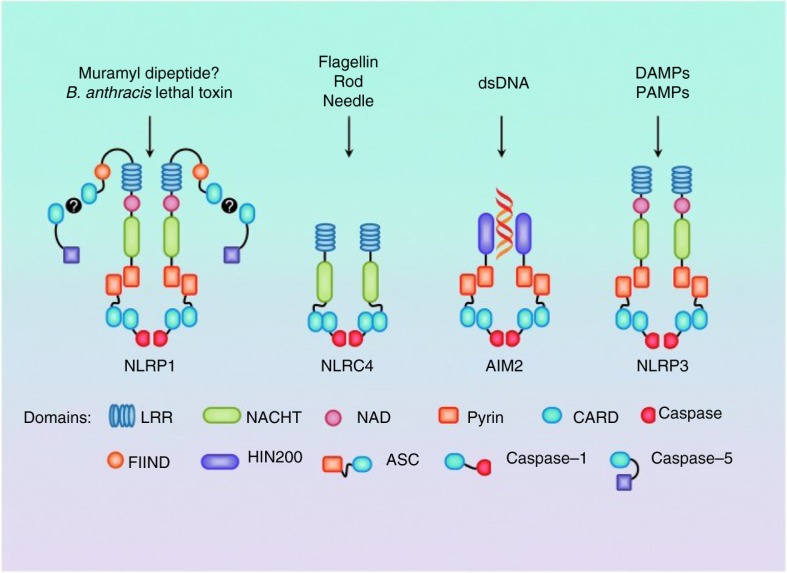
Inflammasomes are large multiprotein complexes localized in the cytoplasm of the cell. They are responsible for the maturation of pro-inflammatory cytokines such as interleukin-1β (IL-1β) and IL-18 as well as for the activation of inflammatory cell death, the so-called pyroptosis. Inflammasomes assemble in response to cellular infection, cellular stress, or tissue damage; promote inflammatory responses and are of great importance in regulating the innate immune system in chronic inflammatory diseases such as periodontitis and several chronic systemic diseases. In addition to sensing cellular integrity, inflammasomes are involved in the homeostatic mutualism between the indigenous microbiota and the host. There are several types of inflammasomes of which NLRP3 is best characterized in microbial pathogenesis. Many opportunistic bacteria try to evade the innate immune system in order to survive in the host cells. One of these is the periodontopathogen Porphyromonas gingivalis which has been shown to have several mechanisms of modulating innate immunity by limiting the activation of the NLRP3 inflammasome. Among them, ATP-/P2X7- signaling is recently associated not only with periodontitis but also with development of several systemic diseases. The present paper reviews multiple mechanisms through which P. gingivalis can modify innate immunity by affecting inflammasome activity.
炎症小体是一种大型多蛋白复合物,位于细胞质中。它们负责促炎细胞因子如白细胞介素-1β (IL-1β) 和 IL-18 的成熟,以及炎症细胞死亡的激活,即所谓的细胞焦亡。炎症小体在细胞感染、细胞应激或组织损伤时组装;促进炎症反应,在牙周炎和几种慢性系统性疾病等慢性炎症性疾病中调节固有免疫系统方面具有重要意义。除了感知细胞完整性外,炎症小体还参与了内源性微生物群和宿主之间的动态共生关系。有几种类型的炎症小体,其中 NLRP3 在微生物发病机制中得到了很好的描述。为了在宿主细胞中生存,许多机会性病原体试图逃避先天免疫系统。其中一种是牙周病原体牙龈卟啉单胞菌,它已经显示出通过限制 NLRP3 炎症小体的激活来调节先天免疫的几种机制。其中,ATP-/P2X7-信号转导最近不仅与牙周炎有关,还与几种系统性疾病的发展有关。本文综述了牙龈卟啉单胞菌通过影响炎症小体活性来修饰先天免疫的多种机制。