Skene Nathan G, Grant Seth G N
Centre for Clinical Brain Sciences, Edinburgh University Edinburgh, UK.
Front Neurosci. 2016 Jan 27;10:16. doi: 10.3389/fnins.2016.00016. eCollection 2016.
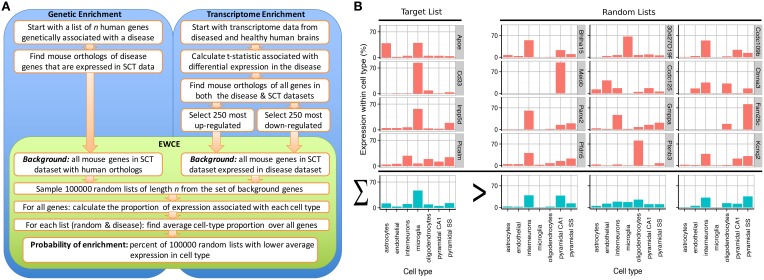
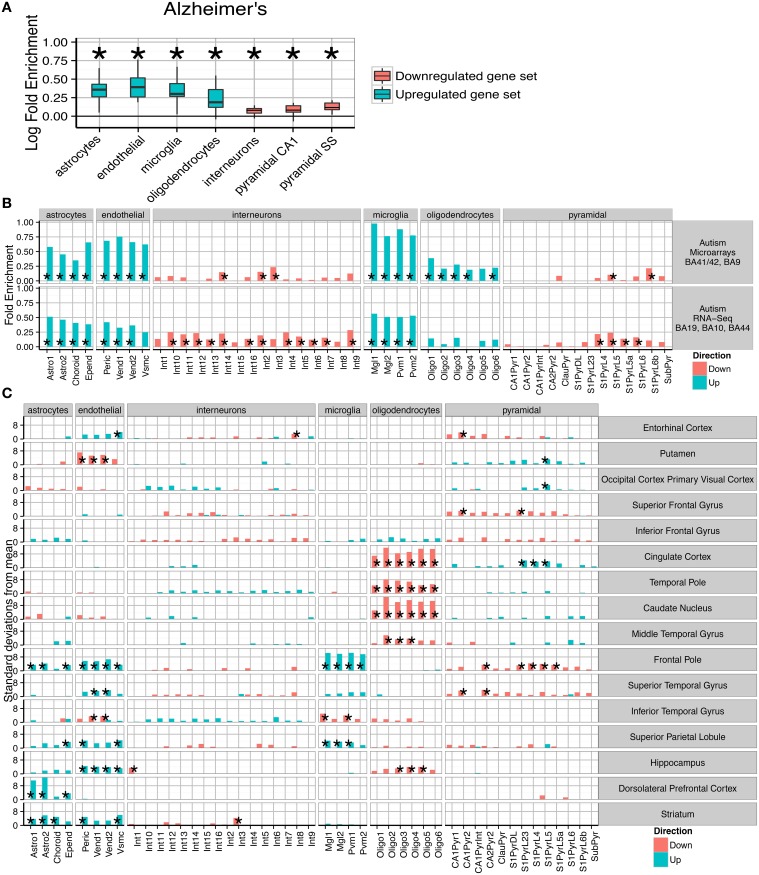
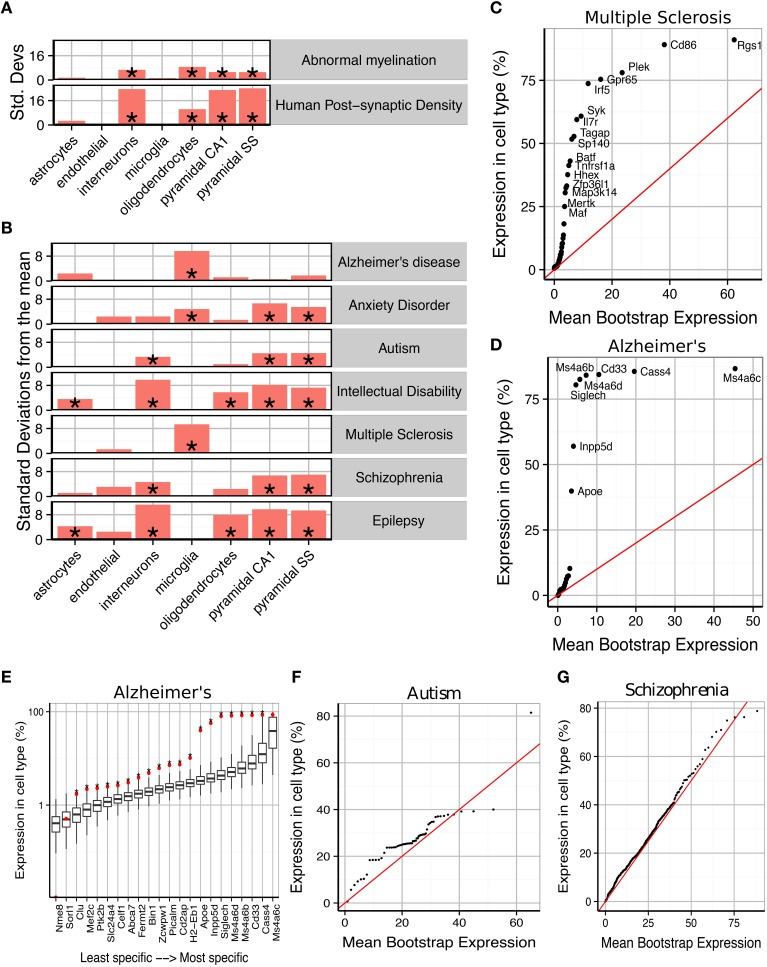
The cell types that trigger the primary pathology in many brain diseases remain largely unknown. One route to understanding the primary pathological cell type for a particular disease is to identify the cells expressing susceptibility genes. Although this is straightforward for monogenic conditions where the causative mutation may alter expression of a cell type specific marker, methods are required for the common polygenic disorders. We developed the Expression Weighted Cell Type Enrichment (EWCE) method that uses single cell transcriptomes to generate the probability distribution associated with a gene list having an average level of expression within a cell type. Following validation, we applied EWCE to human genetic data from cases of epilepsy, Schizophrenia, Autism, Intellectual Disability, Alzheimer's disease, Multiple Sclerosis and anxiety disorders. Genetic susceptibility primarily affected microglia in Alzheimer's and Multiple Sclerosis; was shared between interneurons and pyramidal neurons in Autism and Schizophrenia; while intellectual disabilities and epilepsy were attributable to a range of cell-types, with the strongest enrichment in interneurons. We hypothesized that the primary cell type pathology could trigger secondary changes in other cell types and these could be detected by applying EWCE to transcriptome data from diseased tissue. In Autism, Schizophrenia and Alzheimer's disease we find evidence of pathological changes in all of the major brain cell types. These findings give novel insight into the cellular origins and progression in common brain disorders. The methods can be applied to any tissue and disorder and have applications in validating mouse models.
在许多脑部疾病中引发主要病理变化的细胞类型在很大程度上仍然未知。了解特定疾病主要病理细胞类型的一种途径是识别表达易感性基因的细胞。对于单基因疾病来说这很直接,因为致病突变可能会改变细胞类型特异性标志物的表达,但对于常见的多基因疾病则需要相应的方法。我们开发了表达加权细胞类型富集(EWCE)方法,该方法利用单细胞转录组来生成与细胞类型内具有平均表达水平的基因列表相关的概率分布。经过验证后,我们将EWCE应用于癫痫、精神分裂症、自闭症、智力障碍、阿尔茨海默病、多发性硬化症和焦虑症患者的人类遗传数据。遗传易感性在阿尔茨海默病和多发性硬化症中主要影响小胶质细胞;在自闭症和精神分裂症中,中间神经元和锥体神经元共同受到影响;而智力障碍和癫痫则归因于一系列细胞类型,其中中间神经元的富集最为明显。我们推测主要细胞类型病理可能会引发其他细胞类型的继发性变化,通过将EWCE应用于患病组织的转录组数据可以检测到这些变化。在自闭症、精神分裂症和阿尔茨海默病中,我们发现了所有主要脑细胞类型发生病理变化的证据。这些发现为常见脑部疾病的细胞起源和进展提供了新的见解。这些方法可应用于任何组织和疾病,并且在验证小鼠模型方面也有应用价值。