Li Jinjin, Li Tong, Sun Ping, Yu Qihong, Wang Kun, Chang Weilong, Song Zifang, Zheng Qichang
Department of Hepatobiliary Surgery, Union Hospital, Tongji Medical College, Huazhong University of Science and Technology, Wuhan, China.
Department of Gastrointestinal Surgery, Union hospital, Tongji Medical College, Huazhong University of Science and Technology, Wuhan, China.
PLoS One. 2016 Feb 9;11(2):e0149066. doi: 10.1371/journal.pone.0149066. eCollection 2016.
To compare the efficacy of using covered self-expandable metal stents (CSEMSs) and uncovered self-expandable metal stents (UCSEMSs) to treat objective jaundice caused by an unresectable malignant tumor.
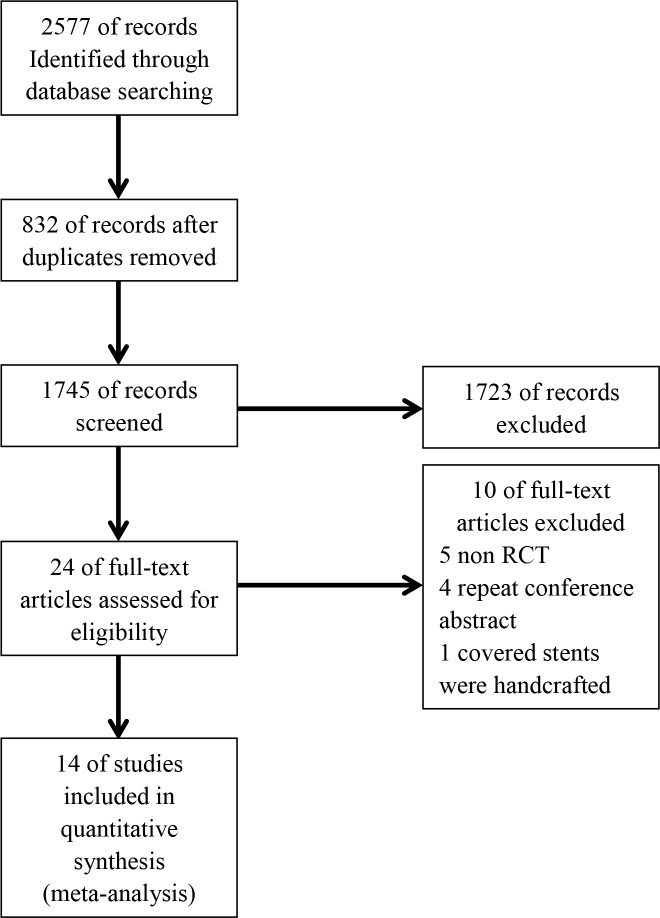
We performed a comprehensive electronic search from 1980 to May 2015. All randomized controlled trials comparing the use of CSEMSs and UCSEMSs to treat malignant distal biliary obstruction were included.
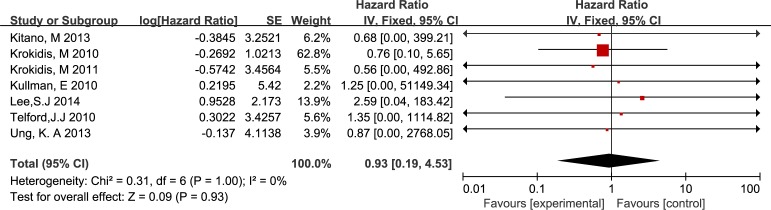
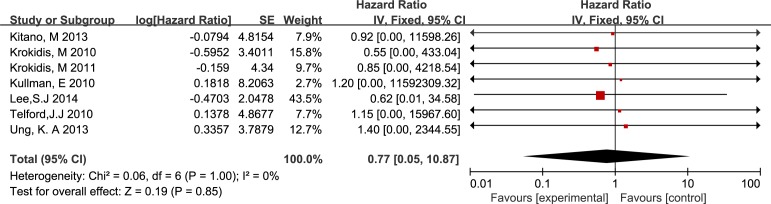
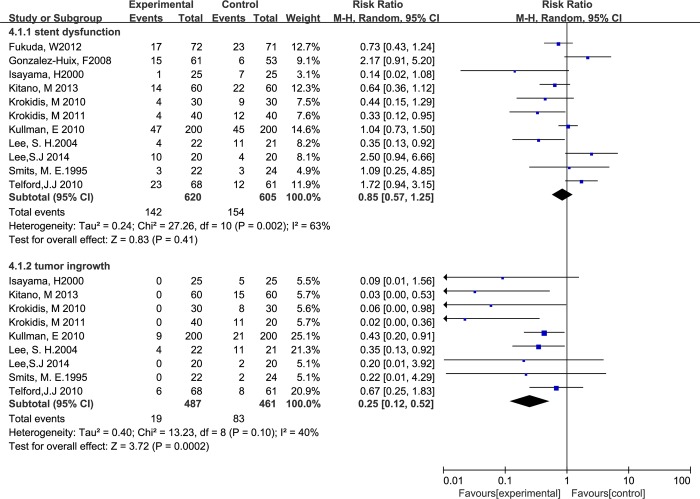
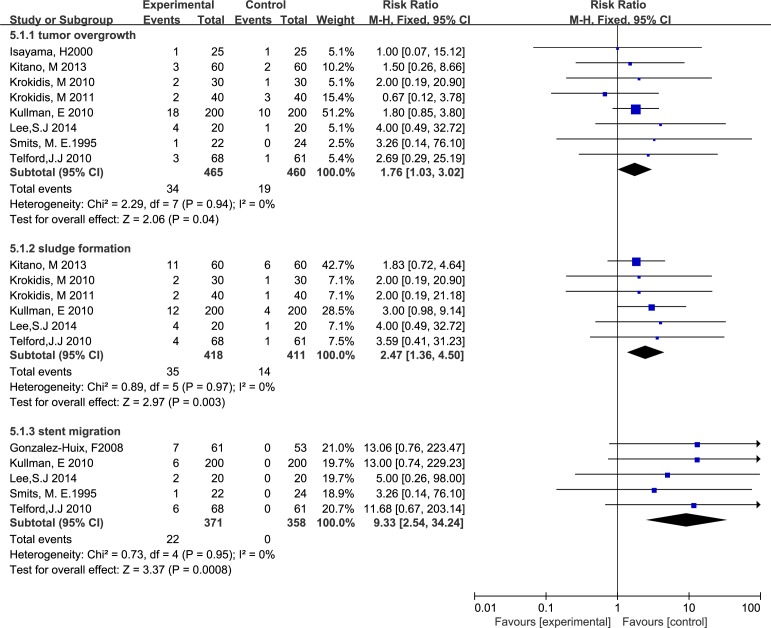
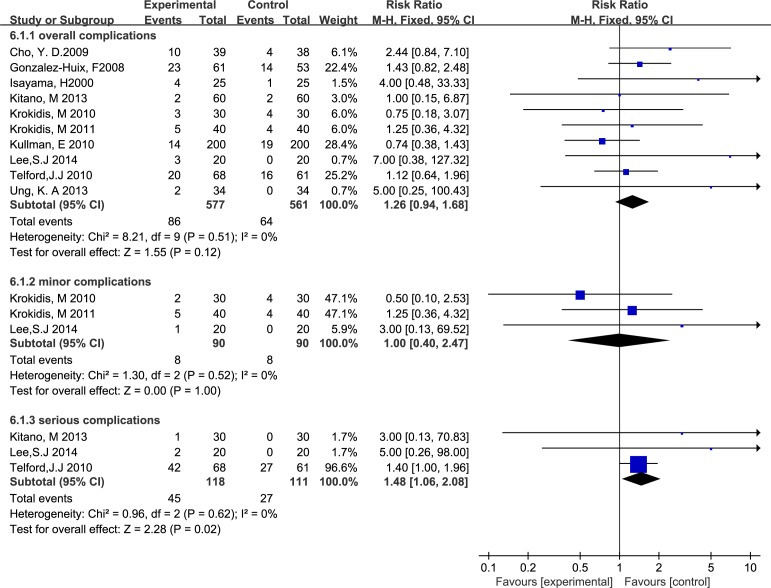
The analysis included 1417 patients enrolled in 14 trials. We did not detect significant differences between the UCSEMS group and the CSEMS group in terms of cumulative stent patency (hazard ratio (HR) 0.93, 95% confidence interval (CI) 0.19-4.53; p = 0.93, I2 = 0%), patient survival (HR 0.77, 95% CI 0.05-10.87; p = 0.85, I2 = 0%), overall stent dysfunction (relative ratio (RR) 0.85, M-H, random, 95% CI 0.57-1.25; p = 0.83, I2 = 63%), the overall complication rate (RR 1.26, M-H, fixed, 95% CI 0.94-1.68; p = 0.12, I2 = 0%) or the change in serum bilirubin (weighted mean difference (WMD) -0.13, IV fixed, 95% CI 0.56-0.3; p = 0.55, I2 = 0%). However, we did detect a significant difference in the main causes of stent dysfunction between the two groups. In particular, the CSEMS group exhibited a lower rate of tumor ingrowth (RR 0.25, M-H, random, 95% CI 0.12-0.52; p = 0.002, I2 = 40%) but a higher rate of tumor overgrowth (RR 1.76, M-H, fixed, 95% CI 1.03-3.02; p = 0.04, I2 = 0%). Patients with CSEMSs also exhibited a higher migration rate (RR 9.33, M-H, fixed, 95% CI 2.54-34.24; p = 0.008, I2 = 0%) and a higher rate of sludge formation (RR 2.47, M-H, fixed, 95% CI 1.36-4.50; p = 0.003, I2 = 0%).
Our meta-analysis indicates that there is no significant difference in primary stent patency and stent dysfunction between CSEMSs and UCSEMSs during the period from primary stent insertion to primary stent dysfunction or patient death. However, when taking further management for occluded stents into consideration, CSEMSs is a better choice for patients with malignant biliary obstruction due to their removability.
比较使用覆膜自膨式金属支架(CSEMS)和非覆膜自膨式金属支架(UCSEMS)治疗不可切除恶性肿瘤所致客观黄疸的疗效。
我们进行了一项从1980年至2015年5月的全面电子检索。纳入所有比较使用CSEMS和UCSEMS治疗恶性远端胆管梗阻的随机对照试验。
分析纳入了14项试验中的1417例患者。我们未发现UCSEMS组和CSEMS组在累积支架通畅率(风险比(HR)0.93,95%置信区间(CI)0.19 - 4.53;p = 0.93,I² = 0%)、患者生存率(HR 0.77,95%CI 0.05 - 10.87;p = 0.85,I² = 0%)、总体支架功能障碍(相对比(RR)0.85,M - H,随机,95%CI 0.57 - 1.25;p = 0.83,I² = 63%)、总体并发症发生率(RR 1.26,M - H,固定,95%CI 0.94 - 1.68;p = 0.12,I² = 0%)或血清胆红素变化(加权均数差(WMD) - 0.13,IV固定,95%CI 0.56 - 0.3;p = 0.55,I² = 0%)方面存在显著差异。然而,我们确实发现两组在支架功能障碍的主要原因上存在显著差异。特别是,CSEMS组肿瘤向内生长率较低(RR 0.25,M - H,随机,95%CI 0.12 - 0.52;p = 0.002,I² = 40%),但肿瘤过度生长率较高(RR 1.76,M - H,固定,95%CI 1.03 - 3.02;p = 0.04,I² = 0%)。使用CSEMS的患者还表现出较高的迁移率(RR 9.33,M - H,固定,95%CI 2.54 - 34.24;p = 0.008,I² = 0%)和较高的胆泥形成率(RR 2.47,M - H,固定,95%CI 1.36 - 4.50;p = 0.003,I² = 0%)。
我们的荟萃分析表明,在从初次支架置入到初次支架功能障碍或患者死亡期间,CSEMS和UCSEMS在主要支架通畅率和支架功能障碍方面无显著差异。然而,考虑到对闭塞支架的进一步处理时,由于CSEMS可移除,对于恶性胆管梗阻患者是更好的选择。