Park James H, Powell Arfon G, Roxburgh Campbell S D, Horgan Paul G, McMillan Donald C, Edwards Joanne
Academic Unit of Surgery, School of Medicine, University of Glasgow, Glasgow Royal Infirmary, Glasgow, UK.
Unit of Experimental Therapeutics, Institute of Cancer Science, University of Glasgow, Garscube Estate, Glasgow, UK.
Br J Cancer. 2016 Mar 1;114(5):562-70. doi: 10.1038/bjc.2016.17. Epub 2016 Feb 9.
Mismatch repair-deficient (dMMR) colorectal cancer (CRC) is associated with a conspicuous local immune infiltrate; however, its relationship with systemic inflammatory responses remains to be determined. The present study aims to examine the relationships and prognostic value of assessment of the local and systemic environment in the context of MMR status in patients with CRC.
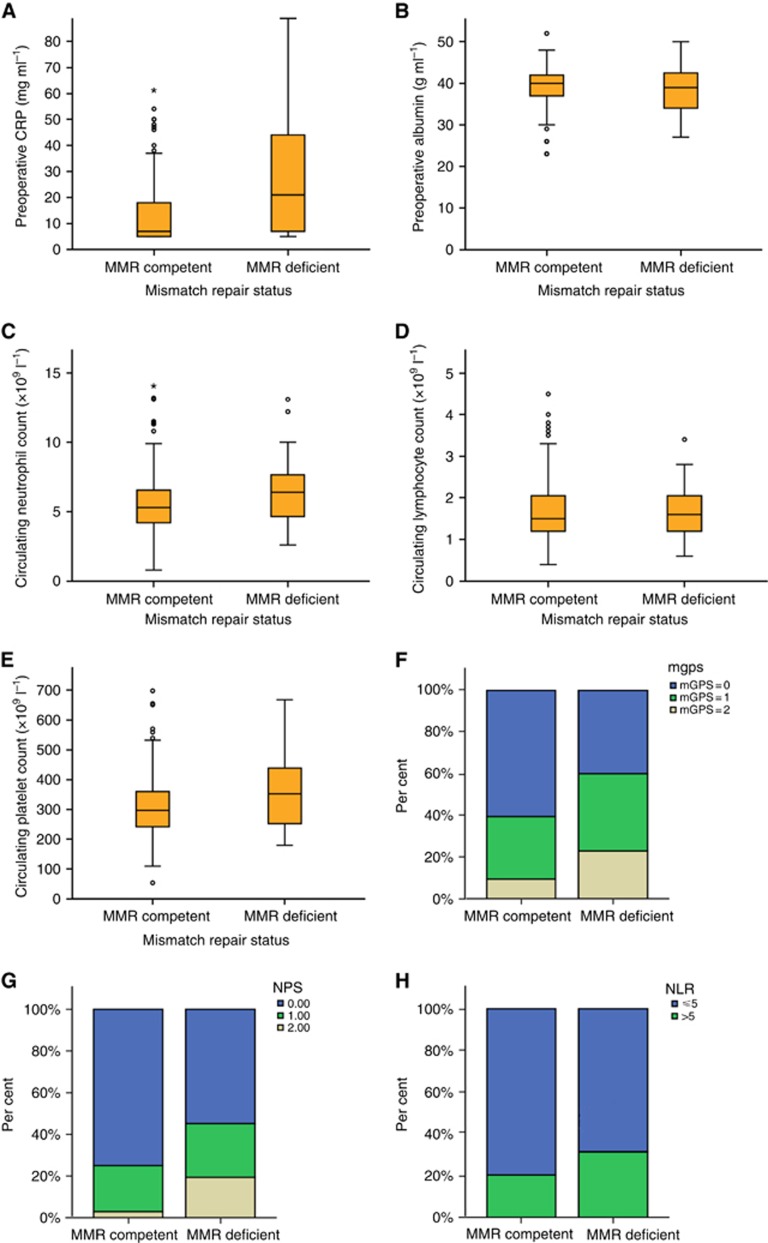
The relationship between MMR status, determined using immunohistochemistry, and the local inflammatory cell infiltrate, differential white cell count, neutrophil : platelet score (NPS), neutrophil : lymphocyte ratio and modified Glasgow Prognostic Score (mGPS), and cancer-specific survival was examined in 228 patients undergoing resection of stage I-III CRC.
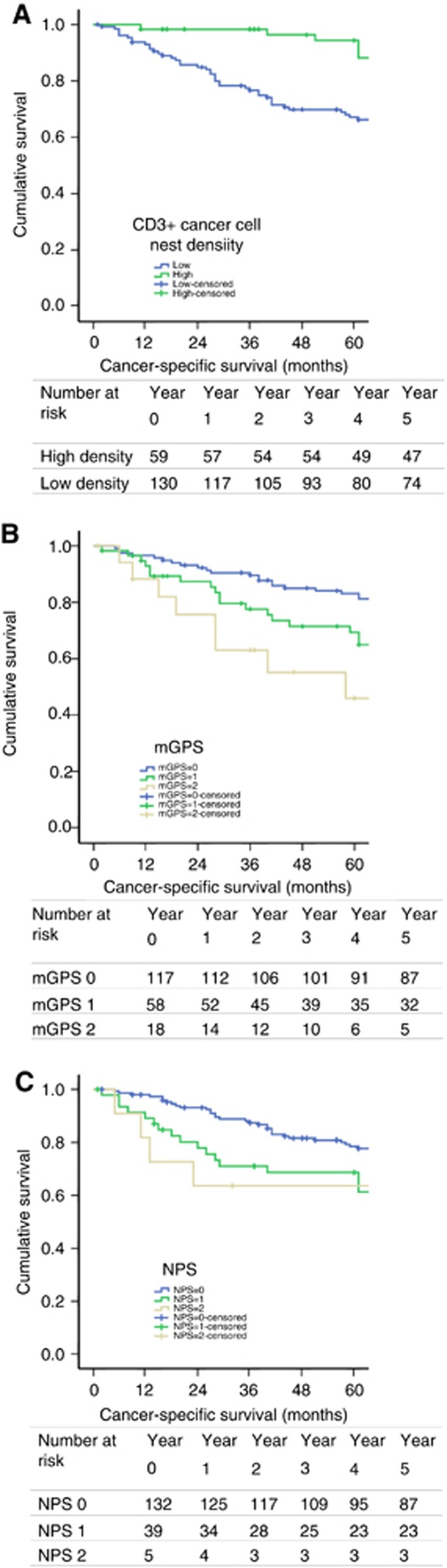
Thirty-five patients (15%) had dMMR CRC. Mismatch repair deficiency was associated with a higher density of CD3(+), CD8(+) and CD45R0(+) T lymphocytes within the cancer cell nests and an elevated mGPS (mGPS2: 23% vs 9%, P=0.007) and NPS (NPS2: 19% vs 3%, P=0.001). CD3(+) density (P<0.001), mGPS (P=0.01) and NPS (P=0.042) were associated with survival independent of MMR status (P=0.367) and stratified 5-year survival of patients with MMR-competent CRC from 94% to 67%, 83% to 46% and 78% to 60% respectively.
Mismatch repair deficiency was associated with local and systemic environments, and in comparison with their assessment, dMMR had relatively poor prognostic value in patients with primary operable CRC. In addition to MMR status, local and systemic inflammatory responses should be assessed in these patients.
错配修复缺陷(dMMR)的结直肠癌(CRC)与明显的局部免疫浸润相关;然而,其与全身炎症反应的关系仍有待确定。本研究旨在探讨CRC患者错配修复状态背景下局部和全身环境评估的关系及预后价值。
在228例接受I-III期CRC切除的患者中,研究了采用免疫组织化学确定的错配修复状态与局部炎症细胞浸润、白细胞分类计数、中性粒细胞:血小板评分(NPS)、中性粒细胞:淋巴细胞比值及改良格拉斯哥预后评分(mGPS)之间的关系,以及与癌症特异性生存的关系。
35例(15%)患者为dMMR CRC。错配修复缺陷与癌细胞巢内CD3(+)、CD8(+)和CD45R0(+) T淋巴细胞密度较高以及mGPS升高(mGPS2:23%对9%,P=0.007)和NPS升高(NPS2:19%对3%,P=0.001)相关。CD3(+)密度(P<0.001)、mGPS(P=0.01)和NPS(P=0.042)与生存相关,独立于错配修复状态(P=0.367),并将错配修复功能正常的CRC患者的5年生存率分别从94%分层至67%、83%分层至46%和78%分层至60%。
错配修复缺陷与局部和全身环境相关,与这些评估相比,dMMR在原发性可手术CRC患者中的预后价值相对较差。除了错配修复状态外,还应评估这些患者的局部和全身炎症反应。