Dik Jan-Willem H, Dinkelacker Ariane G, Vemer Pepijn, Lo-Ten-Foe Jerome R, Lokate Mariëtte, Sinha Bhanu, Friedrich Alex W, Postma Maarten J
Department of Medical Microbiology, University of Groningen, University Medical Center Groningen, Groningen, the Netherlands.
Department of Medical Microbiology, University Hospital Tübingen, Tübingen, Germany.
PLoS One. 2016 Feb 10;11(2):e0149226. doi: 10.1371/journal.pone.0149226. eCollection 2016.
Nosocomial outbreaks, especially with (multi-)resistant microorganisms, are a major problem for health care institutions. They can cause morbidity and mortality for patients and controlling these costs substantial amounts of funds and resources. However, how much is unclear. This study sets out to provide a comparable overview of the costs of multiple outbreaks in a single academic hospital in the Netherlands.
Based on interviews with the involved staff, multiple databases and stored records from the Infection Prevention Division all actions undertaken, extra staff employment, use of resources, bed-occupancy rates, and other miscellaneous cost drivers during different outbreaks were scored and quantified into Euros. This led to total costs per outbreak and an estimated average cost per positive patient per outbreak day.
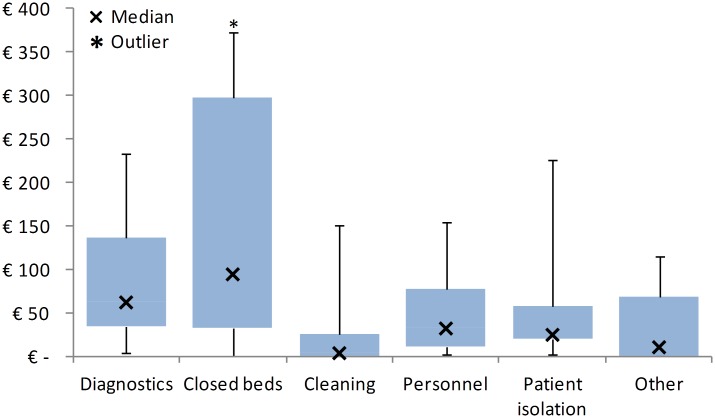
Seven outbreaks that occurred between 2012 and 2014 in the hospital were evaluated. Total costs for the hospital ranged between €10,778 and €356,754. Costs per positive patient per outbreak day, ranged between €10 and €1,369 (95% CI: €49-€1,042), with a mean of €546 and a median of €519. Majority of the costs (50%) were made because of closed beds.
This analysis is the first to give a comparable overview of various outbreaks, caused by different microorganisms, in the same hospital and all analyzed with the same method. It shows a large variation within the average costs due to different factors (e.g. closure of wards, type of ward). All outbreaks however cost considerable amounts of efforts and money (up to €356,754), including missed revenue and control measures.
医院感染暴发,尤其是由(多重)耐药微生物引起的感染暴发,是医疗机构面临的一个主要问题。它们可导致患者发病和死亡,并耗费大量资金和资源用于控制感染。然而,具体花费多少尚不清楚。本研究旨在对荷兰一家学术医院内多次感染暴发的成本提供一个可比较的概述。
基于对相关工作人员的访谈、多个数据库以及感染预防部门存储的记录,对不同感染暴发期间采取的所有行动、额外雇佣的工作人员、资源使用情况、床位占用率以及其他杂项成本驱动因素进行评分,并换算为欧元进行量化。由此得出每次感染暴发的总成本以及每次感染暴发日每例阳性患者的估计平均成本。
对该医院2012年至2014年间发生的7次感染暴发进行了评估。医院的总成本在10,778欧元至356,754欧元之间。每次感染暴发日每例阳性患者的成本在10欧元至1,369欧元之间(95%置信区间:49欧元至1,042欧元),平均为546欧元,中位数为519欧元。大部分成本(50%)是由于床位关闭造成的。
本分析首次对同一医院内由不同微生物引起的各种感染暴发进行了可比较的概述,且所有分析均采用相同方法。结果显示,由于不同因素(如病房关闭、病房类型),平均成本存在很大差异。然而,所有感染暴发都耗费了大量的精力和资金(高达356,754欧元),包括收入损失和控制措施成本。