Maharani Asri, Tampubolon Gindo
Medical Faculty, Brawijaya University, Malang, Indonesia.
Cathie Marsh Institute for Social Research, University of Manchester, Humanities Bridgeford Street Building, Oxford Road, Manchester, M13 9PL, United Kingdom.
PLoS One. 2016 Feb 10;11(2):e0148406. doi: 10.1371/journal.pone.0148406. eCollection 2016.
Obesity is becoming a global problem, rather than one found only in developed countries. Although recent studies have suggested a detrimental effect of obesity on cognition, studies of the relationship between obesity and cognition among older adults have been limited to developed countries. We aimed to examine the associations between central obesity, as measured by waist circumference, and cognition level in adults aged 50 years and older in England and Indonesia.
We used linear regression models to analyse these associations and multiple imputation to manage missing data. The 2006 English Longitudinal Study of Ageing Wave 3 is the source of data from England, while data from Indonesia is sourced from the 2007 Indonesian Family Life Survey Wave 4.
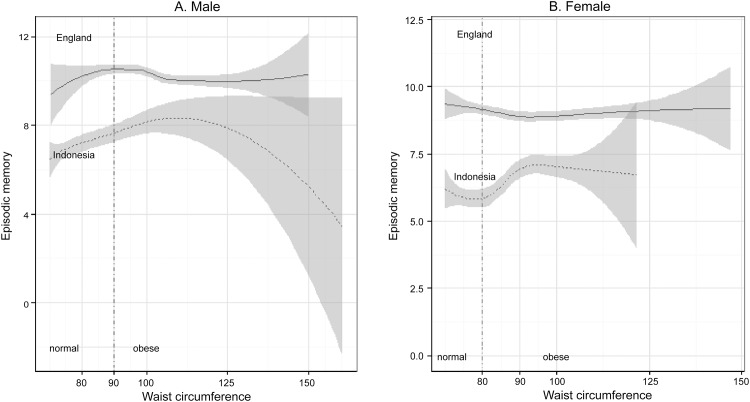
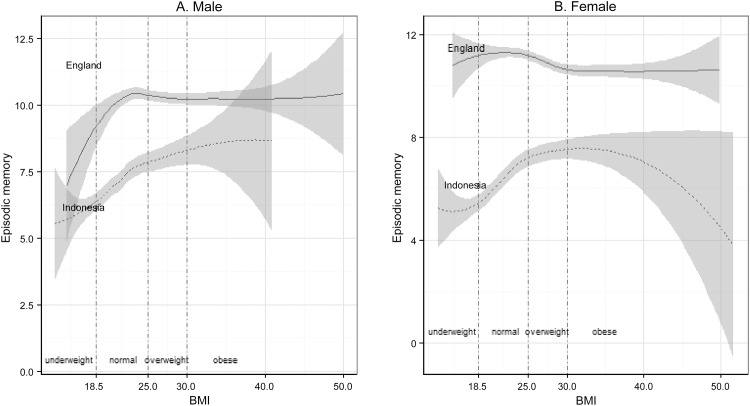
Centrally obese respondents had lower cognition levels than non-centrally obese respondents in England. In contrast, central adiposity had a statistically significant positive association with cognition in Indonesia. Higher levels of education and higher economic status were associated with higher cognitive ability, while age was associated with lower cognition in both countries. Elevated C-reactive protein (CRP) concentrations and smoking behaviour, both linked to higher risk of obesity, were negatively associated with cognitive ability among older adults in England, but they had no statistically significant association with cognition among Indonesians.
The contradictory findings on obesity and cognition in England and Indonesia not only create a puzzle, but they may also have different policy implications in these countries. Reducing the prevalence of obesity may be the main focus in England and other developed countries to maintain older adults' cognition. However, Indonesia and other developing countries should place more emphasis on education, in addition to continued efforts to tackle the double burden of malnutrition, in order to prevent cognitive impairment among older adults.
肥胖正成为一个全球性问题,而非仅存在于发达国家。尽管近期研究表明肥胖对认知有不利影响,但关于老年人肥胖与认知之间关系的研究仅限于发达国家。我们旨在研究在英格兰和印度尼西亚,以腰围衡量的中心性肥胖与50岁及以上成年人认知水平之间的关联。
我们使用线性回归模型分析这些关联,并采用多重填补法处理缺失数据。2006年英格兰老年纵向研究第3波是英格兰的数据来源,而印度尼西亚的数据来自2007年印度尼西亚家庭生活调查第4波。
在英格兰,中心性肥胖的受访者认知水平低于非中心性肥胖的受访者。相比之下,在印度尼西亚,中心性肥胖与认知呈统计学显著的正相关。较高的教育水平和较高的经济地位与较高的认知能力相关,而在这两个国家,年龄与较低的认知相关。与肥胖风险较高相关的C反应蛋白(CRP)浓度升高和吸烟行为,在英格兰与老年人的认知能力呈负相关,但在印度尼西亚与认知无统计学显著关联。
英格兰和印度尼西亚关于肥胖与认知的矛盾研究结果不仅令人困惑,在这些国家可能也有不同的政策含义。在英格兰和其他发达国家,降低肥胖患病率可能是维持老年人认知的主要重点。然而,印度尼西亚和其他发展中国家除了继续努力应对营养不良的双重负担外,应更加强调教育,以预防老年人认知障碍。