Sell David R, Sun Wanjie, Gao Xiaoyu, Strauch Christopher, Lachin John M, Cleary Patricia A, Genuth Saul, Monnier Vincent M
Department of Pathology, Case Western Reserve University, Wolstein Research Bldg. 5-301, 2103 Cornell Road, Cleveland, OH, 44106, USA.
Biostatistics Center, George Washington University, Rockville, MD, 20852, USA.
Cardiovasc Diabetol. 2016 Feb 11;15:30. doi: 10.1186/s12933-016-0343-3.
Skin collagen Long Wavelength Fluorescence (LWF) is widely used as a surrogate marker for accumulation of advanced glycation end-products. Here we determined the relationship of LWF with glycemia, skin fluorescence, and the progression of complications during EDIC in 216 participants from the DCCT.
LW-1 and collagen-linked fluorescence (CLF) were measured by either High Performance Liquid Chromatography (HPLC) with fluorescence detection (LW-1) or total fluorescence of collagenase digests (CLF) in insoluble skin collagen extracted from skin biopsies obtained at the end of the DCCT (1993). Skin intrinsic fluorescence (SIF) was noninvasively measured on volar forearm skin at EDIC year 16 by the SCOUT DS instrument.
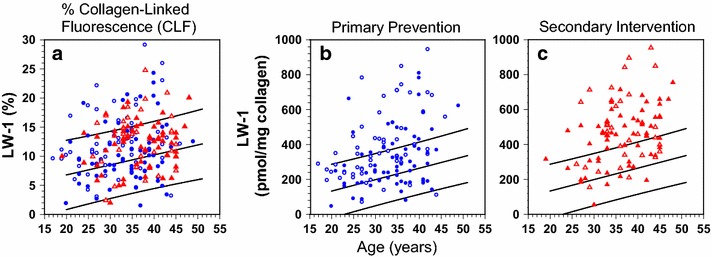
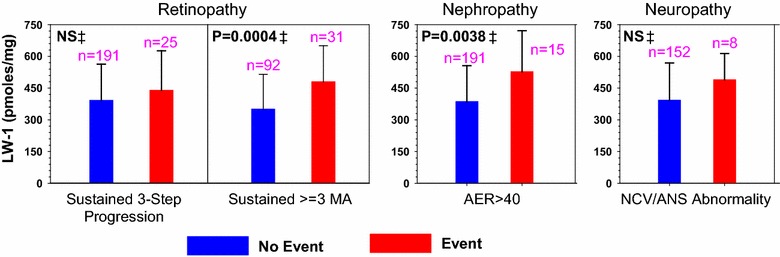
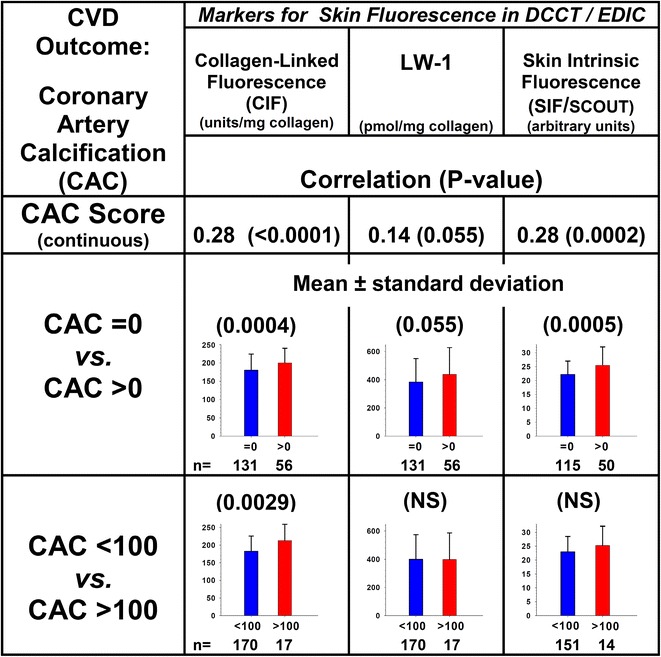
LW-1 levels significantly increased with age and diabetes duration (P < 0.0001) and significantly decreased by intensive vs. conventional glycemic therapy in both the primary (P < 0.0001) and secondary (P < 0.037) DCCT cohorts. Levels were associated with 13-16 year progression risk of retinopathy (>3 sustained microaneurysms, P = 0.0004) and albumin excretion rate (P = 0.0038), the latter despite adjustment for HbA1c. Comparative analysis for all three fluorescent measures for future risk of subclinical macrovascular disease revealed the following significant (P < 0.05) associations after adjusting for age, diabetes duration and HbA1c: coronary artery calcium with SIF and CLF; intima-media thickness with SIF and LW-1; and left ventricular mass with LW-1 and CLF.
LW-1 is a novel risk marker that is robustly and independently associated with the future progression of microvascular disease, intima-media thickness and left ventricular mass in type 1 diabetes. Trial registration NCT00360815 and NCT00360893 at clinicaltrials.gov.
皮肤胶原蛋白长波长荧光(LWF)被广泛用作晚期糖基化终产物积累的替代标志物。在此,我们确定了来自糖尿病控制与并发症试验(DCCT)的216名参与者在糖尿病干预和并发症流行病学研究(EDIC)期间LWF与血糖、皮肤荧光以及并发症进展之间的关系。
LW-1和胶原连接荧光(CLF)通过高效液相色谱(HPLC)结合荧光检测(LW-1)或对从DCCT结束时(1993年)获取的皮肤活检标本中提取的不溶性皮肤胶原蛋白进行胶原酶消化后的总荧光(CLF)来测量。在EDIC第16年,使用SCOUT DS仪器对掌侧前臂皮肤进行无创性测量皮肤固有荧光(SIF)。
LW-1水平随年龄和糖尿病病程显著升高(P < 0.0001),在DCCT的初级队列(P < 0.0001)和次级队列(P < 0.037)中,强化血糖治疗与传统血糖治疗相比,LW-1水平显著降低。LW-1水平与视网膜病变13至16年的进展风险(>3个持续性微动脉瘤,P = 0.0004)和白蛋白排泄率(P = 0.0038)相关,后者在调整糖化血红蛋白(HbA1c)后仍具有相关性。对所有三种荧光测量指标进行比较分析,以评估未来亚临床大血管疾病风险,在调整年龄、糖尿病病程和HbA1c后,发现以下显著(P < 0.05)关联:冠状动脉钙化与SIF和CLF相关;内膜中层厚度与SIF和LW-1相关;左心室质量与LW-1和CLF相关。
LW-1是一种新的风险标志物,与1型糖尿病患者微血管疾病的未来进展、内膜中层厚度和左心室质量密切且独立相关。在clinicaltrials.gov上的试验注册号为NCT00360815和NCT00360893。