
正选择氨基酸替换在哺乳动物视紫红质进化中的功能作用。
Functional role of positively selected amino acid substitutions in mammalian rhodopsin evolution.
作者信息
Fernández-Sampedro Miguel A, Invergo Brandon M, Ramon Eva, Bertranpetit Jaume, Garriga Pere
机构信息
Grup de Biotecnologia Molecular i Industrial, Centre de Biotecnologia Molecular, Departament d'Enginyeria Química, Universitat Politècnica de Catalunya, Edifici Gaia, Rambla de Sant Nebridi 22, 08222 Terrassa, Catalonia, Spain.
IBE - Institute of Evolutionary Biology (CSIC-Universitat Pompeu Fabra), CEXS-UPF-PRBB, Barcelona, Catalonia, Spain.
出版信息
Sci Rep. 2016 Feb 11;6:21570. doi: 10.1038/srep21570.
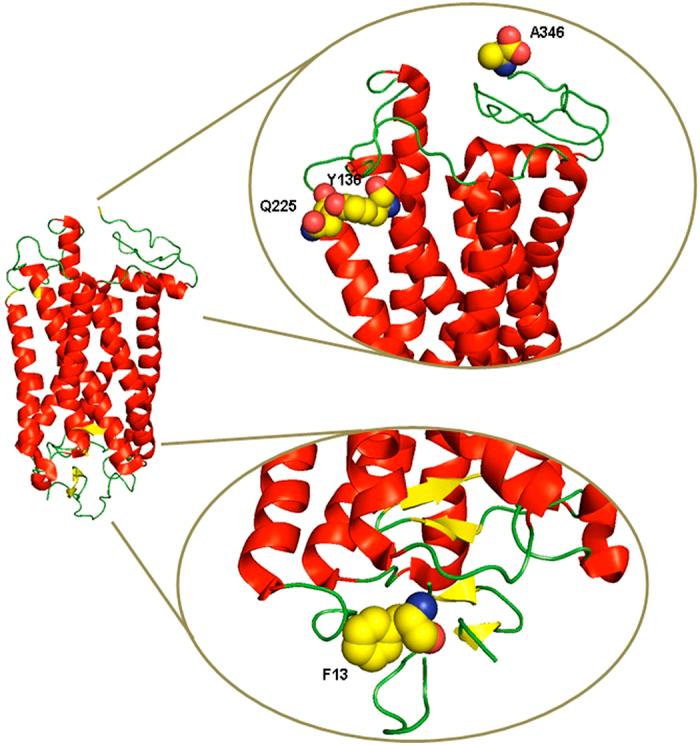
Visual rhodopsins are membrane proteins that function as light photoreceptors in the vertebrate retina. Specific amino acids have been positively selected in visual pigments during mammal evolution, which, as products of adaptive selection, would be at the base of important functional innovations. We have analyzed the top candidates for positive selection at the specific amino acids and the corresponding reverse changes (F13M, Q225R and A346S) in order to unravel the structural and functional consequences of these important sites in rhodopsin evolution. We have constructed, expressed and immunopurified the corresponding mutated pigments and analyzed their molecular phenotypes. We find that position 13 is very important for the folding of the receptor and also for proper protein glycosylation. Position 225 appears to be important for the function of the protein affecting the G-protein activation process, and position 346 would also regulate functionality of the receptor by enhancing G-protein activation and presumably affecting protein phosphorylation by rhodopsin kinase. Our results represent a link between the evolutionary analysis, which pinpoints the specific amino acid positions in the adaptive process, and the structural and functional analysis, closer to the phenotype, making biochemical sense of specific selected genetic sequences in rhodopsin evolution.
视紫红质是一种膜蛋白,在脊椎动物视网膜中作为光感受器发挥作用。在哺乳动物进化过程中,视色素中的特定氨基酸受到了正向选择,这些作为适应性选择产物的氨基酸,可能是重要功能创新的基础。我们分析了特定氨基酸正向选择的顶级候选位点以及相应的反向变化(F13M、Q225R和A346S),以揭示视紫红质进化中这些重要位点的结构和功能后果。我们构建、表达并免疫纯化了相应的突变色素,并分析了它们的分子表型。我们发现13位氨基酸对受体的折叠以及蛋白质的正确糖基化非常重要。225位氨基酸似乎对影响G蛋白激活过程的蛋白质功能很重要,而346位氨基酸也会通过增强G蛋白激活并可能影响视紫红质激酶的蛋白质磷酸化来调节受体的功能。我们的结果在进化分析(确定适应性过程中的特定氨基酸位置)与更接近表型的结构和功能分析之间建立了联系,从而对视紫红质进化中特定选择的基因序列做出生化解释。


 Zotero 插件