Schalasta Gunnar, Speicher Andrea, Börner Anna, Enders Martin
Prof. Gisela Enders & Kollegen MVZ GbR, Stuttgart, Germany
Prof. Gisela Enders & Kollegen MVZ GbR, Stuttgart, Germany.
J Clin Microbiol. 2016 Apr;54(4):1101-7. doi: 10.1128/JCM.03236-15. Epub 2016 Feb 10.
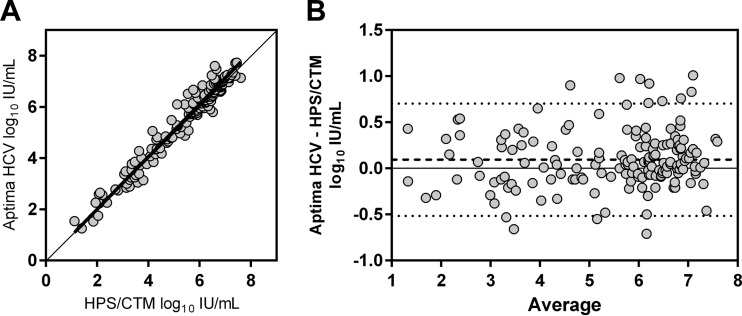
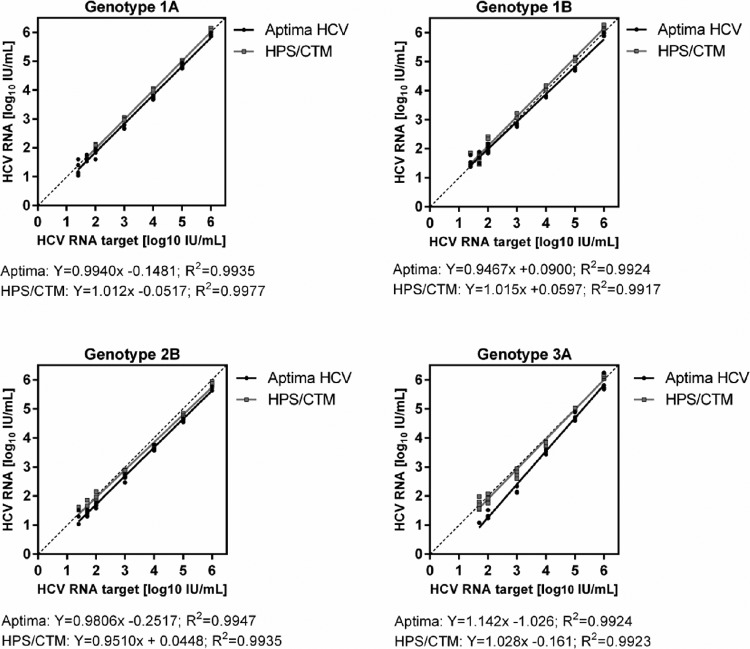
Quantitating the level of hepatitis C virus (HCV) RNA is the standard of care for monitoring HCV-infected patients during treatment. The performances of commercially available assays differ for precision, limit of detection, and limit of quantitation (LOQ). Here, we compare the performance of the Hologic Aptima HCV Quant Dx assay (Aptima) to that of the Roche Cobas TaqMan HCV test, version 2.0, using the High Pure system (HPS/CTM), considered a reference assay since it has been used in trials defining clinical decision points in patient care. The assays' performance characteristics were assessed using HCV RNA reference panels and plasma/serum from chronically HCV-infected patients. The agreement between the assays for the 3 reference panels was good, with a difference in quantitation values of <0.5 log. High concordance was demonstrated between the assays for 245 clinical samples (kappa = 0.80; 95% confidence interval [CI], 0.720 to 0.881); however, Aptima detected and/or quantitated 20 samples that HPS/CTM did not detect, while Aptima did not detect 1 sample that was quantitated by HPS/CTM. For the 165 samples quantitated by both assays, the values were highly correlated (R= 0.98;P< 0.0001). The linearity of quantitation from concentrations of 1.4 to 6 log was excellent for both assays for all HCV genotypes (GT) tested (GT 1a, 1b, 2b, and 3a) (R(2)> 0.99). The assays had similar levels of total and intra-assay variability across all genotypes at concentrations from 1,000 to 25 IU/ml. Aptima had a greater analytical sensitivity, quantitating more than 50% of replicates at 25-IU/ml target. Aptima showed performance characteristics comparable to those of HPS/CTM and increased sensitivity, making it suitable for use as a clinical diagnostic tool on the fully automated Panther platform.
定量丙型肝炎病毒(HCV)RNA水平是治疗期间监测HCV感染患者的标准治疗方法。市售检测方法在精密度、检测限和定量限(LOQ)方面表现各异。在此,我们将Hologic Aptima HCV Quant Dx检测法(Aptima)与罗氏Cobas TaqMan HCV检测法2.0版(使用高纯系统,即HPS/CTM)的性能进行比较,HPS/CTM被视为参考检测法,因为它已用于确定患者治疗临床决策点的试验中。使用HCV RNA参考品组以及慢性HCV感染患者的血浆/血清评估检测方法的性能特征。两种检测方法对3个参考品组的定量结果一致性良好,定量值差异<0.5个对数。两种检测方法对245份临床样本的结果高度一致(kappa = 0.80;95%置信区间[CI],0.720至0.881);然而,Aptima检测和/或定量了20份HPS/CTM未检测到的样本,而Aptima未检测到1份HPS/CTM定量的样本。对于两种检测方法都定量的165份样本,其数值高度相关(R = 0.98;P<0.0001)。对于所有测试的HCV基因型(GT 1a、1b、2b和3a),两种检测方法在1.4至6个对数浓度范围内的定量线性均极佳(R²>0.99)。在1000至25 IU/ml浓度范围内,两种检测方法在所有基因型中的总变异和批内变异水平相似。Aptima具有更高的分析灵敏度,在25 IU/ml靶标浓度下,超过50%的重复样本可被定量。Aptima的性能特征与HPS/CTM相当且灵敏度更高,使其适合在全自动Panther平台上用作临床诊断工具。