Li Yue, Hu Zhongzhou, Bai Chujie, Liu Jie, Zhang Tao, Ge Yangyang, Luan Shaoliang, Guo Wei
Department of Vascular Surgery, General Hospital of People's Liberation Army, Beijing 100853, China.
Medical Center Tsinghua University, Beijing, China.
Sci Rep. 2016 Feb 12;6:20497. doi: 10.1038/srep20497.
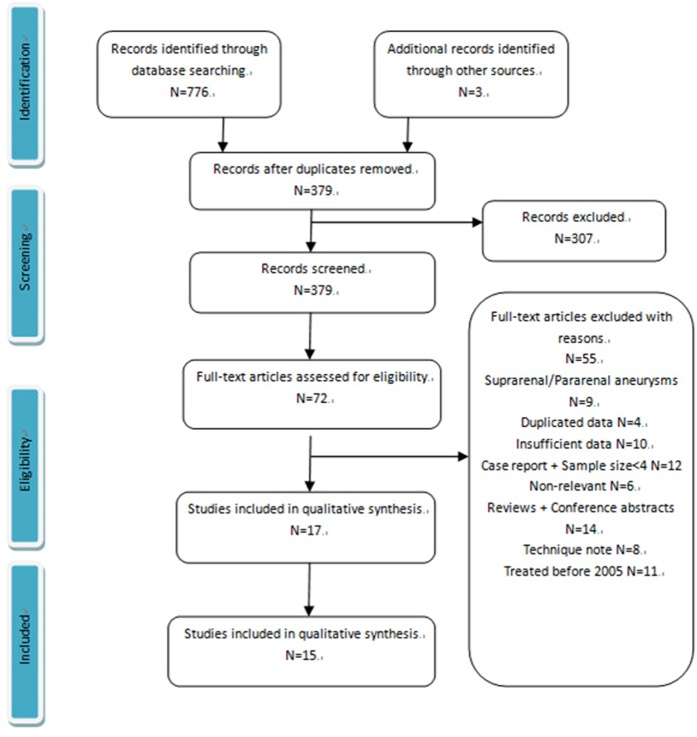
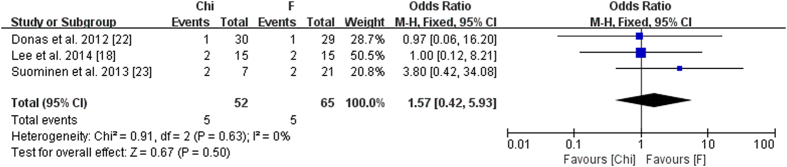
Juxtarenal aortic aneurysms (JAA) account for approximately 15% of abdominal aortic aneurysms. Fenestrated endovascular aneurysm repair (FEVAR) and chimney endovascular aneurysm repair (CH-EVAR) are both effective methods to treat JAAs, but the comparative effectiveness of these treatment modalities is unclear. We searched the PubMed, Medline, Embase, and Cochrane databases to identify English language articles published between January 2005 and September 2013 on management of JAA with fenestrated and chimney techniques to conduct a systematic review to compare outcomes of patients with juxtarenal aortic aneurysm (JAA) treated with the two techniques. We compared nine F-EVAR cohort studies including 542 JAA patients and 8 CH-EVAR cohorts with 158 JAA patients regarding techniques success rates, 30-day mortality, late mortality, endoleak events and secondary intervention rates. The results of this systematic review indicate that both fenestrated and chimney techniques are attractive options for JAAs treatment with encouraging early and mid-term outcomes.
肾旁主动脉瘤(JAA)约占腹主动脉瘤的15%。开窗式腔内动脉瘤修复术(FEVAR)和烟囱式腔内动脉瘤修复术(CH-EVAR)都是治疗JAA的有效方法,但这些治疗方式的相对有效性尚不清楚。我们检索了PubMed、Medline、Embase和Cochrane数据库,以识别2005年1月至2013年9月期间发表的关于采用开窗和烟囱技术治疗JAA的英文文章,进行系统评价,以比较采用这两种技术治疗的肾旁主动脉瘤(JAA)患者的结局。我们比较了9项F-EVAR队列研究(包括542例JAA患者)和8项CH-EVAR队列研究(包括158例JAA患者)的技术成功率、30天死亡率、晚期死亡率、内漏事件和二次干预率。该系统评价的结果表明,开窗技术和烟囱技术对于治疗JAA都是有吸引力的选择,其早期和中期结局令人鼓舞。