Oostra Kristine M, Van Bladel Anke, Vanhoonacker Ann C L, Vingerhoets Guy
Department of Physical and Rehabilitation Medicine, Ghent University Hospital Ghent, Belgium.
Department of Rehabilitation Sciences and Physiotherapy, Ghent University Ghent, Belgium.
Front Behav Neurosci. 2016 Feb 1;10:5. doi: 10.3389/fnbeh.2016.00005. eCollection 2016.
Mental practice with motor imagery has been shown to promote motor skill acquisition in healthy subjects and patients. Although lesions of the common motor imagery and motor execution neural network are expected to impair motor imagery ability, functional equivalence appears to be at least partially preserved in stroke patients.
To identify brain regions that are mandatory for preserved motor imagery ability after stroke.
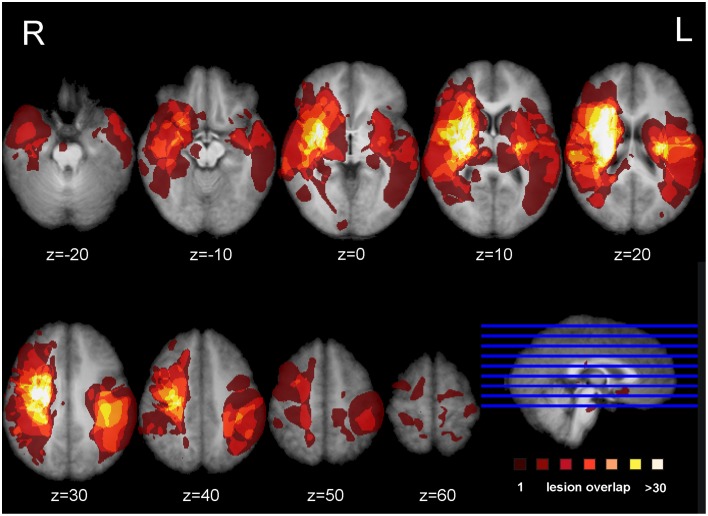
Thirty-seven patients with hemiplegia after a first time stroke participated. Motor imagery ability was measured using a Motor Imagery questionnaire and temporal congruence test. A voxelwise lesion symptom mapping approach was used to identify neural correlates of motor imagery in this cohort within the first year post-stroke.
Poor motor imagery vividness was associated with lesions in the left putamen, left ventral premotor cortex and long association fibers linking parieto-occipital regions with the dorsolateral premotor and prefrontal areas. Poor temporal congruence was otherwise linked to lesions in the more rostrally located white matter of the superior corona radiata.
This voxel-based lesion symptom mapping study confirms the association between white matter tract lesions and impaired motor imagery ability, thus emphasizing the importance of an intact fronto-parietal network for motor imagery. Our results further highlight the crucial role of the basal ganglia and premotor cortex when performing motor imagery tasks.
运动想象的心理练习已被证明可促进健康受试者和患者的运动技能习得。尽管常见的运动想象和运动执行神经网络受损预计会损害运动想象能力,但功能等效性在中风患者中似乎至少部分得以保留。
确定中风后保留运动想象能力所必需的脑区。
37例首次中风后偏瘫患者参与研究。使用运动想象问卷和时间一致性测试来测量运动想象能力。采用体素病变症状映射方法,在中风后第一年内确定该队列中运动想象的神经关联。
运动想象生动性差与左侧壳核、左侧腹侧运动前区皮质以及连接顶枕区与背外侧运动前区和前额叶区域的长联合纤维病变有关。时间一致性差则与更靠前的放射冠上部白质病变有关。
这项基于体素的病变症状映射研究证实了白质束病变与运动想象能力受损之间的关联,从而强调了完整的额顶网络对运动想象的重要性。我们的结果进一步凸显了基底神经节和运动前区皮质在执行运动想象任务时的关键作用。