Liang Shuang, Kisseleva Tatiana, Brenner David A
Department of Surgery, University of California, San DiegoLa Jolla, CA, USA; Department of Medicine, University of California, San DiegoLa Jolla, CA, USA.
Department of Surgery, University of California, San Diego La Jolla, CA, USA.
Front Physiol. 2016 Feb 2;7:17. doi: 10.3389/fphys.2016.00017. eCollection 2016.
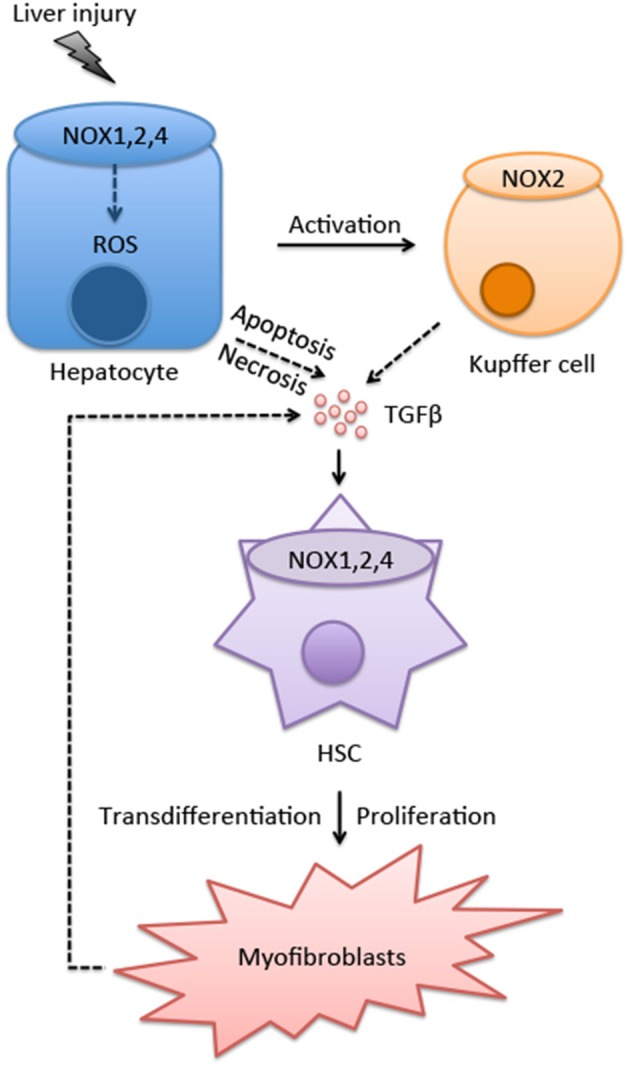
Chronic liver injury, resulted from different etiologies (e.g., virus infection, alcohol abuse, nonalcoholic steatohepatitis (NASH) and cholestasis) can lead to liver fibrosis characterized by the excess accumulation of extracellular matrix (ECM) proteins (e.g., type I collagen). Hepatic myofibroblasts that are activated upon liver injury are the key producers of ECM proteins, contributing to both the initiation and progression of liver fibrosis. Hepatic stellate cells (HSCs) and to a lesser extent, portal fibroblast, are believed to be the precursor cells that give rise to hepatic myofibroblasts in response to liver injury. Although, much progress has been made toward dissecting the lineage origin of myofibroblasts, how these cells are activated and become functional producers of ECM proteins remains incompletely understood. Activation of myofibroblasts is a complex process that involves the interactions between parenchymal and non-parenchymal cells, which drives the phenotypic change of HSCs from a quiescent stage to a myofibroblastic and active phenotype. Accumulating evidence has suggested a critical role of NADPH oxidase (NOX), a multi-component complex that catalyzes reactions from molecular oxygen to reactive oxygen species (ROS), in the activation process of hepatic myofibroblasts. NOX isoforms, including NOX1, NOX2 and NOX4, and NOX-derived ROS, have all been implicated to regulate HSC activation and hepatocyte apoptosis, both of which are essential steps for initiating liver fibrosis. This review highlights the importance of NOX isoforms in hepatic myofibroblast activation and the progression of liver fibrosis, and also discusses the therapeutic potential of targeting NOXs for liver fibrosis and associated hepatic diseases.
由不同病因(如病毒感染、酒精滥用、非酒精性脂肪性肝炎(NASH)和胆汁淤积)导致的慢性肝损伤可引发肝纤维化,其特征是细胞外基质(ECM)蛋白(如I型胶原蛋白)过度积累。肝损伤时被激活的肝肌成纤维细胞是ECM蛋白的主要产生者,在肝纤维化的起始和进展过程中均发挥作用。肝星状细胞(HSCs)以及程度较轻的门周成纤维细胞被认为是肝损伤时产生肝肌成纤维细胞的前体细胞。尽管在剖析肌成纤维细胞的谱系起源方面已取得很大进展,但这些细胞如何被激活并成为ECM蛋白的功能性产生者仍未完全明确。肌成纤维细胞的激活是一个复杂过程,涉及实质细胞和非实质细胞之间的相互作用,这促使肝星状细胞从静止状态转变为肌成纤维细胞和活跃表型。越来越多的证据表明,NADPH氧化酶(NOX)在肝肌成纤维细胞的激活过程中起关键作用,NOX是一种多组分复合物,可催化从分子氧到活性氧(ROS)的反应。包括NOX1、NOX2和NOX4在内的NOX亚型以及NOX衍生的ROS均被认为可调节肝星状细胞激活和肝细胞凋亡,这两个过程都是启动肝纤维化的关键步骤。本综述强调了NOX亚型在肝肌成纤维细胞激活和肝纤维化进展中的重要性,并讨论了针对NOX治疗肝纤维化及相关肝脏疾病的潜力。