Sluiter N R, de Cuba E M V, Kwakman R, Meijerink W J H J, Delis-van Diemen P M, Coupé V M H, Beliën J A M, Meijer G A, de Hingh I H J T, te Velde E A
Section of Surgical Oncology and Digestive Surgery, Department of General Surgery, VU University Medical Centre, De Boelelaan 1117, 1081 HV, Amsterdam, The Netherlands.
Department of Pathology, VU University Medical Centre, De Boelelaan 1117, 1081 HV, Amsterdam, The Netherlands.
Clin Exp Metastasis. 2016 Apr;33(4):297-307. doi: 10.1007/s10585-016-9779-9. Epub 2016 Feb 12.
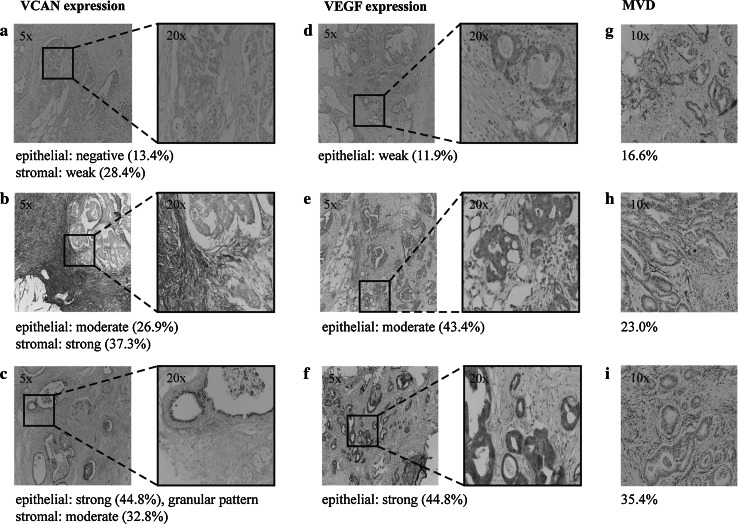
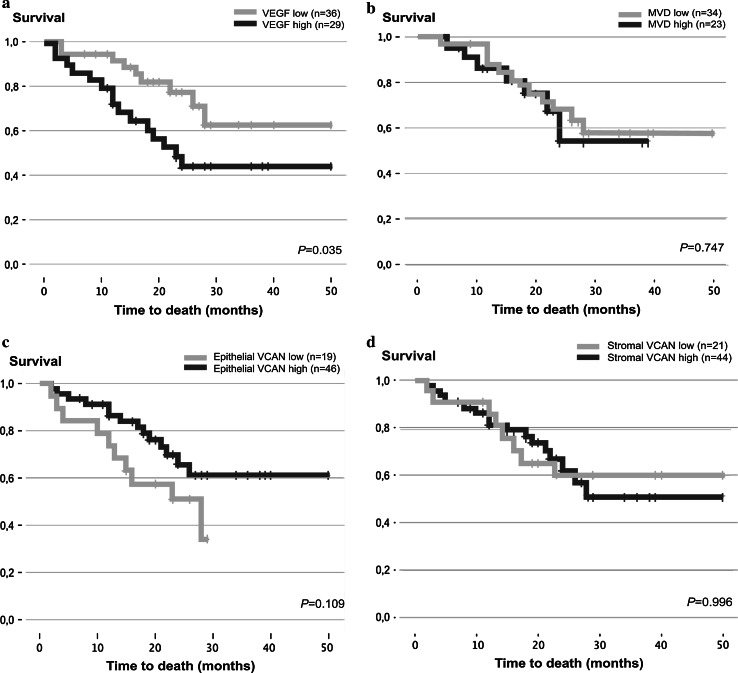
Cytoreductive surgery (CRS) and hyperthermic intraperitoneal chemotherapy (HIPEC) can increase survival of colorectal cancer (CRC) patients with peritoneal metastases (PM). This treatment is associated with high morbidity and mortality rates. Therefore, improvement of patient selection is necessary. Assuming that the clinical phenotype is dictated by biological mechanisms, biomarkers could play a crucial role in this process. Since it is unknown whether and to what extent angiogenesis influences the course of disease in patients with PM, we investigated the expression of two angiogenesis-related markers and their relation to overall survival (OS) in CRC patients after CRS and HIPEC. Clinicopathological data and tissue samples were collected from 65 CRC patients with isolated metastases to the peritoneum that underwent CRS and HIPEC. Whole tissue specimens from PM were evaluated for versican (VCAN) expression, VEGF expression and microvessel density (MVD) by immunohistochemistry. The relation between these markers and OS was assessed using univariate and multivariate analysis. Associations between VEGF expression, VCAN expression, MVD and clinicopathological data were tested. High stromal VCAN expression was associated with high MVD (p = 0.001), better resection outcome (p = 0.003) and high T-stage (p = 0.027). High epithelial VCAN expression was associated with MVD (p = 0.007) and a more complete resection (p < 0.001). In multivariate analysis, simplified peritoneal cancer index (p = 0.001), VEGF expression levels (p = 0.012), age (p = 0.030), epithelial VCAN expression levels (p = 0.042) and lymph node status (p = 0.053) were associated with OS. Concluding, VCAN and VEGF were associated with survival in CRC patients with PM after CRS and HIPEC. Independent validation in a well-defined patient cohort is required to confirm the putative prognostic role of these candidate biomarkers.
减瘤手术(CRS)和热灌注化疗(HIPEC)可提高伴有腹膜转移(PM)的结直肠癌(CRC)患者的生存率。这种治疗与高发病率和死亡率相关。因此,有必要改进患者的选择。假设临床表型由生物学机制决定,生物标志物可能在这一过程中发挥关键作用。由于尚不清楚血管生成是否以及在何种程度上影响PM患者的疾病进程,我们研究了两种血管生成相关标志物的表达及其与CRS和HIPEC术后CRC患者总生存期(OS)的关系。收集了65例接受CRS和HIPEC且腹膜有孤立转移的CRC患者的临床病理数据和组织样本。通过免疫组织化学评估PM的全组织标本中多功能蛋白聚糖(VCAN)表达、血管内皮生长因子(VEGF)表达和微血管密度(MVD)。使用单因素和多因素分析评估这些标志物与OS的关系。测试了VEGF表达、VCAN表达、MVD与临床病理数据之间的关联。高基质VCAN表达与高MVD(p = 0.001)、更好的切除结果(p = 0.003)和高T分期(p = 0.027)相关。高上皮VCAN表达与MVD(p = 0.007)和更完整的切除(p < 0.001)相关。在多因素分析中,简化腹膜癌指数(p = 0.001)、VEGF表达水平(p = 0.012)、年龄(p = 0.030)、上皮VCAN表达水平(p = 0.042)和淋巴结状态(p = 0.053)与OS相关。结论是,CRS和HIPEC术后,VCAN和VEGF与伴有PM的CRC患者的生存相关。需要在明确界定的患者队列中进行独立验证,以确认这些候选生物标志物的假定预后作用。