Department of Surgery, VU University Medical Center, Amsterdam, The Netherlands.
Department of Surgery, Catharina Hospital Eindhoven, Eindhoven, The Netherlands.
Ann Surg Oncol. 2018 Aug;25(8):2347-2356. doi: 10.1245/s10434-018-6539-x. Epub 2018 May 31.
Cytoreduction and hyperthermic intraperitoneal chemotherapy (HIPEC) improve the survival of colorectal cancer (CRC) patients with peritoneal metastases. Patient selection is key since this treatment is associated with high morbidity. Patients with peritoneal recurrence within 1 year after previous adjuvant chemotherapy are thought to benefit less from HIPEC treatment; however, no published data are available to assist in clinical decision making. This study assessed whether peritoneal recurrence within 1 year after adjuvant chemotherapy was associated with survival after HIPEC treatment.
Peritoneal recurrence within 1 year after adjuvant chemotherapy, as well as other potentially prognostic clinical and pathological variables, were tested in univariate and multivariate analysis for correlation with primary outcomes, i.e. overall survival (OS) and disease-free survival (DFS). Two prospectively collected databases from the VU University Medical Center Amsterdam and Catherina Hospital Eindhoven containing 345 CRC patients treated with the intent of HIPEC were utilized.
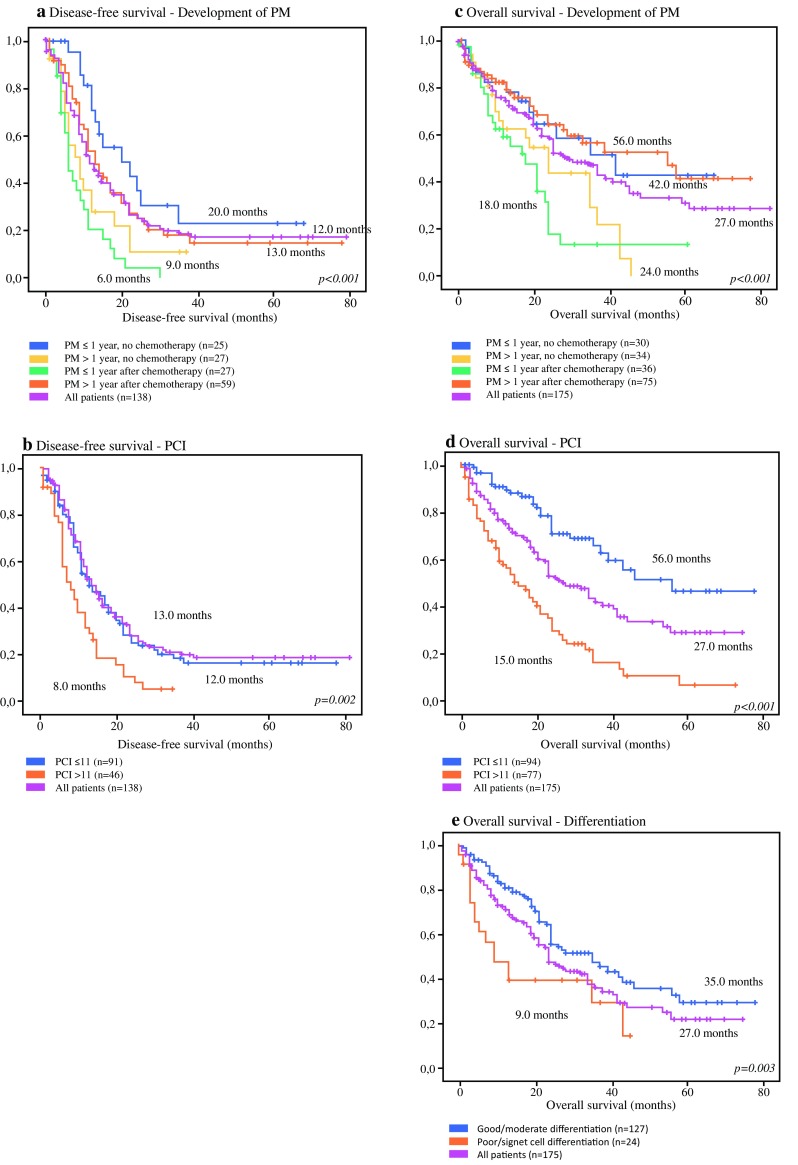
High Peritoneal Cancer Index (PCI) scores were associated with worse DFS [hazard ratio (HR) 1.04, 95% confidence interval (CI) 1.00-1.08, p = 0.040] and OS (HR 1.11, 95% CI 1.07-1.15, p < 0.001) in multivariate analysis. Furthermore, patients with peritoneal recurrence within 1 year following adjuvant chemotherapy had worse DFS (HR 2.13, 95% CI 1.26-3.61, p = 0.005) and OS (HR 2.76, 95% CI 1.45-5.27, p = 0.002) than patients who did not receive adjuvant chemotherapy or patients with peritoneal recurrence after 1 year.
Peritoneal recurrence within 1 year after previous adjuvant chemotherapy, as well as high PCI scores, are associated with poor survival after cytoreduction and HIPEC. These factors should be considered in order to avoid high-morbidity treatment in patients who might not benefit from such treatment.
减瘤术和腹腔内热化疗(HIPEC)可提高结直肠癌(CRC)伴腹膜转移患者的生存率。由于该治疗方法与高发病率相关,因此患者选择是关键。有研究认为,在接受辅助化疗后 1 年内发生腹膜复发的患者从 HIPEC 治疗中获益较少;然而,目前尚无相关数据可用于辅助临床决策。本研究旨在评估辅助化疗后 1 年内腹膜复发与 HIPEC 治疗后生存的相关性。
在单因素和多因素分析中,我们检测了辅助化疗后 1 年内发生腹膜复发以及其他可能具有预后意义的临床和病理变量与主要结局(即总生存期(OS)和无病生存期(DFS))之间的相关性。我们使用了阿姆斯特丹 VU 大学医学中心和埃因霍温 Catherina 医院两个前瞻性收集的数据库,其中包含 345 例接受 HIPEC 治疗意向的 CRC 患者。
高腹膜肿瘤指数(PCI)评分与较差的 DFS(风险比(HR)1.04,95%置信区间(CI)1.00-1.08,p=0.040)和 OS(HR 1.11,95%CI 1.07-1.15,p<0.001)显著相关。此外,与未接受辅助化疗或辅助化疗后 1 年以上发生腹膜复发的患者相比,辅助化疗后 1 年内发生腹膜复发的患者的 DFS(HR 2.13,95%CI 1.26-3.61,p=0.005)和 OS(HR 2.76,95%CI 1.45-5.27,p=0.002)更差。
辅助化疗后 1 年内发生腹膜复发以及高 PCI 评分与减瘤术和 HIPEC 后生存率差相关。在为患者选择治疗方案时应考虑这些因素,以避免对可能无法从该治疗中获益的患者采用高发病率的治疗方案。