Motohashi Hideyuki H, Ishibashi Hidetoshi
Department of Neurophysiology, National Institute of Neuroscience (NIN), National Center for Neurology and Psychiatry (NCNP), 4-1-1 Ogawa-Higashi, Kodaira, Tokyo 187-8502, Japan.
Exp Anim. 2016 Jul 29;65(3):189-96. doi: 10.1538/expanim.15-0097. Epub 2016 Feb 15.
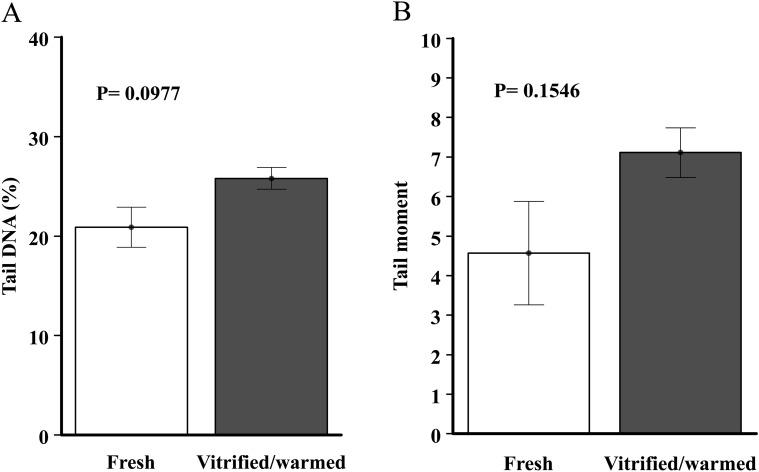
The ovary of neonatal nonhuman primates contains the highest number of immature oocytes, but its cryopreservation has not yet been sufficiently investigated in all life stages. In the current study, we investigated cryodamage after vitrification/warming of neonatal ovaries from a nonhuman primate, the common marmoset (Callithrix jacchus). A Cryotop was used for cryopreservation of whole ovaries. The morphology of the vitrified/warmed ovaries was found to be equivalent to that of fresh ovaries. No significant difference in the number of oocytes retaining normal morphology per unit area in histological sections was found between the two groups. In an analysis of dispersed cells from the ovaries, however, the cell viability of the vitrified/warmed group tended to be decreased. The results of a comet assay showed no significant differences in DNA damage. These results show that cryopreservation of neonatal marmoset ovaries using vitrification may be useful as a storage system for whole ovaries.
新生非人灵长类动物的卵巢中含有数量最多的未成熟卵母细胞,但其在所有生命阶段的冷冻保存尚未得到充分研究。在本研究中,我们调查了普通狨猴(Callithrix jacchus)这种非人灵长类动物新生卵巢玻璃化/复温后的冷冻损伤情况。使用Cryotop对整个卵巢进行冷冻保存。发现玻璃化/复温后的卵巢形态与新鲜卵巢相当。两组在组织学切片中每单位面积保留正常形态的卵母细胞数量上未发现显著差异。然而,在对卵巢分散细胞的分析中,玻璃化/复温组的细胞活力有下降趋势。彗星试验结果显示DNA损伤无显著差异。这些结果表明,使用玻璃化法冷冻保存新生狨猴卵巢作为整个卵巢的储存系统可能是有用的。