Department of Internal Medicine, College of Medicine, Dong-A University Medical School, Busan, Korea.
Kidney Res Clin Pract. 2013 Dec;32(4):158-63. doi: 10.1016/j.krcp.2013.09.002. Epub 2013 Nov 2.
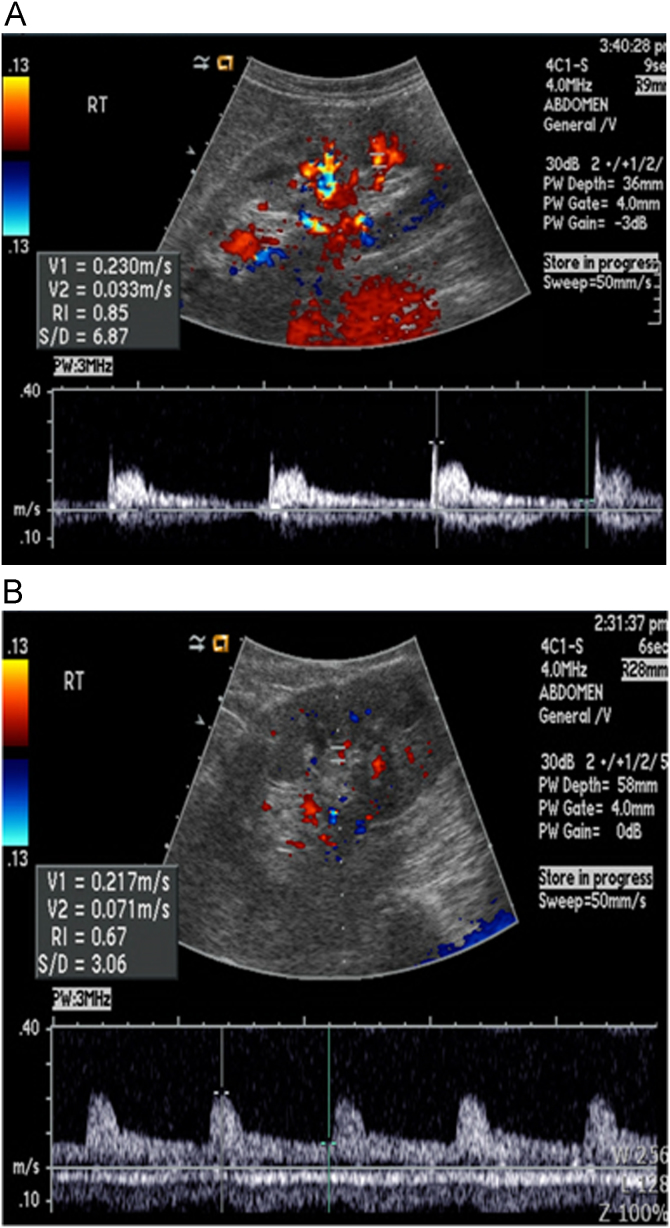
Angiotensin converting enzyme (ACE) inhibitor and angiotensin receptor blocker (ARB) may induce acute kidney injury (AKI). The aim of this study was to evaluate the role of the resistive index (RI), which reflects renal artery resistance on renal duplex ultrasonography, as a predictor of AKI in chronic kidney disease (CKD) patients who are prescribed an ACE inhibitor or ARB.
We screened 105 CKD patients evaluated with renal duplex ultrasonography from 2008 to 2012. We excluded patients not treated with ACE inhibitor or ARB and diagnosed with renal artery stenosis. Finally, we retrospectively analyzed the medical records of 54 patients. AKI was defined as increased serum creatinine by >30% compared with baseline after starting ACE inhibitor or ARB treatment.
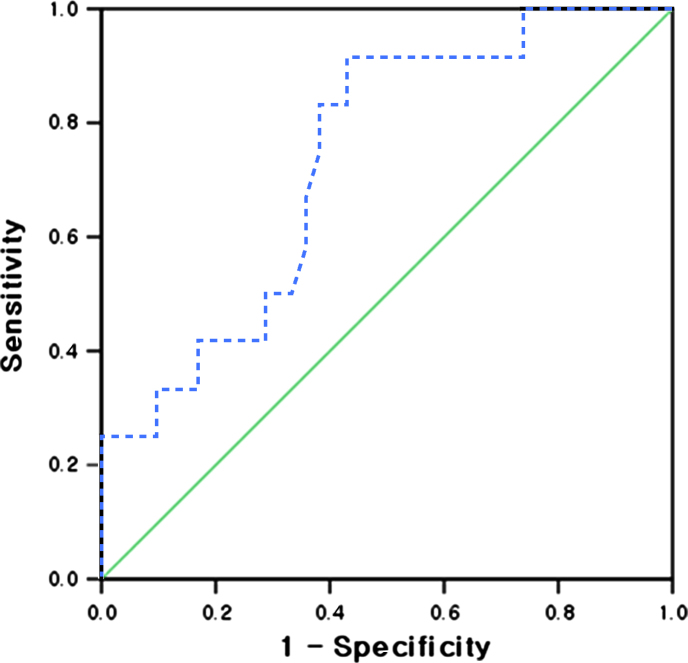
The mean age of the patients was 60.5±13.0 years, serum creatinine level was 1.85±0.85 mg/dL and 22.2% of the patients had AKI after the use of an ACE inhibitor or ARB. The RI (P=0.006) and the percentages of patients with diabetes (P=0.008) and using diuretics (P=0.046) were higher in the AKI group. The area under the receiver operating characteristics curve for the prediction of AKI was 0.736 (95% confidence interval=0.587-0.885, P=0.013), and RI≥0.80 predicted AKI with 83.3% sensitivity and 61.9% specificity. In the multivariate analysis, RI≥0.80 was an independent prognostic factor [Exp (B)=8.03, 95% confidence interval=1.14-56.74, P=0.037] for AKI.
RI≥0.80 on the renal duplex ultrasonography may be a helpful predictor for AKI in CKD patients who are prescribed an ACE inhibitor or ARB.
血管紧张素转换酶(ACE)抑制剂和血管紧张素受体阻滞剂(ARB)可能会引起急性肾损伤(AKI)。本研究旨在评估肾双功超声检查中反映肾动脉阻力的阻力指数(RI)作为接受 ACE 抑制剂或 ARB 治疗的慢性肾脏病(CKD)患者发生 AKI 的预测指标的作用。
我们筛选了 2008 年至 2012 年期间接受肾双功超声检查的 105 例 CKD 患者。我们排除了未接受 ACE 抑制剂或 ARB 治疗且诊断为肾动脉狭窄的患者。最后,我们回顾性分析了 54 例患者的病历。AKI 的定义为 ACE 抑制剂或 ARB 治疗后血清肌酐较基线增加>30%。
患者的平均年龄为 60.5±13.0 岁,血清肌酐水平为 1.85±0.85mg/dL,22.2%的患者在使用 ACE 抑制剂或 ARB 后发生 AKI。AKI 组的 RI(P=0.006)和糖尿病患者比例(P=0.008)以及使用利尿剂的患者比例(P=0.046)较高。预测 AKI 的受试者工作特征曲线下面积为 0.736(95%置信区间=0.587-0.885,P=0.013),RI≥0.80 预测 AKI 的敏感性为 83.3%,特异性为 61.9%。多因素分析显示,RI≥0.80 是 AKI 的独立预后因素[Exp(B)=8.03,95%置信区间=1.14-56.74,P=0.037]。
肾双功超声检查中 RI≥0.80 可能有助于预测接受 ACE 抑制剂或 ARB 治疗的 CKD 患者发生 AKI。