Goloudina Anastasia R, Kochetkova Elena Y, Pospelova Tatyana V, Demidov Oleg N
INSERM UMR 866, University of Burgundy, Dijon, France.
Institute of Cytology, RAS, St. Petersburg, Russia.
Oncotarget. 2016 May 24;7(21):31563-71. doi: 10.18632/oncotarget.7325.
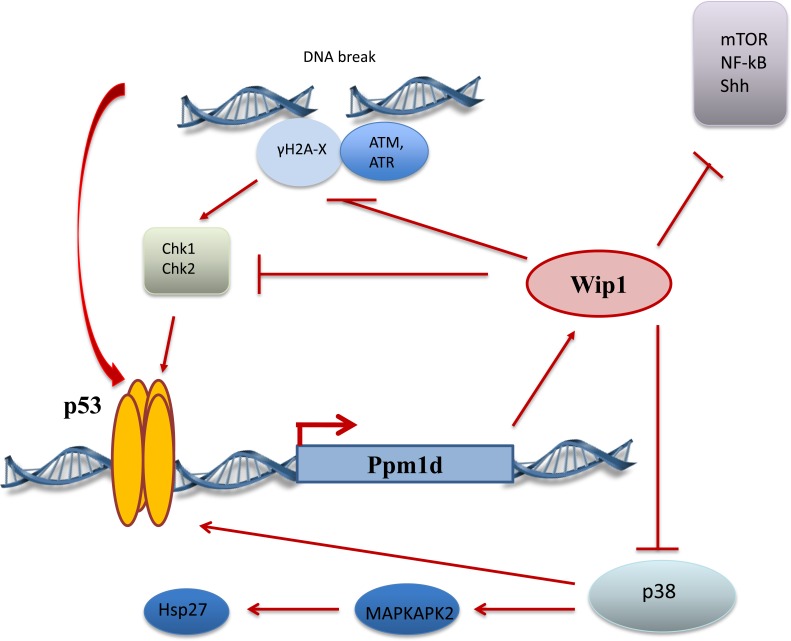
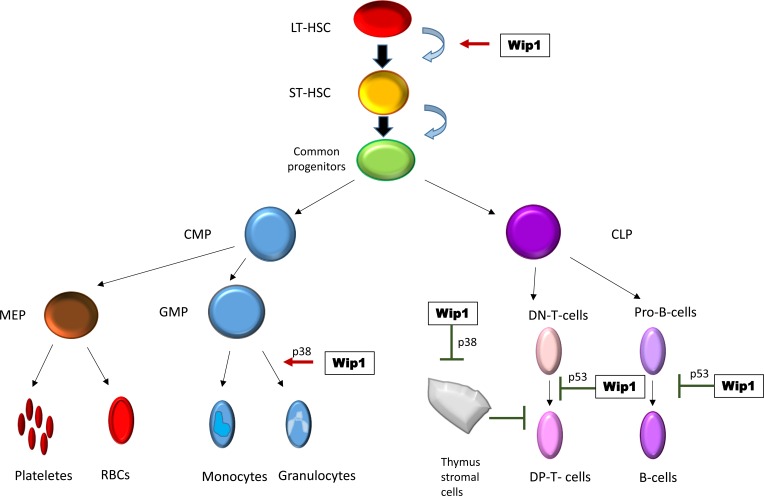
Cells undergoing oncogenic transformation frequently inactivate tumor suppressor pathways that could prevent their uncontrolled growth. Among those pathways p53 and p38MAPK pathways play a critical role in regulation of cell cycle, senescence and cell death in response to activation of oncogenes, stress and DNA damage. Consequently, these two pathways are important in determining the sensitivity of tumor cells to anti-cancer treatment. Wild type p53-induced phosphatase, Wip1, is involved in governance of both pathways. Recently, strategies directed to manipulation with Wip1 activity proposed to advance current day anticancer treatment and novel chemical compounds synthesized to improve specificity of manipulation with Wip1 activity. Here we reviewed the history of Wip1 studies in vitro and in vivo, in genetically modified animal models that support Wip1 role in tumorigenesis through regulation of p53 and p38MAPK pathways. Based on our knowledge we propose several recommendations for future more accurate studies of Wip1 interactions with other pathways involved in tumorigenesis using recently developed tools and for adoption of Wip1 manipulation strategies in anti-cancer therapy.
经历致癌转化的细胞常常会使那些能够阻止其不受控制生长的肿瘤抑制途径失活。在这些途径中,p53和p38丝裂原活化蛋白激酶(p38MAPK)途径在响应癌基因激活、应激和DNA损伤时对细胞周期、衰老和细胞死亡的调控中发挥关键作用。因此,这两条途径对于确定肿瘤细胞对抗癌治疗的敏感性很重要。野生型p53诱导的磷酸酶Wip1参与这两条途径的调控。最近,旨在调控Wip1活性的策略被提出以推进当前的抗癌治疗,并合成了新型化合物以提高对Wip1活性调控的特异性。在此,我们回顾了在体外和体内、在转基因动物模型中进行的Wip1研究历程,这些研究通过调控p53和p38MAPK途径支持了Wip1在肿瘤发生中的作用。基于我们的知识,我们提出了一些建议,以便未来使用最近开发的工具更准确地研究Wip1与肿瘤发生中涉及的其他途径的相互作用,并在抗癌治疗中采用Wip1调控策略。