Whitty Adrian, Zhong Mengqi, Viarengo Lauren, Beglov Dmitri, Hall David R, Vajda Sandor
Department of Chemistry, Boston University, Boston, MA, USA.
Department of Chemistry, Boston University, Boston, MA, USA.
Drug Discov Today. 2016 May;21(5):712-7. doi: 10.1016/j.drudis.2016.02.005. Epub 2016 Feb 15.
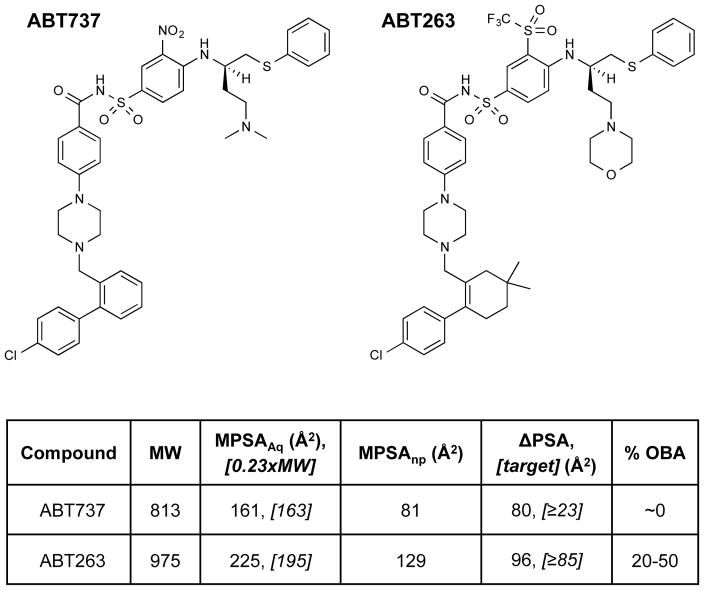
Key to the pharmaceutical utility of certain macrocyclic drugs is a 'chameleonic' ability to change their conformation to expose polar groups in aqueous solution, but bury them when traversing lipid membranes. Based on analysis of the structures of 20 macrocyclic compounds that are approved oral drugs, we propose that good solubility requires a topological polar surface area (TPSA, in Å(2)) of ≥0.2×molecular weight (MW). Meanwhile, good passive membrane permeability requires a molecular (i.e., 3D) PSA in nonpolar environments of ≤140Å(2). We show that one or other of these limits is almost invariably violated for compounds with MW>600Da, suggesting that some degree of chameleonic behavior is required for most high MW oral drugs.
某些大环药物具有药物效用的关键在于其“变色龙般的”能力,即在水溶液中改变构象以暴露极性基团,但在穿过脂质膜时将它们隐藏起来。基于对20种已获批口服大环化合物结构的分析,我们提出良好的溶解性要求拓扑极性表面积(TPSA,单位为Ų)≥0.2×分子量(MW)。同时,良好的被动膜通透性要求在非极性环境中的分子(即三维)PSA≤140Ų。我们发现,对于分子量>600Da的化合物,几乎总是违反这些限制中的一个或另一个,这表明大多数高分子量口服药物需要某种程度的变色龙行为。