Punt Simone, Dronkers Emilie A C, Welters Marij J P, Goedemans Renske, Koljenović Senada, Bloemena Elisabeth, Snijders Peter J F, Gorter Arko, van der Burg Sjoerd H, Baatenburg de Jong Robert J, Jordanova Ekaterina S
Department of Pathology, Leiden University Medical Center (LUMC), P.O. Box 9600, 2300 RC, Leiden, The Netherlands.
Department of Otorhinolaryngology and Head and Neck Surgery, Erasmus University Medical Center, Rotterdam, The Netherlands.
Cancer Immunol Immunother. 2016 Apr;65(4):393-403. doi: 10.1007/s00262-016-1805-x. Epub 2016 Feb 22.
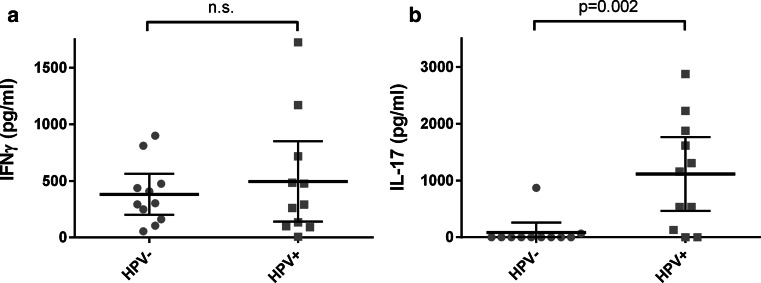
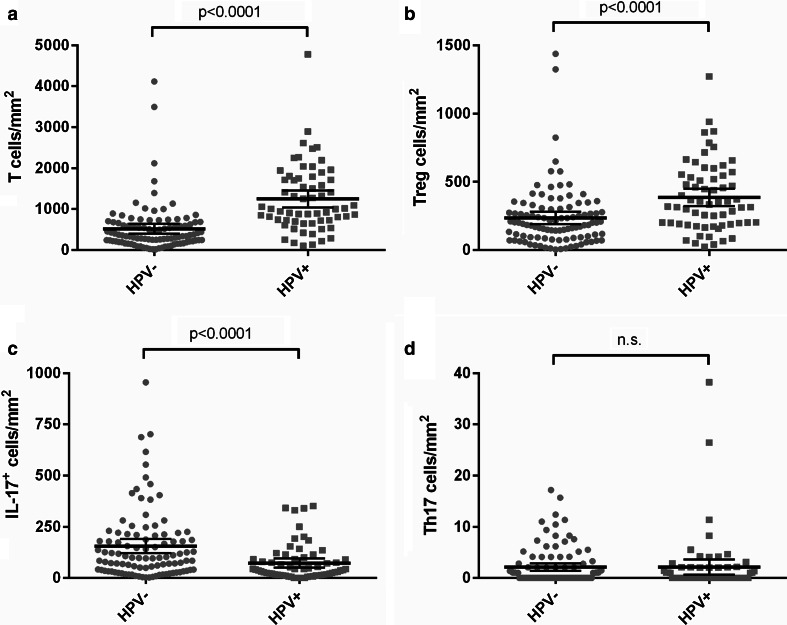
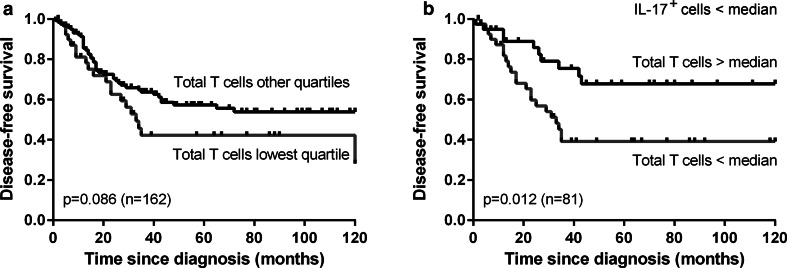
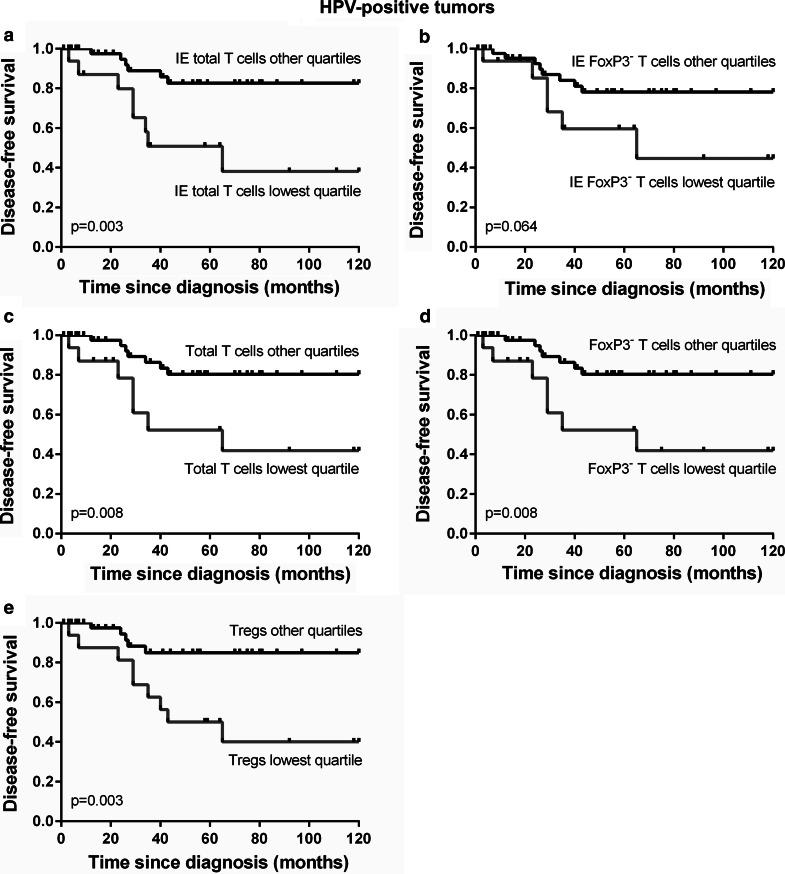
Patients with HPV-positive oropharyngeal squamous cell carcinomas (OPSCCs) have a better prognosis than patients with non-HPV-induced OPSCC. The role of the immune response in this phenomenon is yet unclear. We studied the number of T cells, regulatory T cells (Tregs), T helper 17 (Th17) cells and IL-17(+) non-T cells (mainly granulocytes) in matched HPV-positive and HPV-negative OPSCC cases (n = 162). Furthermore, the production of IFN-γ and IL-17 by tumor-infiltrating T cells was analyzed. The number of tumor-infiltrating T cells and Tregs was higher in HPV-positive than HPV-negative OPSCC (p < 0.0001). In contrast, HPV-negative OPSCC contained significantly higher numbers of IL-17(+) non-T cells (p < 0.0001). Although a high number of intra-tumoral T cells showed a trend toward improved survival of all OPSCC patients, their prognostic effect in patients with a low number of intra-tumoral IL-17(+) non-T cells was significant with regard to disease-specific (p = 0.033) and disease-free survival (p = 0.012). This suggests that a high frequency of IL-17(+) non-T cells was related to a poor immune response, which was further supported by the observation that a high number of T cells was correlated with improved disease-free survival in the HPV-positive OPSCC (p = 0.008). In addition, we detected a minor Th17 cell population. However, T cells obtained from HPV-positive OPSCC produced significantly more IL-17 than those from HPV-negative tumors (p = 0.006). The improved prognosis of HPV-positive OPSCC is thus correlated with higher numbers of tumor-infiltrating T cells, more active Th17 cells and lower numbers of IL-17(+) non-T cells.
人乳头瘤病毒(HPV)阳性的口咽鳞状细胞癌(OPSCC)患者的预后比非HPV诱导的OPSCC患者更好。免疫反应在这一现象中的作用尚不清楚。我们研究了配对的HPV阳性和HPV阴性OPSCC病例(n = 162)中T细胞、调节性T细胞(Tregs)、辅助性T细胞17(Th17)和IL-17(+)非T细胞(主要是粒细胞)的数量。此外,还分析了肿瘤浸润性T细胞产生的IFN-γ和IL-17。HPV阳性OPSCC中肿瘤浸润性T细胞和Tregs的数量高于HPV阴性OPSCC(p < 0.0001)。相反,HPV阴性OPSCC中IL-17(+)非T细胞的数量明显更高(p < 0.0001)。虽然大量肿瘤内T细胞显示出所有OPSCC患者生存率提高的趋势,但它们对肿瘤内IL-17(+)非T细胞数量较少的患者的预后影响在疾病特异性生存(p = 0.033)和无病生存方面具有显著意义(p = 0.012)。这表明IL-17(+)非T细胞的高频率与免疫反应不良有关,HPV阳性OPSCC中大量T细胞与无病生存率提高相关的观察结果进一步支持了这一点(p = 0.008)。此外,我们检测到少量Th17细胞群。然而,从HPV阳性OPSCC中获得的T细胞产生的IL-17明显多于HPV阴性肿瘤中的T细胞(p = 0.006)。因此,HPV阳性OPSCC预后的改善与肿瘤浸润性T细胞数量增加、Th17细胞更活跃以及IL-17(+)非T细胞数量减少相关。