Ngabo Fidele, Mvundura Mercy, Gazley Lauren, Gatera Maurice, Rugambwa Celse, Kayonga Eugene, Tuyishime Yvette, Niyibaho Jeanne, Mwenda Jason M, Donnen Philippe, Lepage Philippe, Binagwaho Agnes, Atherly Deborah
Université Libre de Bruxelles, Ecole de Santé Publique, Brussels, Belgium.
Ministry of Health, Rwanda Biomedical Center, Kigali, Rwanda.
PLoS One. 2016 Feb 22;11(2):e0149805. doi: 10.1371/journal.pone.0149805. eCollection 2016.
Diarrhea is one of the leading causes of childhood morbidity and mortality. Hospitalization for diarrhea can pose a significant burden to health systems and households. The objective of this study was to estimate the economic burden attributable to hospitalization for diarrhea among children less than five years old in Rwanda. These data can be used by decision-makers to assess the impact of interventions that reduce diarrhea morbidity, including rotavirus vaccine introduction.
This was a prospective costing study where medical records and hospital bills for children admitted with diarrhea at three hospitals were collected to estimate resource use and costs. Hospital length of stay was calculated from medical records. Costs incurred during the hospitalization were abstracted from the hospital bills. Interviews with the child's caregivers provided data to estimate household costs which included transport costs and lost income. The portion of medical costs borne by insurance and household were reported separately. Annual economic burden before and after rotavirus vaccine introduction was estimated by multiplying the reported number of diarrhea hospitalizations in public health centers and district hospitals by the estimated economic burden per hospitalization. All costs are presented in 2014 US$.
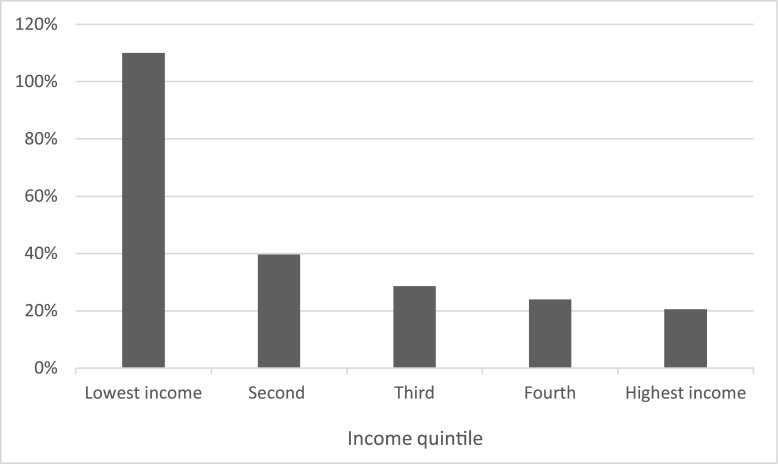
Costs for 203 children were analyzed. Approximately 93% of the children had health insurance coverage. Average hospital length of stay was 5.3 ± 3.9 days. Average medical costs for each child for the illness resulting in a hospitalization were $44.22 ± $23.74 and the total economic burden was $101, of which 65% was borne by the household. For households in the lowest income quintile, the household costs were 110% of their monthly income. The annual economic burden to Rwanda attributable to diarrhea hospitalizations ranged from $1.3 million to $1.7 million before rotavirus vaccine introduction.
Households often bear the largest share of the economic burden attributable to diarrhea hospitalization and the burden can be substantial, especially for households in the lowest income quintile.
腹泻是儿童发病和死亡的主要原因之一。因腹泻住院会给卫生系统和家庭带来沉重负担。本研究的目的是估计卢旺达五岁以下儿童因腹泻住院所产生的经济负担。决策者可利用这些数据评估减少腹泻发病率的干预措施的影响,包括引入轮状病毒疫苗。
这是一项前瞻性成本核算研究,收集了三家医院腹泻患儿的病历和住院账单,以估计资源使用情况和成本。住院时间根据病历计算。住院期间产生的费用从住院账单中提取。对儿童照料者的访谈提供了估计家庭成本的数据,其中包括交通成本和收入损失。分别报告了保险和家庭承担的医疗费用比例。通过将公共卫生中心和地区医院报告的腹泻住院病例数乘以每次住院的估计经济负担,来估计引入轮状病毒疫苗前后的年度经济负担。所有成本均以2014年美元表示。
分析了203名儿童的成本。约93%的儿童有医疗保险。平均住院时间为5.3±3.9天。导致住院的疾病,每名儿童的平均医疗费用为44.22美元±23.74美元,总经济负担为101美元,其中65%由家庭承担。对于收入最低的五分之一家庭,家庭成本是其月收入的110%。在引入轮状病毒疫苗之前,卢旺达因腹泻住院造成的年度经济负担在130万美元至170万美元之间。
家庭通常承担腹泻住院经济负担的最大份额,而且负担可能很大,特别是对于收入最低的五分之一家庭。