Tagawa Michihito, Maekawa Naoya, Konnai Satoru, Takagi Satoshi
Veterinary Medical Center, Department of Clinical Veterinary Science, Obihiro University of Agriculture and Veterinary Medicine, Obihiro, Hokkaido, Japan.
Department of Disease Control, Graduate School of Veterinary Medicine, Hokkaido University, Sappro, Hokkaido, Japan.
PLoS One. 2016 Feb 22;11(2):e0150030. doi: 10.1371/journal.pone.0150030. eCollection 2016.
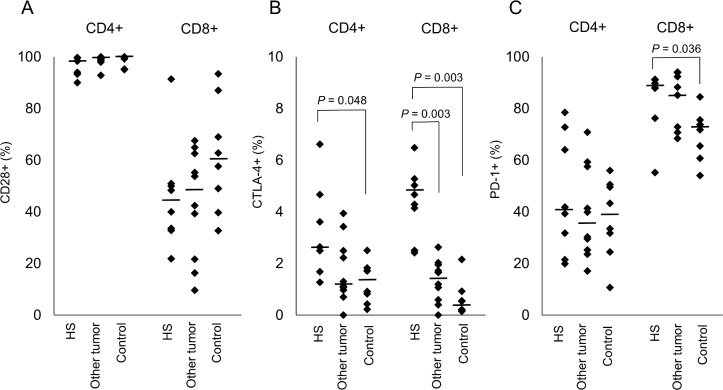
Histiocytic sarcoma is a rapidly progressive and fatal neoplastic disease in dogs. It is unclear whether costimulatory molecules, including CD28, cytotoxic T-lymphocyte-associated antigen-4 (CTLA-4), and programmed death-1 (PD-1), are expressed on peripheral blood lymphocytes (PBLs) of canine patients with histiocytic sarcoma. The objective of this study was to evaluate the expression of CD28, CTLA-4, and PD-1 molecules on PBLs of patients with histiocytic sarcoma, patients with other tumors, and healthy controls. Twenty-six dogs were included in the study, with eight, ten, and eight dogs in the histiocytic sarcoma, other tumor, and healthy control groups, respectively. PBLs and serum were prospectively obtained from patients diagnosed histopathologically with histiocytic sarcoma, other tumors and healthy controls. The surface expression of CTLA-4, CD28, and PD-1 on T lymphocytes was examined using flow cytometric analysis. Serum samples were frozen at -30°C until serum interferon-γ (IFN-γ) was measured by enzyme-linked immunosorbent assay. The expression level of CTLA-4 on CD4+ lymphocytes was significantly higher in the histiocytic sarcoma group than in the control group. The expression of CTLA-4 on CD8+ lymphocytes was significantly higher in the histiocytic sarcoma group than in the other two groups. In addition, the expression of PD-1 on CD8+ lymphocytes was significantly higher in the histiocytic sarcoma group than in the control group. However, no significant differences in CD28 expressions and serum IFN-γ levels were observed. The present results provided evidence showing that the expression levels of CTLA-4 on both CD4+ and CD8+ lymphocytes and PD-1 on CD8+ lymphocytes in peripheral blood obtained from dogs with histiocytic sarcoma were upregulated. The overexpressions of CTLA 4 and PD-1 suggested that antitumor immunity may be suppressed in dogs with histiocytic sarcoma.
组织细胞肉瘤是犬类一种快速进展且致命的肿瘤性疾病。目前尚不清楚包括CD28、细胞毒性T淋巴细胞相关抗原4(CTLA-4)和程序性死亡蛋白1(PD-1)在内的共刺激分子是否在患有组织细胞肉瘤的犬类患者外周血淋巴细胞(PBLs)上表达。本研究的目的是评估CD28、CTLA-4和PD-1分子在组织细胞肉瘤患者、其他肿瘤患者和健康对照者的PBLs上的表达情况。该研究纳入了26只犬,组织细胞肉瘤组、其他肿瘤组和健康对照组分别有8只、10只和8只犬。前瞻性地从经组织病理学诊断为组织细胞肉瘤、其他肿瘤的患者以及健康对照者中获取PBLs和血清。使用流式细胞术分析检测T淋巴细胞上CTLA-4、CD28和PD-1的表面表达。血清样本在-30°C下冷冻,直至通过酶联免疫吸附测定法测量血清干扰素-γ(IFN-γ)。组织细胞肉瘤组CD4 +淋巴细胞上CTLA-4的表达水平显著高于对照组。组织细胞肉瘤组CD8 +淋巴细胞上CTLA-4的表达显著高于其他两组。此外,组织细胞肉瘤组CD8 +淋巴细胞上PD-1的表达显著高于对照组。然而,未观察到CD28表达和血清IFN-γ水平的显著差异。目前的结果提供了证据表明,从患有组织细胞肉瘤的犬类获取的外周血中,CD4 +和CD8 +淋巴细胞上CTLA-4的表达水平以及CD8 +淋巴细胞上PD-1的表达水平均上调。CTLA-4和PD-1的过表达表明患有组织细胞肉瘤的犬类的抗肿瘤免疫可能受到抑制。