Zhang Xingyu, Zhang Tao, Pei Jiao, Liu Yuanyuan, Li Xiaosong, Medrano-Gracia Pau
Department of Anatomy with Radiology, University of Auckland, Auckland, New Zealand.
Department of Epidemiology and Health Statistics, West China School of Public Health, Sichuan University, Chengdu, Sichuan, P.R.China.
PLoS One. 2016 Feb 22;11(2):e0149401. doi: 10.1371/journal.pone.0149401. eCollection 2016.
The infection rate of syphilis in China has increased dramatically in recent decades, becoming a serious public health concern. Early prediction of syphilis is therefore of great importance for heath planning and management.
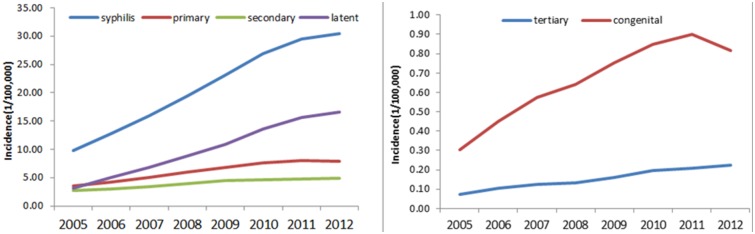
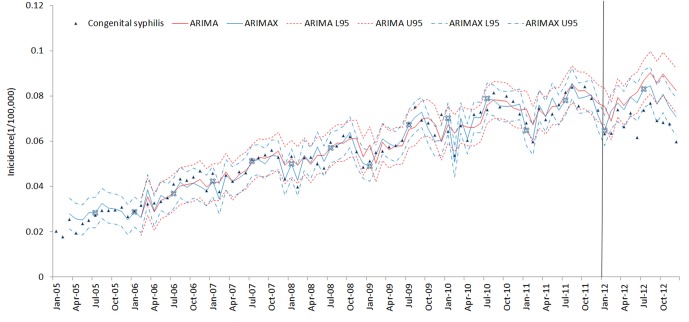
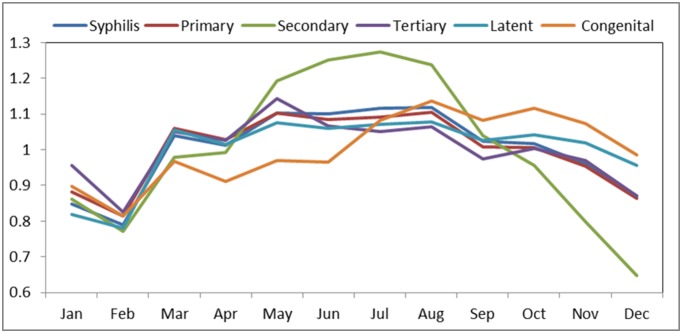
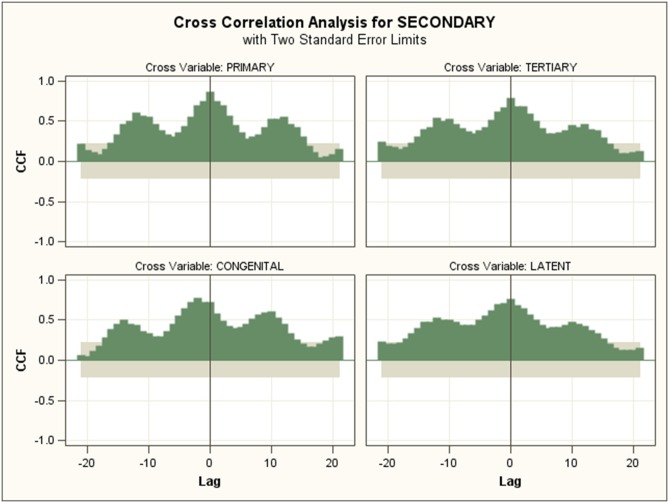
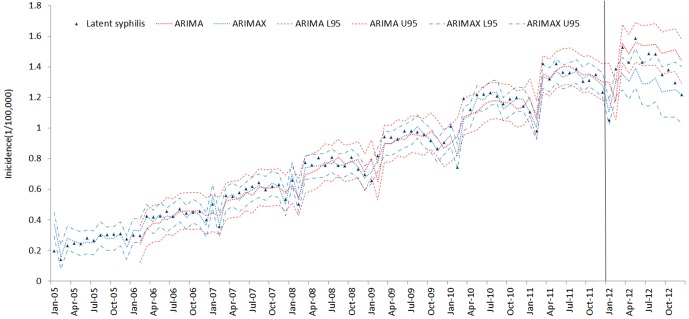
In this paper, we analyzed surveillance time series data for primary, secondary, tertiary, congenital and latent syphilis in mainland China from 2005 to 2012. Seasonality and long-term trend were explored with decomposition methods. Autoregressive integrated moving average (ARIMA) was used to fit a univariate time series model of syphilis incidence. A separate multi-variable time series for each syphilis type was also tested using an autoregressive integrated moving average model with exogenous variables (ARIMAX).
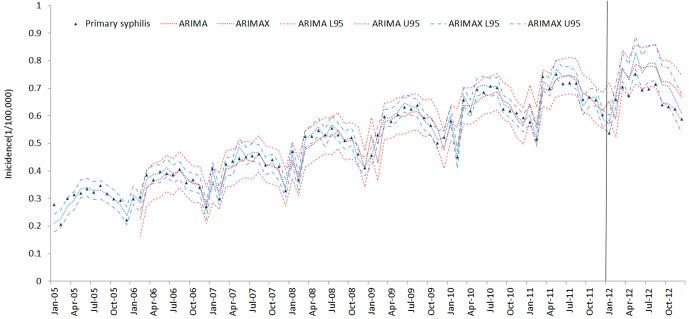
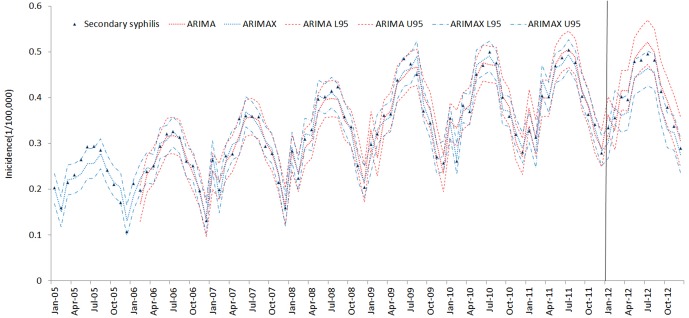
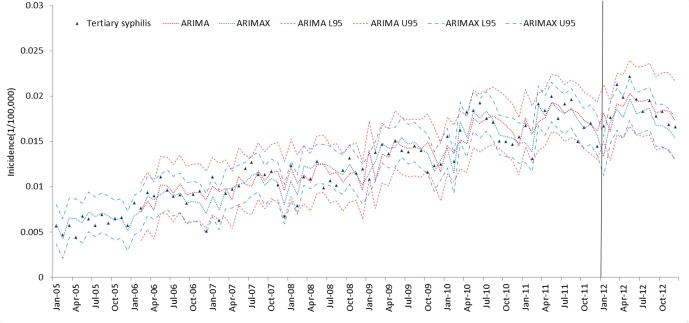
The syphilis incidence rates have increased three-fold from 2005 to 2012. All syphilis time series showed strong seasonality and increasing long-term trend. Both ARIMA and ARIMAX models fitted and estimated syphilis incidence well. All univariate time series showed highest goodness-of-fit results with the ARIMA(0,0,1)×(0,1,1) model.
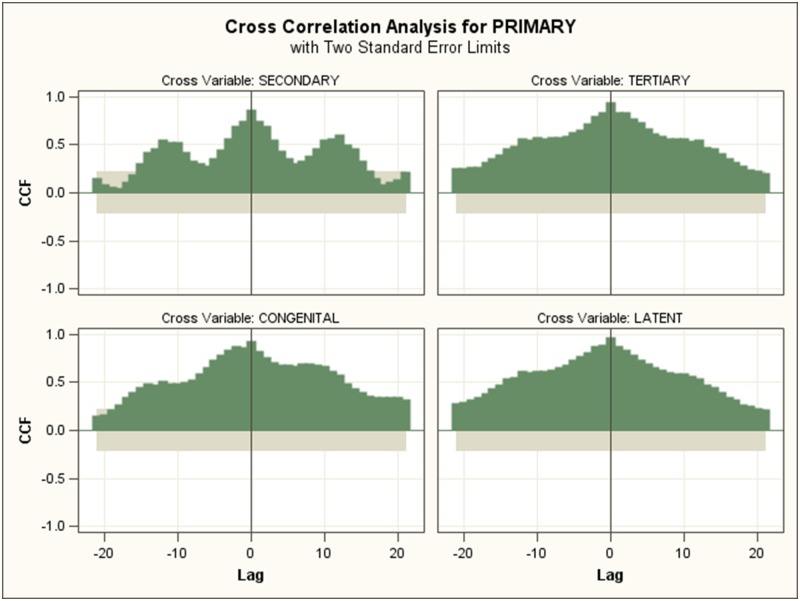
Time series analysis was an effective tool for modelling the historical and future incidence of syphilis in China. The ARIMAX model showed superior performance than the ARIMA model for the modelling of syphilis incidence. Time series correlations existed between the models for primary, secondary, tertiary, congenital and latent syphilis.
近几十年来,中国梅毒感染率急剧上升,成为一个严重的公共卫生问题。因此,梅毒的早期预测对于健康规划和管理至关重要。
在本文中,我们分析了2005年至2012年中国大陆一期、二期、三期、先天性和潜伏性梅毒的监测时间序列数据。采用分解方法探索季节性和长期趋势。使用自回归积分移动平均(ARIMA)来拟合梅毒发病率的单变量时间序列模型。还使用带有外生变量的自回归积分移动平均模型(ARIMAX)对每种梅毒类型单独的多变量时间序列进行了测试。
2005年至2012年梅毒发病率增长了两倍。所有梅毒时间序列均显示出强烈的季节性和上升的长期趋势。ARIMA和ARIMAX模型对梅毒发病率的拟合和估计效果都很好。所有单变量时间序列在ARIMA(0,0,1)×(0,1,1)模型下显示出最高的拟合优度结果。
时间序列分析是模拟中国梅毒历史和未来发病率的有效工具。在梅毒发病率建模方面,ARIMAX模型比ARIMA模型表现更优。一期、二期、三期、先天性和潜伏性梅毒模型之间存在时间序列相关性。