The Kirby Institute for infection and immunity in society, Faculty of Medicine, University of New South Wales, Sydney, Australia.
PLoS One. 2012;7(2):e31076. doi: 10.1371/journal.pone.0031076. Epub 2012 Feb 16.
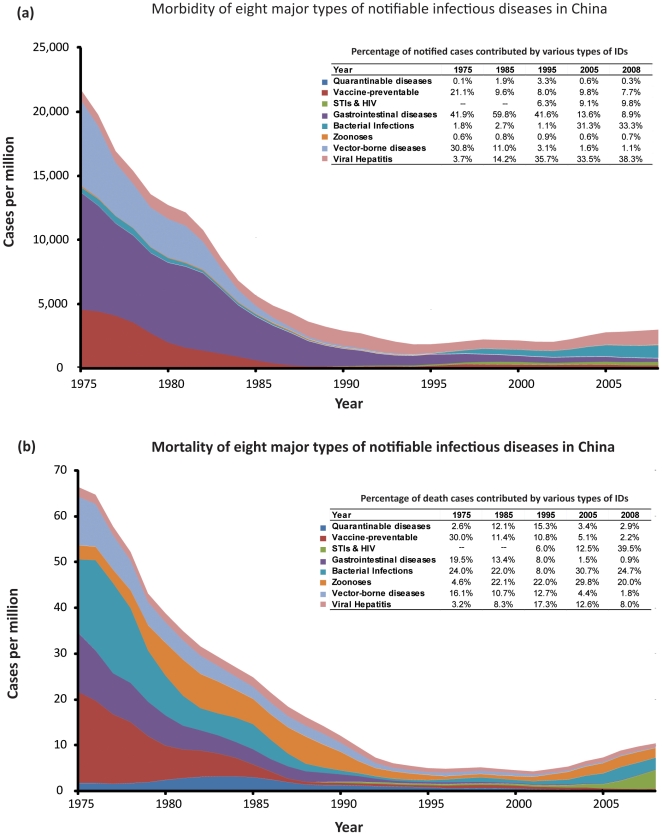
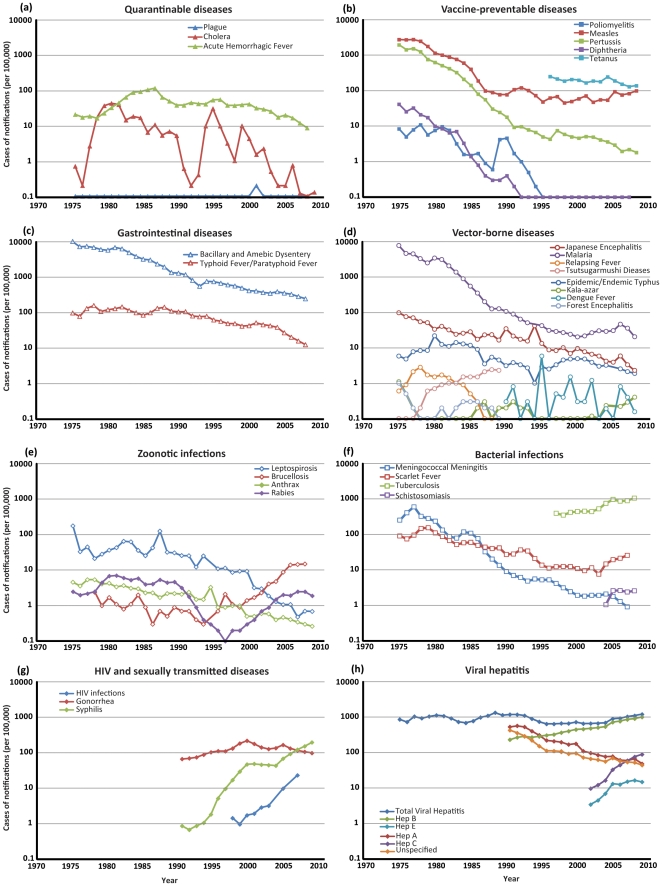
This study aimed to analyse trends in notifiable infectious diseases in China, in their historical context. Both English and Chinese literature was searched and diseases were categorised according to the type of disease or transmission route. Temporal trends of morbidity and mortality rates were calculated for eight major infectious diseases types. Strong government commitment to public health responses and improvements in quality of life has led to the eradication or containment of a wide range of infectious diseases in China. The overall infectious diseases burden experienced a dramatic drop during 1975-1995, but since then, it reverted and maintained a gradual upward trend to date. Most notifiable diseases are contained at a low endemic level; however, local small-scale outbreaks remain common. Tuberculosis, as a bacterial infection, has re-emerged since the 1990s and has become prevalent in the country. Sexually transmitted infections are in a rapid, exponential growth phase, spreading from core groups to the general population. Together human immunodeficiency virus (HIV), they account for 39% of all death cases due to infectious diseases in China in 2008. Zoonotic infections, such as severe acute respiratory syndrome (SARS), rabies and influenza, pose constant threats to Chinese residents and remain the most deadly disease type among the infected individuals. Therefore, second-generation surveillance of behavioural risks or vectors associated with pathogen transmission should be scaled up. It is necessary to implement public health interventions that target HIV and relevant coinfections, address transmission associated with highly mobile populations, and reduce the risk of cross-species transmission of zoonotic pathogens.
本研究旨在分析中国传染病的流行趋势及其历史背景。检索了英文和中文文献,并根据疾病类型或传播途径对疾病进行分类。计算了 8 种主要传染病类型的发病率和死亡率的时间趋势。政府对公共卫生反应的坚定承诺和生活质量的提高,导致中国广泛的传染病得到了根除或控制。1975 年至 1995 年期间,传染病总负担急剧下降,但此后,传染病负担又恢复并持续呈缓慢上升趋势。大多数传染病都被控制在低流行水平,但仍有局部小规模暴发。自 20 世纪 90 年代以来,结核病作为一种细菌感染再次出现,并在该国流行。性传播感染处于快速、指数增长阶段,从核心群体传播到一般人群。艾滋病毒(HIV)与它们一起,占 2008 年中国因传染病死亡的所有病例的 39%。人畜共患感染,如严重急性呼吸系统综合征(SARS)、狂犬病和流感,不断威胁着中国居民,仍然是感染人群中最致命的疾病类型。因此,应扩大与病原体传播相关的行为风险或媒介物的第二代监测。有必要实施针对 HIV 及相关合并感染的公共卫生干预措施,解决与高流动性人群相关的传播问题,并降低人畜共患病原体跨物种传播的风险。