Hong Jie, Li Dan, Cao Weibiao
Department of Medicine, Rhode Island Hospital and the Warren Alpert Medical School of Brown University, Providence, RI, United States of America.
Department of Gastroenterology, Shanghai Jiao-Tong University School of Medicine Renji Hospital, Shanghai Institute of Digestive Disease, Shanghai, China.
PLoS One. 2016 Feb 22;11(2):e0149735. doi: 10.1371/journal.pone.0149735. eCollection 2016.
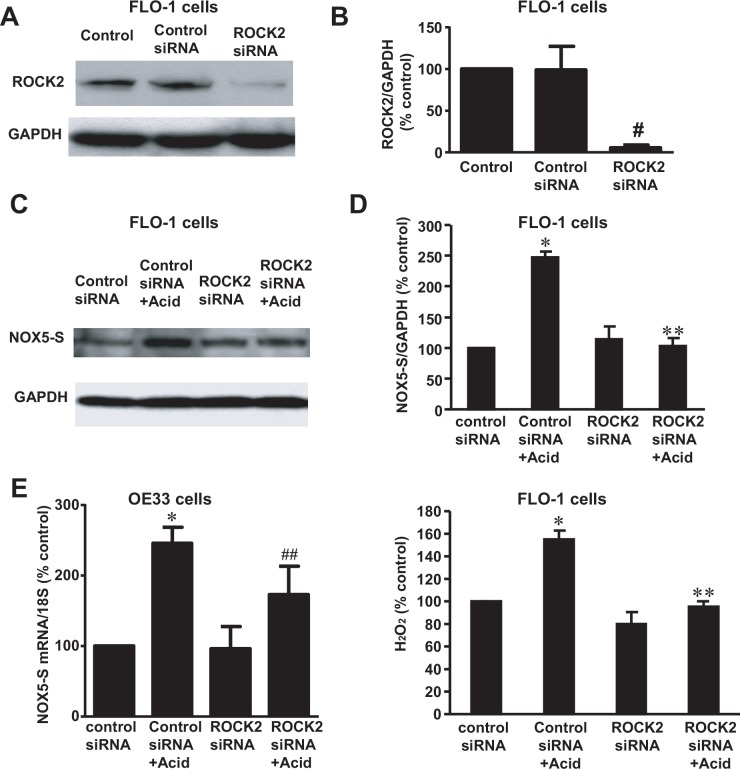
Mechanisms of the progression from Barrett's esophagus (BE) to esophageal adenocarcinoma (EA) are not fully understood. We have shown that NOX5-S may be involved in this progression. However, how acid upregulates NOX5-S is not well known. We found that acid-induced increase in NOX5-S expression was significantly decreased by the Rho kinase (ROCK) inhibitor Y27632 in BE mucosal biopsies and FLO-1 EA cells. In addition, acid treatment significantly increased the Rho kinase activity in FLO-1 cells. The acid-induced increase in NOX5-S expression and H2O2 production was significantly decreased by knockdown of Rho kinase ROCK2, but not by knockdown of ROCK1. Conversely, the overexpression of the constitutively active ROCK2, but not the constitutively active ROCK1, significantly enhanced the NOX5-S expression and H2O2 production. Moreover, the acid-induced increase in Rho kinase activity and in NOX5-S mRNA expression was blocked by the removal of calcium in both FLO-1 and OE33 cells. The calcium ionophore A23187 significantly increased the Rho kinase activity and NOX5-S mRNA expression. We conclude that acid-induced increase in NOX5-S expression and H2O2 production may depend on the activation of ROCK2, but not ROCK1, in EA cells. The acid-induced activation of Rho kinase may be mediated by the intracellular calcium increase. It is possible that persistent acid reflux present in BE patients may increase the intracellular calcium, activate ROCK2 and thereby upregulate NOX5-S. High levels of reactive oxygen species derived from NOX5-S may cause DNA damage and thereby contribute to the progression from BE to EA.
巴雷特食管(BE)进展为食管腺癌(EA)的机制尚未完全明确。我们已经表明,NOX5-S可能参与了这一进展过程。然而,酸如何上调NOX5-S尚不清楚。我们发现,在BE黏膜活检组织和FLO-1 EA细胞中,Rho激酶(ROCK)抑制剂Y27632可显著降低酸诱导的NOX5-S表达增加。此外,酸处理显著增加了FLO-1细胞中的Rho激酶活性。敲低Rho激酶ROCK2可显著降低酸诱导的NOX5-S表达增加和H2O2生成,但敲低ROCK1则无此作用。相反,组成型活性ROCK2的过表达,而非组成型活性ROCK1的过表达,显著增强了NOX5-S表达和H2O2生成。此外,在FLO-1和OE33细胞中,去除钙可阻断酸诱导的Rho激酶活性增加和NOX5-S mRNA表达增加。钙离子载体A23187显著增加了Rho激酶活性和NOX5-S mRNA表达。我们得出结论,在EA细胞中,酸诱导的NOX5-S表达增加和H2O2生成可能依赖于ROCK2而非ROCK1的激活。酸诱导的Rho激酶激活可能由细胞内钙增加介导。BE患者中持续存在的酸反流可能会增加细胞内钙,激活ROCK2,从而上调NOX5-S。源自NOX5-S的高水平活性氧可能导致DNA损伤,进而促进从BE到EA的进展。