Chapman Phoebe A, Owen Helen, Flint Mark, Traub Rebecca J, Cribb Thomas H, Mills Paul C
Veterinary-Marine Animal Research Teaching and Investigation Unit, School of Veterinary Science, University of Queensland, Gatton, Queensland, Australia.
School of Forest Resources and Conservation, University of Florida, The Florida Aquarium's Center for Conservation, Apollo Beach, Florida, United States of America.
PLoS One. 2016 Feb 22;11(2):e0149962. doi: 10.1371/journal.pone.0149962. eCollection 2016.
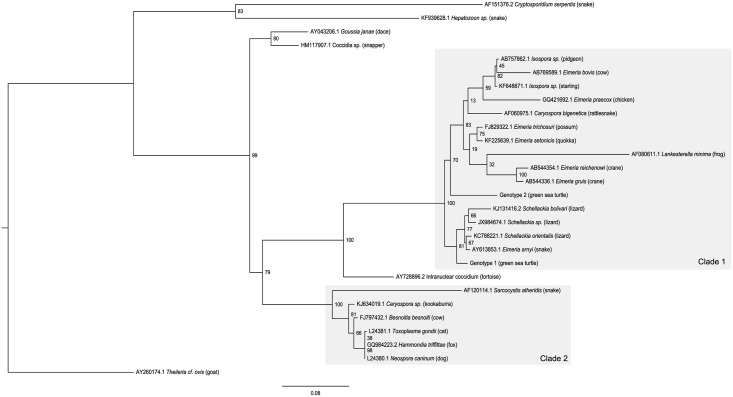
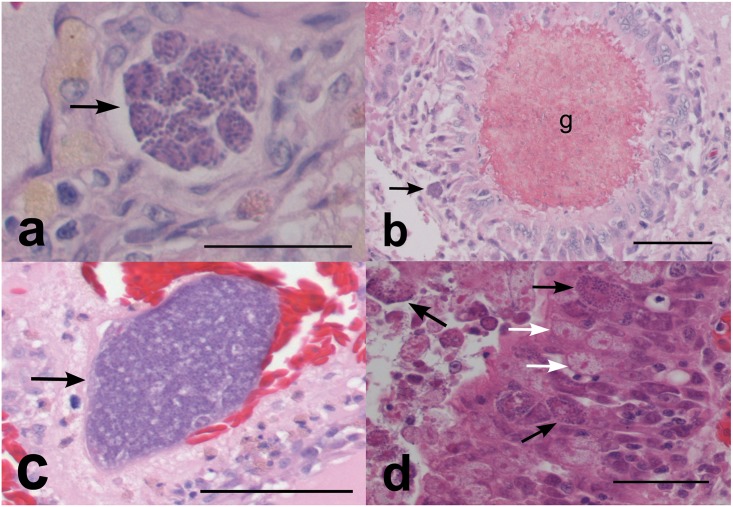
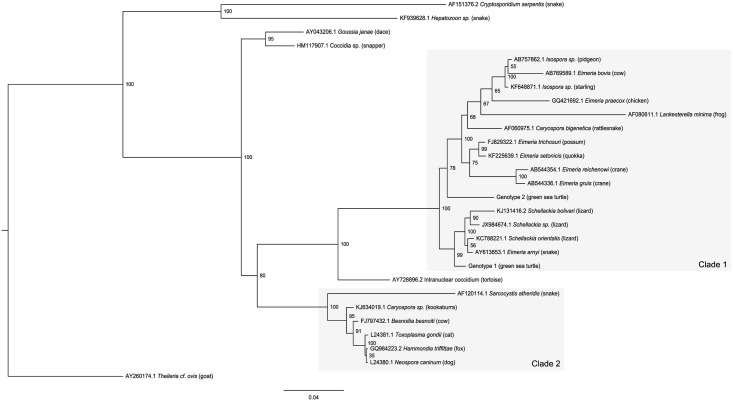
In the spring of 2014, mass mortalities among wild green sea turtles occurred off the coast of south-east Queensland, Australia. The suspected causative agent was Caryospora cheloniae, an eimeriid coccidian implicated in previous epizootics. Necropsies were undertaken on a subset of 11 dead turtles, with subsequent histopathology and molecular analyses. All turtles returned positive PCR results for coccidial infection in various tissues; these included the brain, gastrointestinal tract, lung, kidney and thyroid. Granulomatous encephalitis was consistently observed, as well as enteritis and, less frequently, thyroiditis and nephritis. Sequencing and phylogenetic analyses indicated the presence of two distinct coccidian genotypes, presumably separate species-one associated with the brain, gastrointestinal tract and lung, and the second with the thyroid and kidney. Maximum likelihood and Bayesian inference analyses placed the first genotype closest to the lankesterellid genus Schellackia, rather than in the Eimeriidae, while the second was paraphyletic to the eimeriids. Presence of coccidial stages in extra-intestinal tissues of the primary host raises questions about the potential presence of intermediate or paratenic hosts within the life cycles, as well as their current placement relative to the genus Caryospora. This study represents the first genetic characterization of this emerging disease agent in green sea turtles, an endangered species, and has relevance for life-cycle elucidation and future development of diagnostics.
2014年春,澳大利亚昆士兰州东南部沿海的野生绿海龟出现大量死亡。疑似病原体为龟卡里孢子虫,这是一种艾美耳科球虫,曾在之前的动物疫病中被牵连。对11只死亡海龟的部分样本进行了尸检,并随后进行了组织病理学和分子分析。所有海龟在各种组织中的球虫感染PCR检测结果均呈阳性;这些组织包括脑、胃肠道、肺、肾和甲状腺。一直观察到肉芽肿性脑炎,还有肠炎,甲状腺炎和肾炎则较少见。测序和系统发育分析表明存在两种不同的球虫基因型,可能是不同的物种——一种与脑、胃肠道和肺有关,另一种与甲状腺和肾有关。在终末宿主的肠外组织中存在球虫阶段,这引发了关于生命周期中可能存在中间宿主或转续宿主的问题,以及它们目前相对于卡里孢子虫属的分类地位。本研究是对这种濒危物种绿海龟中这种新出现的病原体的首次基因特征描述,对阐明生命周期和未来诊断方法的开发具有重要意义。