Sussex Jon, Feng Yan, Mestre-Ferrandiz Jorge, Pistollato Michele, Hafner Marco, Burridge Peter, Grant Jonathan
RAND Europe, Cambridge, UK.
Formerly, Office of Health Economics, London, UK.
BMC Med. 2016 Feb 24;14:32. doi: 10.1186/s12916-016-0564-z.
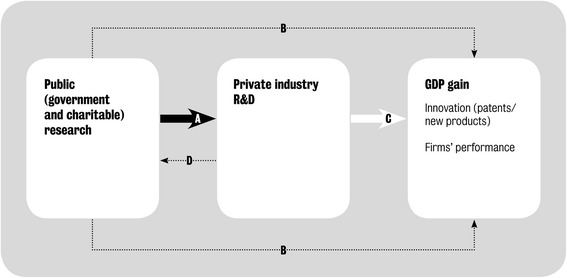
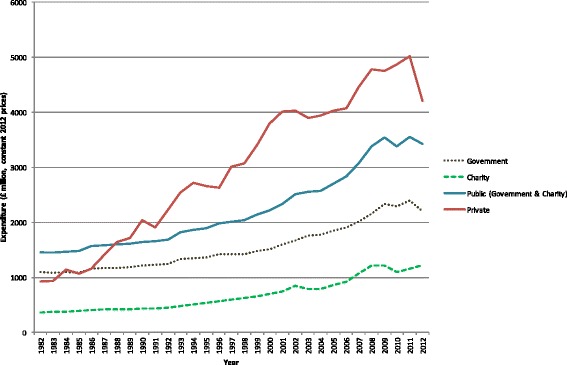
Government- and charity-funded medical research and private sector research and development (R&D) are widely held to be complements. The only attempts to measure this complementarity so far have used data from the United States of America and are inevitably increasingly out of date. This study estimates the magnitude of the effect of government and charity biomedical and health research expenditure in the United Kingdom (UK), separately and in total, on subsequent private pharmaceutical sector R&D expenditure in the UK.
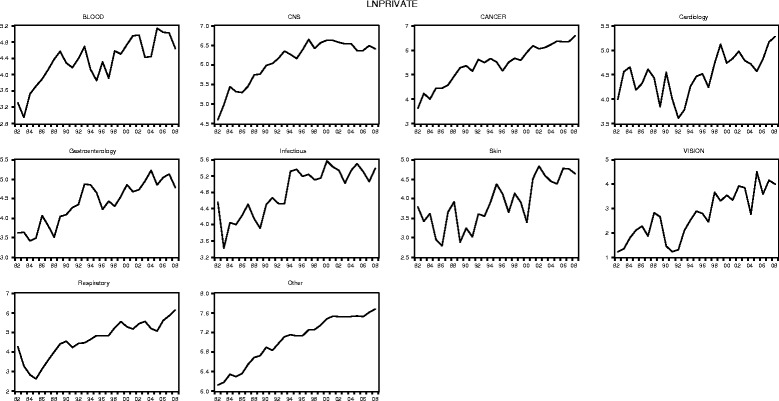
The results for this study are obtained by fitting an econometric vector error correction model (VECM) to time series for biomedical and health R&D expenditure in the UK for ten disease areas (including 'other') for the government, charity and private sectors. The VECM model describes the relationship between public (i.e. government and charities combined) sector expenditure, private sector expenditure and global pharmaceutical sales as a combination of a long-term equilibrium and short-term movements.
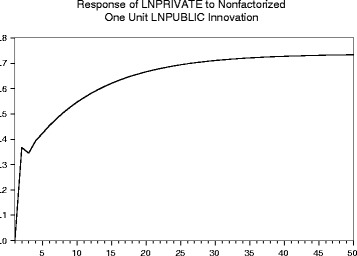
There is a statistically significant complementary relationship between public biomedical and health research expenditure and private pharmaceutical R&D expenditure. A 1% increase in public sector expenditure is associated in the best-fit model with a 0.81% increase in private sector expenditure. Sensitivity analysis produces a similar and statistically significant result with a slightly smaller positive elasticity of 0.68. Overall, every additional £1 of public research expenditure is associated with an additional £0.83-£1.07 of private sector R&D spend in the UK; 44% of that additional private sector expenditure occurs within 1 year, with the remainder accumulating over decades. This spillover effect implies a real annual rate of return (in terms of economic impact) to public biomedical and health research in the UK of 15-18%. When combined with previous estimates of the health gain that results from public medical research in cancer and cardiovascular disease, the total rate of return would be around 24-28%.
Overall, this suggests that government and charity funded research in the UK crowds in additional private sector R&D in the UK. The implied historical returns from UK government and charity funded investment in medical research in the UK compare favourably with the rates of return achieved on investments in the rest of the UK economy and are greatly in excess of the 3.5% real annual rate of return required by the UK government to public investments generally.
政府和慈善机构资助的医学研究与私营部门的研发活动普遍被认为是互补的。迄今为止,仅有的几次衡量这种互补性的尝试使用的是来自美国的数据,且不可避免地越来越过时。本研究估计了英国政府和慈善机构在生物医学与健康研究方面的支出,分别以及总体上,对英国后续私营制药行业研发支出的影响程度。
本研究的结果是通过对英国政府、慈善机构和私营部门十个疾病领域(包括“其他”)的生物医学与健康研发支出的时间序列拟合一个计量经济学向量误差修正模型(VECM)而获得的。VECM模型将公共部门(即政府和慈善机构合并)支出、私营部门支出与全球药品销售之间的关系描述为长期均衡和短期变动的组合。
公共生物医学与健康研究支出和私营制药研发支出之间存在统计学上显著的互补关系。在最佳拟合模型中,公共部门支出增加1%与私营部门支出增加0.81%相关。敏感性分析得出了类似且具有统计学显著性的结果,正弹性略小,为0.68。总体而言,英国公共研究支出每增加1英镑,就会带来私营部门研发支出额外增加0.83 - 1.07英镑;额外的私营部门支出中有44%在1年内发生,其余部分则在几十年内积累。这种溢出效应意味着英国公共生物医学与健康研究的实际年回报率(就经济影响而言)为15% - 18%。结合先前对公共医学研究在癌症和心血管疾病方面带来的健康收益的估计,总回报率将约为24% - 28%。
总体而言,这表明英国政府和慈善机构资助的研究吸引了英国私营部门额外的研发投入。英国政府和慈善机构对英国医学研究的投资所隐含的历史回报率与英国其他经济领域投资所实现的回报率相比具有优势,且大大超过了英国政府对公共投资总体要求的3.5%的实际年回报率。