Ring Brian Z, Hout David R, Morris Stephan W, Lawrence Kasey, Schweitzer Brock L, Bailey Daniel B, Lehmann Brian D, Pietenpol Jennifer A, Seitz Robert S
Institute of Personalized and Genomic Medicine, College of Life Science, Huazhong University of Science and Technology, Wuhan, China.
Insight Genetics Incorporated, Nashville, Tennessee, USA.
BMC Cancer. 2016 Feb 23;16:143. doi: 10.1186/s12885-016-2198-0.
Recently, a gene expression algorithm, TNBCtype, was developed that can divide triple-negative breast cancer (TNBC) into molecularly-defined subtypes. The algorithm has potential to provide predictive value for TNBC subtype-specific response to various treatments. TNBCtype used in a retrospective analysis of neoadjuvant clinical trial data of TNBC patients demonstrated that TNBC subtype and pathological complete response to neoadjuvant chemotherapy were significantly associated. Herein we describe an expression algorithm reduced to 101 genes with the power to subtype TNBC tumors similar to the original 2188-gene expression algorithm and predict patient outcomes.
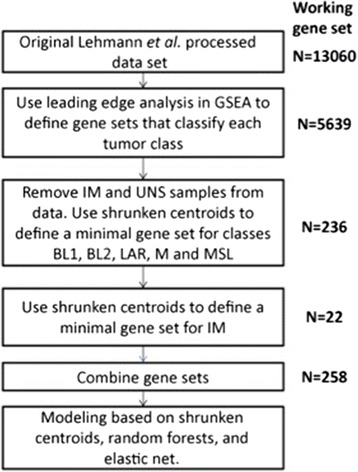
The new classification model was built using the same expression data sets used for the original TNBCtype algorithm. Gene set enrichment followed by shrunken centroid analysis were used for feature reduction, then elastic-net regularized linear modeling was used to identify genes for a centroid model classifying all subtypes, comprised of 101 genes. The predictive capability of both this new "lean" algorithm and the original 2188-gene model were applied to an independent clinical trial cohort of 139 TNBC patients treated initially with neoadjuvant doxorubicin/cyclophosphamide and then randomized to receive either paclitaxel or ixabepilone to determine association of pathologic complete response within the subtypes.
The new 101-gene expression model reproduced the classification provided by the 2188-gene algorithm and was highly concordant in the same set of seven TNBC cohorts used to generate the TNBCtype algorithm (87%), as well as in the independent clinical trial cohort (88%), when cases with significant correlations to multiple subtypes were excluded. Clinical responses to both neoadjuvant treatment arms, found BL2 to be significantly associated with poor response (Odds Ratio (OR) =0.12, p=0.03 for the 2188-gene model; OR = 0.23, p < 0.03 for the 101-gene model). Additionally, while the BL1 subtype trended towards significance in the 2188-gene model (OR = 1.91, p = 0.14), the 101-gene model demonstrated significant association with improved response in patients with the BL1 subtype (OR = 3.59, p = 0.02).
These results demonstrate that a model using small gene sets can recapitulate the TNBC subtypes identified by the original 2188-gene model and in the case of standard chemotherapy, the ability to predict therapeutic response.
最近,一种基因表达算法TNBCtype被开发出来,它可以将三阴性乳腺癌(TNBC)分为分子定义的亚型。该算法有可能为TNBC亚型对各种治疗的特异性反应提供预测价值。在一项对TNBC患者新辅助临床试验数据的回顾性分析中使用TNBCtype,结果表明TNBC亚型与新辅助化疗的病理完全缓解显著相关。在此,我们描述了一种简化为101个基因的表达算法,它能够对TNBC肿瘤进行亚型分类,类似于原始的2188基因表达算法,并能预测患者的预后。
使用与原始TNBCtype算法相同的表达数据集构建新的分类模型。通过基因集富集分析,随后进行收缩质心分析以进行特征约简,然后使用弹性网络正则化线性建模来识别用于对所有亚型进行分类的质心模型的基因,该模型由101个基因组成。将这种新的“精简”算法和原始的2188基因模型的预测能力应用于一个独立的临床试验队列,该队列中有139例TNBC患者,最初接受新辅助多柔比星/环磷酰胺治疗,然后随机接受紫杉醇或伊沙匹隆治疗,以确定亚型内病理完全缓解的相关性。
新的101基因表达模型重现了2188基因算法提供的分类,并且在用于生成TNBCtype算法的同一组7个TNBC队列中高度一致(87%),在独立的临床试验队列中也是如此(88%),排除了与多个亚型有显著相关性的病例。对两个新辅助治疗组的临床反应分析发现,BL2与较差的反应显著相关(2188基因模型的优势比(OR)=0.12,p=0.03;101基因模型的OR = 0.23,p < 0.03)。此外,虽然在2188基因模型中BL1亚型有显著趋势(OR = 1.91,p = 0.14),但101基因模型显示BL1亚型患者的反应改善有显著相关性(OR = 3.59,p = 0.02)。
这些结果表明,使用小基因集的模型可以概括原始2188基因模型所识别的TNBC亚型,并且在标准化疗的情况下,具有预测治疗反应的能力。