Wexler Nancy S, Collett Laura, Wexler Alice R, Rawlins Michael D, Tabrizi Sarah J, Douglas Ian, Smeeth Liam, Evans Stephen J
Department of Neurology and Psychiatry, Columbia University, New York, New York, USA Hereditary Disease Foundation, New York, New York, USA.
Department of Medical Statistics, London School of Hygiene and Tropical Medicine, London, UK.
BMJ Open. 2016 Feb 23;6(2):e009070. doi: 10.1136/bmjopen-2015-009070.
The prevalence of Huntington's disease (HD) recorded in the UK primary care records has increased twofold between 1990 and 2010. This investigation was undertaken to assess whether this might be due to an increased incidence. We have also undertaken a systematic review of published estimates of the incidence of HD.
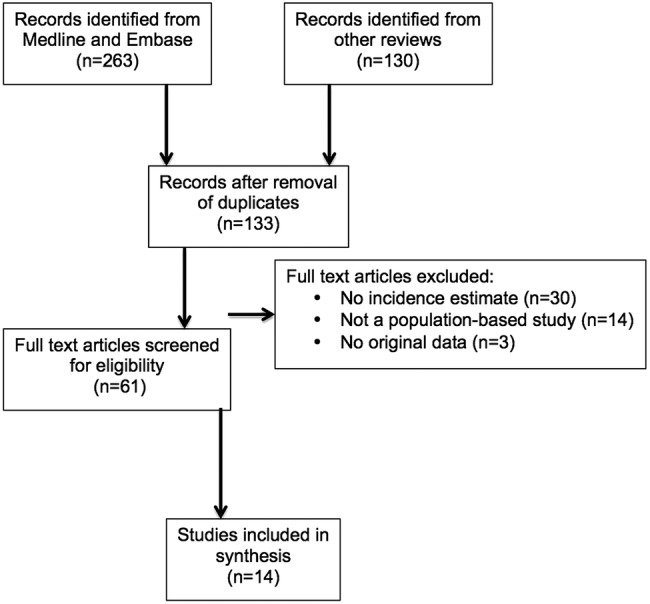
Incident patients with a new diagnosis of HD were identified from the primary care records of the Clinical Practice Research Datalink (CPRD). The systematic review included all published estimates of the incidence of HD in defined populations.
A total of 393 incident cases of HD were identified from the CPRD database between 1990 and 2010 from a total population of 9,282,126 persons.
The incidence of HD per million person-years was estimated. From the systematic review, the extent of heterogeneity of published estimates of the incidence of HD was examined using the I(2) statistic.
The data showed that the incidence of HD has remained constant between 1990 and 2010 with an overall rate of 7.2 (95% CI 6.5 to 7.9) per million person-years. The systematic review identified 14 independent estimates of incidence with substantial heterogeneity and consistently lower rates reported in studies from East Asia compared with those from Australia, North America and some--though not all--those from Europe. Differences in incidence estimates did not appear to be explained solely by differences in case ascertainment or diagnostic methods.
The rise in the prevalence of diagnosed HD in the UK, between 1990 and 2010, cannot be attributed to an increase in incidence. Globally, estimates of the incidence of HD show evidence of substantial heterogeneity with consistently lower rates in East Asia and parts of Europe. Modifiers may play an important role in determining the vulnerability of different populations to expansions of the HD allele.
英国初级医疗记录中登记的亨廷顿舞蹈症(HD)患病率在1990年至2010年间增长了两倍。本次调查旨在评估这是否可能归因于发病率上升。我们还对已发表的HD发病率估计进行了系统综述。
从临床实践研究数据链(CPRD)的初级医疗记录中识别出初诊为HD的患者。系统综述纳入了所有已发表的特定人群中HD发病率的估计。
1990年至2010年间,从CPRD数据库中9,282,126人的总人口中识别出393例HD新发病例。
估计每百万人口年的HD发病率。通过系统综述,使用I(2)统计量检查已发表的HD发病率估计的异质性程度。
数据显示,1990年至2010年间HD发病率保持恒定,总体发病率为每百万人口年7.2(95%置信区间6.5至7.9)。系统综述确定了14项独立的发病率估计,存在显著异质性,与澳大利亚、北美以及部分(但并非全部)欧洲研究相比,东亚研究报告的发病率始终较低。发病率估计的差异似乎不能仅由病例确定或诊断方法的差异来解释。
1990年至2010年间英国确诊HD患病率的上升不能归因于发病率的增加。在全球范围内,HD发病率的估计显示出显著异质性的证据,东亚和部分欧洲地区的发病率始终较低。修饰因子可能在决定不同人群对HD等位基因扩增的易感性方面发挥重要作用。