Martins-Melo Francisco Rogerlândio, Ramos Alberto Novaes, Alencar Carlos Henrique, Heukelbach Jorg
Department of Community Health, School of Medicine, Federal University of Ceará, Rua Professor Costa Mendes, 1608, 5. andar, Rodolfo Teófilo, 60430-140 Fortaleza, Ceará, Brazil .
Bull World Health Organ. 2016 Feb 1;94(2):103-10. doi: 10.2471/BLT.15.152363. Epub 2015 Nov 24.
To describe mortality from neglected tropical diseases (NTDs) in Brazil, 2000-2011.
We extracted information on cause of death, age, sex, ethnicity and place of residence from the nationwide mortality information system at the Brazilian Ministry of Health. We selected deaths in which the underlying cause of death was a neglected tropical disease (NTD), as defined by the World Health Organization (WHO) and based on its International statistical classification of diseases and related health problems, 10th revision (ICD-10) codes. For specific NTDs, we estimated crude and age-adjusted mortality rates and 95% confidence intervals (CI). We calculated crude and age-adjusted mortality rates and mortality rate ratios by age, sex, ethnicity and geographic area.
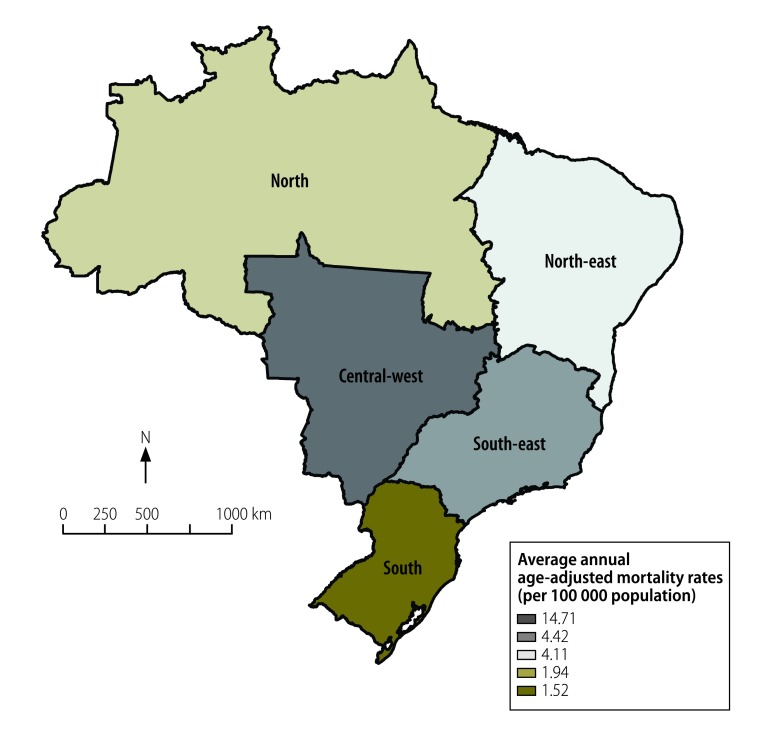
Over the 12-year study period, 12 491 280 deaths were recorded; 76 847 deaths (0.62%) were caused by NTDs. Chagas disease was the most common cause of death (58 928 deaths; 76.7%), followed by schistosomiasis (6319 deaths; 8.2%) and leishmaniasis (3466 deaths; 4.5%). The average annual age-adjusted mortality from all NTDs combined was 4.30 deaths per 100 000 population (95% CI: 4.21-4.40). Rates were higher in males: 4.98 deaths per 100 000; people older than 69 years: 33.12 deaths per 100 000; Afro-Brazilians: 5.25 deaths per 100 000; and residents in the central-west region: 14.71 deaths per 100 000.
NTDs are important causes of death and are a significant public health problem in Brazil. There is a need for intensive integrated control measures in areas of high morbidity and mortality.
描述2000 - 2011年巴西被忽视热带病(NTDs)导致的死亡率。
我们从巴西卫生部的全国死亡率信息系统中提取了关于死亡原因、年龄、性别、种族和居住地点的信息。我们选择了那些潜在死亡原因是被忽视热带病(按照世界卫生组织(WHO)的定义,并基于其《疾病和相关健康问题国际统计分类》第10次修订版(ICD - 10)编码)的死亡病例。对于特定的被忽视热带病,我们估计了粗死亡率和年龄调整死亡率以及95%置信区间(CI)。我们按年龄、性别、种族和地理区域计算了粗死亡率、年龄调整死亡率和死亡率比。
在12年的研究期间,记录了12491280例死亡;76847例死亡(0.62%)由被忽视热带病导致。恰加斯病是最常见的死亡原因(58928例死亡;76.7%),其次是血吸虫病(6319例死亡;8.2%)和利什曼病(3466例死亡;4.5%)。所有被忽视热带病综合起来的年均年龄调整死亡率为每10万人口4.30例死亡(95% CI:4.21 - 4.40)。男性的死亡率更高:每10万人口4.98例死亡;69岁以上人群:每10万人口33.12例死亡;非裔巴西人:每10万人口5.25例死亡;中西部地区居民:每10万人口14.71例死亡。
被忽视热带病是重要的死亡原因,在巴西是一个重大的公共卫生问题。在高发病率和高死亡率地区需要采取强化的综合控制措施。